Le 18e Salon du livre francophone ouvre ses portes.
18e, déjà ! Cet évènement cher au cœur des Libanais est désormais bien planté dans le paysage, comme le figuier géant dans « L’arbre » de Julie Bertuccelli, projeté à Beyrouth fin septembre, comme les architectures monumentales des frères Schuiten, maîtres belges de la bande dessinée, qui nous font l’honneur, avec d’autres, d’être au Liban cette année.
18e édition : le Salon francophone est devenu une évidence, un roc sur lequel s’appuyer, un îlot de stabilité dans un monde en mouvement, secoué par les tempêtes. Comme il est important de pouvoir compter sur les évidences qui nous entourent ! Elles sont si peu nombreuses ! Même si l’on sait que l’évidence est souvent trompeuse : rien n’est évident, tout est une question de choix, de volonté, d’engagement. L’évidence n’existe pas. L’arbre peut être déraciné, le sol peut s’ouvrir sous nos pieds. La francophonie, le trilinguisme, richesses du Liban, sont des défis quotidiens, des promesses qui doivent chaque jour être renouvelées.
C’est pour cela qu’il faut venir et revenir au Salon du livre, en famille, seul ou avec ses amis. Pour parcourir les stands, rencontrer des auteurs, participer aux conférences et aux ateliers. Mais surtout pour s’offrir une belle récompense et retrouver la force, au moins une fois par an, de tenir toutes nos promesses.
Aurélien Lechevallier
Conseiller de coopération et d’action culturelle
Directeur de l’Institut français du Liban
Dans l’esprit de tous les Libanais, le Salon du livre de Beyrouth reste l’espace privilégié de rencontres et de dialogue autour de la culture francophone. La 18e édition ne fait pas exception et cette année encore, peut-être devrais-je dire cette année plus que jamais grâce à la présence remarquable de notre invité d’honneur : Belgique-Wallonie-Bruxelles, ce Salon est l’occasion d’échanges de qualité et de valorisation de la francophonie, de sa littérature, de ses passeurs.
La participation de Belgique-Wallonie-Bruxelles nous réjouit puisque nous accueillons des auteurs et des œuvres qui apportent un souffle artistique inédit au Salon. Des auteurs occidentaux, les frères Schuiten, Philippe Berthet et Marc Lévy côtoient les auteurs méditerranéens comme Khaled Al-Khamissi, Farouk Mardam Bey ou encore Alexandre Najjar. Les nombreuses signatures, conférences, rencontres, expositions et animations au programme permettent de vérifier la vitalité de ces auteurs et artistes francophones, qui viennent se mêler aux livres avec bonheur.
Saluons enfin le rôle essentiel de nos amis libraires, éditeurs et diffuseurs qui contribuent sans aucun doute à la réussite de ce Salon et qui se sont investis pleinement pour satisfaire notre curiosité et notre appétit littéraire. Ils sont les indispensables médiateurs de la langue française au Liban.
Que ce Salon soit l’occasion d’approfondir notre connaissance de la francophonie et un beau moment d’échanges pour tous.
Pierre SAYEGH
Président du Syndicat des Importateurs de livres
«Γνωστός ως ο αλχημιστής του μοντέρνου εικονοκλαστικού θεάτρου, ο Ρομπέρ Λεπάζ είναι ένας από τους πιο συναρπαστικούς και ‘χιμαιρικούς’ σκηνοθέτες της εποχής μας» – John O’ Mahony, The Guardian
«Ο Ρομπέρ [Λεπάζ] είναι ένας πραγματικός οραματιστής, δημιουργώντας θέατρο για ανθρώπους που δεν τους αρέσει το θέατρο» – Peter Gabriel (μουσικός)
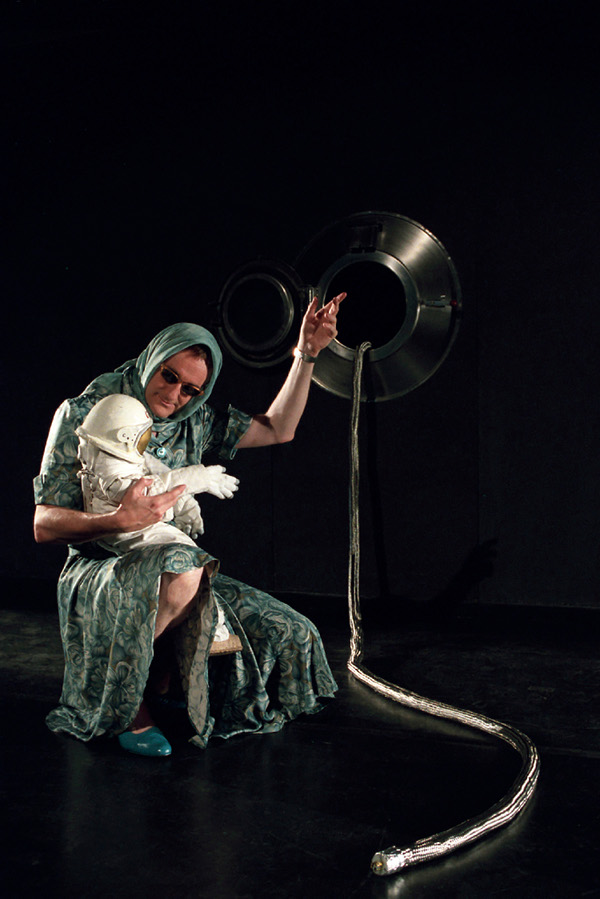
Ο «μάγος» της σκηνής, Ρομπέρ Λεπάζ, έρχεται να συναρπάσει το ελληνικό κοινό στην πρώτη του εμφάνιση στη χώρα μας, με την παράσταση Thefarsideofthemoon, έργο-σταθμό του παγκοσμίου θεάτρου, στις 12-16 Οκτωβρίου 2011, στην Κεντρική Σκηνή της Στέγης Γραμμάτων & Τεχνών.
«Είμαστε μόνοι μας στο σύμπαν;»
Ένα συναρπαστικό ταξίδι στο φεγγάρι από το «μάγο» της σκηνής Ρομπέρ Λεπάζ.
Ο Καναδός σκηνοθέτης του θεάτρου, της όπερας και του κινηματογράφου, παρουσιάζει το φαντασμαγορικό one-man show Thefarsideofthemoon, που έχει παιχτεί σε περισσότερες από 45 χώρες παγκοσμίως και απέσπασε Υποψηφιότητα για Όσκαρ Ξενόγλωσσης Ταινίας με την κινηματογραφική του μεταφορά το 2003.
Το πολυεπίπεδο, αυτοβιογραφικό και γεμάτο φαντασία έργο του Λεπάζ, που πρωτοπαρουσιάστηκε το 2000 στο Κεμπέκ του Καναδά, μας παρασύρει σε ένα ταξίδι ανακάλυψης των μυστηρίων του Σύμπαντος, ενώ αφηγείται την ταραχώδη σχέση δύο αδερφών μετά την απώλεια της μητέρας τους. Οι μνήμες της εφηβείας και της νιότης πλέκονται με την Ιστορία, τον ανταγωνισμό Σοβιετικών και Αμερικανών στην εξερεύνηση του διαστήματος, την ατμόσφαιρα του Ψυχρού Πολέμου. Η ακαταμάχητη σαγήνη που ασκεί στον άνθρωπο το φεγγάρι και τα καλά κρυμμένα μυστικά του Διαστήματος, δίνουν τον καμβά για την αφήγηση μιας προσωπικής ιστορίας, καθώς η σύνδεση του κεντρικού ήρωα με τον εαυτό του και τους οικείους του μοιάζει σχεδόν ταυτόσημη με τη σύνδεση του ανθρώπου με τον κόσμο που τον περιβάλλει. Μνήμη και ιστορία σε ένα συναρπαστικό γαϊτανάκι γεμάτο ποιητική θεατρική και εικαστική γλώσσα, «ντυμένο» με την υπέροχη πρωτότυπη μουσική της Λώρι Άντερσον.
Ο Λεπάζ στην παράσταση αυτή χρησιμοποιεί πολλά είδη τέχνης (μαριονέτα, βίντεο, χορό), ενώ επανέρχεται σε αγαπημένα του μοτίβα: υπαρξιακή αναζήτηση, οικογενειακοί δεσμοί, ταξίδι, καθρέπτες, οθόνες, προβολές, παιχνίδια του φωτός, ευφάνταστες μεταμορφώσεις αντικειμένων. Αλλά δεν είναι μόνο τα αντικείμενα που μεταμορφώνονται στο σύμπαν του Λεπάζ. Όλα τα πρόσωπα ενσαρκώνονται από έναν και μόνο ηθοποιό, τον ταλαντούχο Καναδό Υβ Ζακ, alter ego του σκηνοθέτη, σε ένα αέναο παιχνίδι μεταμορφώσεων.
Ο Καναδός δημιουργός προσφέρει μια μοναδική σκηνική εμπειρία, ενώ ο θεατής αιωρείται ανάμεσα σε χώρους καθημερινούς και οικείους και σε διαστημικές αποστολές, στις οποίες η σκηνή μεταμορφώνεται -σαν πραγματική laterna magica- με τη χρήση προβολών.
***
Πολύπλευρος στη σχέση του με το θέατρο, ο Ρομπέρ Λεπάζ -γεννημένος το 1957 στο Κεμπέκ- είναι εξίσου ταλαντούχος ως σκηνοθέτης, σεναριογράφος, ηθοποιός και κινηματογραφιστής.
Ξεκίνησε τις σπουδές του στο Κονσερβατόριο Δραματικής Τέχνης του Κεμπέκ το 1975, σε ηλικία 17 ετών. Έπειτα από σπουδές στο Παρίσι επέστρεψε στο Κεμπέκ και συμμετείχε σε πολλές καλλιτεχνικές παραγωγές, κερδίζοντας εμπειρία ως ηθοποιός, συγγραφέας και σκηνοθέτης. Το 1985, με το έργο TheDragon’sTrilogy κέρδισε παγκόσμια αναγνώριση, ενώ σύντομα ακολούθησαν τα Vinci (1986), Polygraph (1987) και TectonicPlates (1988). Από το 1989 ως το 1993 διετέλεσε καλλιτεχνικός διευθυντής του Γαλλικού θεάτρου στο Εθνικό Κέντρο Τεχνών της Οττάβα. Παράλληλα, σκηνοθέτησε τα: Βελόνες και όπιο (1991), Κοριολανός, Μάκβεθ και Τρικυμία (1992). Με το Όνειρο θερινής νυκτός το 1992, ήταν ο πρώτος Καναδός που σκηνοθέτησε έργο του Σαίξπηρ στο Βασιλικό Εθνικό Θέατρο του Λονδίνου.
Σημαντική καμπή στην πορεία του υπήρξε η ίδρυση της εταιρείας παραγωγής του Ex Machina, to 1994. Με την καλλιτεχνική διεύθυνση του ίδιου, η νέα αυτή ομάδα δημιούργησε πλήθος παραγωγών, ξεκινώντας με τα Επτά εκβολές του ποταμού Ότα (1994), Όνειρο θερινής νυκτός (1995) και το σόλο Ελσινόρη (1995). Το 1994 έκανε το ντεμπούτο του στον κινηματογράφο. Έγραψε και σκηνοθέτησε το πρώτο του φιλμ, με τίτλο LeConfessional, το οποίο και παρουσιάστηκε την επόμενη χρονιά στη Νύχτα Δημιουργών του Φεστιβάλ Καννών. Έπειτα σκηνοθέτησε τις ταινίες Polygraph το 1996, Νô το 1997, PossibleWorlds το 2000 (η πρώτη του ταινία γραμμένη στα αγγλικά), και τέλος, το 2003, μια κινηματογραφική μεταφορά του έργου του Thefarsideofthemoon.
Ο Ρομπέρ Λεπάζ συχνά κινείται και σε διαφορετικά πεδία δημιουργίας. Το 1993 σκηνοθέτησε την παγκόσμια περιοδεία του μουσικού Peter Gabriel. Αργότερα σχεδίασε και σκηνοθέτησε παραστάσεις του Cirque du Soleil. Επίσης, έχει παρουσιάσει μια εξαιρετικά επιτυχημένη πορεία στην όπερα, σκηνοθετώντας ήδη από το 1993.
Ο Ρομπέρ Λεπάζ επισκέφθηκε την Θεσσαλονίκη το 2007, όπου και τιμήθηκε με το Ευρωπαϊκό Βραβείο Θεάτρου.
Η ομάδα Ex Machina επιχορηγείται από το Συμβούλιο για τις Τέχνες του Καναδά, το Συμβούλιο Τεχνών & Γραμμάτων του Κεμπέκ, καθώς και από το Δήμο του Κεμπέκ.
Η παραγωγή αυτή χρηματοδοτήθηκε από το Millennium Arts Fund του Συμβουλίου για τις Τέχνες του Καναδά.
Η παράσταση είναι στα γαλλικά με ελληνικούς υπέρτιτλους
***
Παράλληλη δράση: Συζήτηση με τον πρωταγωνιστή Υβ Ζακ μετά την παράσταση
BUCHAREST NATIONAL THEATER FESTIVAL, 21st EDITION 28 October-6 November 2011
Friday, 28 October
10.30 Act Theater Teahouse – Divan 18.00 Bucharest National Theater, Great Hall Opening of the National Theater Festival 18.30 Bucharest National Theater, Great Hall – Three Sisters by A.P. Chekhov, directed by Andrei Şerban, Budapest National Theater – 3h 15min with intermission / Focus Andrei Şerban – Chekhovisions 19.00 and 22.00 Bucharest Odeon Theater, Great Hall – Mountainbikers by Volker Schmidt, directed by Radu Alexandru Nica, Timişoara German State Theater – 1h 30min without intermission / Thematic shows 19.00 Bucharest Bulandra Theater, Izvor Hall – Leonce and Lena by Georg Büchner, directed by Gábor Tompa, Cluj Hungarian State Theater – 1h 40min without intermission / Thematic shows 22.00 Bucharest Very Little Theater – Crazy Stories in the City, a show by Arcadie Rusu, Bucharest Little Theater – 1h without intermission / Dance in theater BucharestVery Little Theater – Set design exhibition: Romanian presence at Prague Quadrennial of Performance Design and Space 2011 (Romanian Cultural Institute)
Saturday, 29 October
10.30 Act Theater Teahouse – Divan 17.30 Bucharest Bulandra Theater, Izvor Hall – Book launch– Camil Petrescu Cultural Foundation – The Russian Avant-garde. Drama, selected, translated, preface and notes by Leo Butnaru; Meyerhold. Writings about Theater, selected, translated, preface and notes by Sorina Bălănescu 17.30Bucharest National Theater, Great Hall – Book launch– Romanian Cultural Institute Publishing House 18.00 Bucharest National Theater, Great Hall – Three Sisters by A.P. Chekhov, directed by Andrei Şerban, Budapest National Theater – 3h 15min with intermission / Focus Andrei Şerban – Chekhovisions 20.30 Bucharest National Theater, Atelier Hall – The Seagull by A.P. Chekhov, directed by Christian Benedetti, Théâtre-Studio, Paris, France – 2h without intermission / Foreign guest show 18.00 Bucharest Bulandra Theater, Izvor Hall –Leonce and Lena by Georg Büchner, directed by Gábor Tompa, Cluj Hungarian State Theater – 1h 40min without intermission / Thematic shows 18.00 Bucharest Bulandra Theater, Toma Caragiu Hall –Notes of a Stranger, after F.M. Dostoyevsky, directed by Alexandru Darie, Bucharest Bulandra Theater – 3h 40min with intermission / Thematic shows 19.00 Radio Romania Cultural – Three Sisters by A.P. Chekhov, dramatized and directed by Dan Puican, Radio Romania Cultural– 86min/ FNT On Air 20.30 Bucharest National Theater, Atelier Hall – The Seagull by A.P. Chekhov, directed by Christian Benedetti, Théâtre-Studio, Paris, Franţa – 2h without intermission / Thematic shows 20.30 Bucharest Little Theater – Contos em viagem– Cabo Verde,text selection and dramaturgy by Natália Luíza, directed by Miguel Seabra, Teatro Meridional, Lisbon, Portugal – 1h/ Actors in the foreground 22.00 Bucharest ACT Theater – Absolutely!, after Ion Creangă, directed by Alexandru Dabija, Bucharest ACT Theater – 1h 30 min without intermission / Actors in the foreground 22.00 Bucharest Arca Theater, Club La Scena – The Emigrantsby Slawomir Mrožek, directed by Lari Georgescu and Silvian Vâlcu, Bucharest Arca Theater, Club la Scena – 1h 20min without intermission / Actors in the foreground BucharestVery Little Theater – Set design exhibition: Romanian presence at Prague Quadrennial of Performance Design and Space 2011 (Romanian Cultural Institute)
Sunday, 30 October
10.30 Act Theater Teahouse – Divan 18.00 Bucharest National Theater, Atelier Hall – The Seagull by A.P. Chekhov, directed by Christian Benedetti, Théâtre-Studio, Paris, Franţa – 2h without intermission / Foreign guest show 18.00 BucharestComedy Theater –The Bald Soprano and The Lesson by Eugène Ionesco, directed by Victor Ioan Frunză, Bucharest Comedy Theater – 2h 40min with intermission / Thematic shows 18.00 Bucharest ACT Theater – Absolutely!, after Ion Creangă, directed by Alexandru Dabija, Bucharest ACT Theater – 1h 30 min without intermission / Actors in the foreground 19.00 Radio Romania Cultural –The Cherry Orchard by A.P. Chekhov, adapted and directed by Dan Puican, Radio Romania Cultural – 84min 15 » / NTF On Air 20.30 Bucharest Odeon Theater, Great Hall – Uncle Vanya by A.P. Chekhov, directed by Andrei Şerban, Cluj Hungarian State Theater – 3h 10min with intermission / Focus Andrei Şerban – Chekhovisions 20.30 Bucharest Little Theater – Contos em viagem– Cabo Verde, text selection and dramaturgy by Natália Luíza, directed by Miguel Seabra, Teatro Meridional, Lisbon, Portugal – 1h/ Foreign guest show 22.00 Bucharest Very Little Theater – Crazy Stories in the Cty, a show by Arcadie Rusu, Bucharest Little Theater – 1h without intermission / Dance in theater 22.00 Bucharest Arca Theater, Club La Scena – The Emigrantsby Slawomir Mrožek, directed by Lari Georgescu and Silvian Vâlcu, Bucharest Arca Theater, Club la Scena – 1h 20min without intermission / Actors in the foreground BucharestVery Little Theater – Set design exhibition: Romanian presence at Prague Quadrennial of Performance Design and Space 2011 (Romanian Cultural Institute)
Monday, 31 October
10.30 Act Theater Teahouse – Divan 15.00 Löwendal Foundation Bucharest – Album launch: Löwendal, the Artist Baron, with the participation of George Banu and Horia Roman Patapievici / Book launch 15.00NUTCA – Meeting with Christopher Wynn / Conferences 17.30 Bucharest Bulandra Theater, Izvor Hall – Book launch 18.00 and 22.00 Bucharest National Theater, Atelier Hall –TV for Dummies – a show for 100 remote controls by Mona Bozdog and Mihaela Michailov, directed by Ioana Păun, Iaşi Vasile Alecsandri National Theater – 1h 30 min without intermission / The theater of tomorrow 18.00 Bucharest Odeon Theater, Great Hall – Uncle Vanya by A.P. Chekhov, directed by Andrei Şerban, Cluj Hungarian State Theater – 3h 10min with intermission / Focus Andrei Şerban – Chekhovisions 18.00 Bucharest Bulandra Theater, Izvor Hall – Bury Me Behind the Baseboard, after Pavel Sanaev, dramatized and directed by Yuri Kordonsky, Bucharest Bulandra Theater – 3h 30min with intermission / Thematic shows 18.00 BucharestMetropolis Theater – The Merry Wives of Windsor by W. Shakespeare, directed by Alexandru Tocilescu, Bucharest Metropolis Theater – 3h with intermission / Dance in theater 19.00 Radio Romania Cultural –Uncle Vanya by A.P. Chekhov, adapted and directed by Dan Puican, Radio Romania Cultural – 89min 15 » / NTF On Air 20.00 Bucharest Nicolae Bălcescu UNESCO Cultural Center – The Tempest by W. Shakespeare, directed by Victor Ioan Frunză, Bucharest Nicolae Bălcescu UNESCO Cultural Center – 1h 30min without intermission / Thematic shows 22.00 Bucharest ACT Theater – 9 Degrees in Paris, a show by Peter Kerek, Bucharest ACT Theater – 56 min without intermission / The theater of tomorrow BucharestVery Little Theater – Set design exhibition: Romanian presence at Prague Quadrennial of Performance Design and Space 2011 (Romanian Cultural Institute)
Tuesday, 1 November
10.30 Act Theater Teahouse – Divan 15.00 NUTCA – Conference with Yun Cheol Kim, Chris Ackerley, Manabu Noda, Monica Săvulescu, Dan C. Mihăilescu / Conference 17.30 Bucharest National Theater, Great Hall – Book launch 18.00 Bucharest National Theater, Great Hall – Caligula by Albert Camus, directed by László Bocsárdi, Craiova Marin Sorescu National Theater – 3h with intermission / Thematic shows 18.00 Bucharest National Theater, Atelier Hall – Purification by Petr Zelenka, directed by Alexandru Mâzgăreanu, Bucharest National Theater – 2h without intermission / The theater of tomorrow 18.00 Bucharest Metropolis Theater – The Merry Wives of Windsor by W. Shakespeare, directed by Alexandru Tocilescu, Bucharest Metropolis Theater – 3h with intermission / Dance in theater 19.00 Radio Romania Cultural – Platonov by A.P. Chekhov, adapted and directed by Dan Puican, Radio Romania Cultural – 56min / NTF On Air 20.30 Bucharest Bulandra Theater, Izvor Hall –Slices by Lia Bugnar, directed by Lia Bugnar, Sibiu Radu Stanca National Theater – 90min without intermission / Actors in the foreground 21.30 Bucharest Odeon Theater, Great Hall –Cries and Whispers by Ingmar Bergman, directed by Andrei Şerban, Cluj Hungarian State Theater – 2h without intermission / Focus Andrei Şerban – Chekhovisions 22.00 Bucharest ACT Theater – 9 Degrees in Paris, a show by Peter Kerek, Bucharest ACT Theater – 56 min without intermission / The theater of tomorrow 00.00 Radio Romania Cultural – Duel on the Wedding Day, after A.P. Chekhov, directed by Alexa Visarion (a radio show in memory of the actor George Constantin), Radio Romania Cultural / NTF On Air Bucharest Very Little Theater – Set design exhibition: Romanian presence at Prague Quadrennial of Performance Design and Space 2011 (Romanian Cultural Institute)
Wednesday, 2 November
10.30 Act Theater Teahouse – Divan 15.00 NUTCA – Conference with Yun Cheol Kim, Chris Ackerley, Manabu Noda, Monica Săvulescu, Dan C. Mihăilescu / Conference 16.00 and 21.00 Bucharest Odeon Theater, Great Hall –Cries and Whispers by Ingmar Bergman, directed by Andrei Şerban, Cluj Hungarian State Theater – 2h without intermission / Focus Andrei Şerban – Chekhovisions 17.30 Bucharest Bulandra Theater, Izvor Hall – Book launch 18.00 Bucharest National Theater, Great Hall – Caligula by Albert Camus, directed by László Bocsárdi, Craiova Marin Sorescu National Theater – 3h with intermission / Thematic shows 18.00Bucharest Bulandra Theater, Izvor Hall –Slices by Lia Bugnar, directed by Lia Bugnar, Sibiu Radu Stanca National Theater – 90min without intermission / Actors in the foreground 18.00 Bucharest Bulandra Theater, Toma Caragiu Hall –Notes of a Stranger, after F.M. Dostoyevsky, directed by Alexandru Darie, Bucharest Bulandra Theater – 3h 40min with intermission / Thematic shows 19.00 Radio Romania Cultural –A Hunting Drama by A.P. Chekhov, directed by Titel Constantinescu, Radio Romania Cultural – 83min 51 » / NTF On Air 20.00 Bucharest National Theater, Atelier Hall – Purification by Petr Zelenka, directed by Alexandru Mâzgăreanu, Bucharest National Theater – 2h without intermission / The theater of tomorrow 22.00 Bucharest Nottara Theater –The Method, after The Grönholm Method by Jordi Galcerán, directed by Theodor Cristian Popescu, Bucharest Nottara Theater – 1h 35min without intermission / Thematic shows 00.00 Radio Romania Cultural – Duel on the Wedding Day, after A.P. Chekhov, directed by Alexa Visarion (a radio show in memory of the actor George Constantin), Radio Romania Cultural / NTF On Air Bucharest Very Little Theater – Set design exhibition: Romanian presence at Prague Quadrennial of Performance Design and Space 2011 (Romanian Cultural Institute)
Thursday, 3 November
10.30 Act Theater Teahouse – Divan 15.00 NUTCA – Book launch:Reforms of Theater in the Century of Renewal,George Banu, followed by debate / Book launch 17.00 Bucharest Very Little Theater – Opening of set design exhibition: Romanian presence at Prague Quadrennial of Performance Design and Space 2011 (Romanian Cultural Institute) 17.30 Bucharest National Theater, Great Hall – Book launch 18.00 Bucharest National Theater, Great Hall – Macbeth (a study) by W. Shakespeare, directed by Radu Penciulescu, Bucharest National Theater (Ion Sava Center for Theatrical Research and Creation) – 2h 50min with intermission / Thematic shows 18.00 Bucharest Odeon Theater, Great Hall – First You’re Born by Line Knutzon, directed by Radu Afrim, Sfântu Gheorghe Andrei Mureşanu Theater – 2h 10min / Thematic shows 18.00 Bucharest Nottara Theater –The Method, after The Grönholm Method by Jordi Galcerán, directed by Theodor Cristian Popescu, Bucharest Nottara Theater – 1h 35min without intermission / Thematic shows 19.00 Radio Romania Cultural –The Seagull by A.P. Chekhov, dramatized and directed by Dan Puican, Radio Romania Cultural – 109min 20 » / NTF On Air 20.30 Bucharest Odeon Theater, StudioHall –Tickled Off by Gabriel Pintilei, directed by Alexandru Mihail, Bucharest Odeon Theater – 1h 10min without intermission / The theater of tomorrow 20.30 Bucharest National Opera – Carnival Scenes by I.L. Caragiale, directed by Silviu Purcarete, Sibiu Radu Stanca National Theater – 1h 45min without intermission / Thematic shows 22.00 Bucharest National Theater, Atelier Hall – Othello and His Beloved Desdemona, after W. Shakespeare, directed by Mihai Măniuţiu, Sfântu Gheorghe M Studio Movement Theater – 1h 20min without intermission / Dance in theater 00.00 Radio Romania Cultural – Duel on the Wedding Day, after A.P. Chekhov, directed by Alexa Visarion (a radio show in memory of the actor George Constantin), Radio Romania Cultural / NTF On Air Bucharest Very Little Theater – Set design exhibition: Romanian presence at Prague Quadrennial of Performance Design and Space 2011 (Romanian Cultural Institute)
Friday, 4 November
10.30 Act Theater Teahouse – Divan 15.00 NUTCA – discussion with George Banu on The Cherry Orchard and film screening / Conferences 17.30 Bucharest National Theater, Great Hall – Book launch 18.00 Bucharest National Theater, Great Hall – Macbeth (a study) by W. Shakespeare, directed by Radu Penciulescu, Bucharest National Theater (Ion Sava Center for Theatrical Research and Creation) – 2h 50min with intermission / Thematic shows 18.00 Bucharest Odeon Theater, Great Hall – First You’re Born by Line Knutzon, directed by Radu Afrim, Sfântu Gheorghe Andrei Mureşanu Theater – 2h 10min / Thematic shows 18.00 Bucharest Bulandra Theater, Izvor Hall –The Merchant of Venice by W. Shakespeare, directed by László Bocsárdi, Sfântu Gheorghe Tamási Áron Theater – 3h 10min with intermission / Thematic shows 19.00 Radio Romania Cultural – The Wood Demon by A.P. Chekhov, directed by Dan Puican, Radio Romania Cultural – 80min / NTF On Air 20.30 Bucharest National Theater, Atelier Hall – Othello and His Beloved Desdemona, after W. Shakespeare, directed by Mihai Măniuţiu, Sfântu Gheorghe M Studio Movement Theater – 1h 20min without intermission / Dance in theater 20.30 Comedy Theater Bucharest –The Bald Soprano and The Lesson by Eugène Ionesco, directed by Victor Ioan Frunză, Comedy Theater Bucharest – 2h 40min with intermission / Thematic shows 21.30 Ţăndărică Theater Bucharest – The Švejk Galaxy, after Jaroslav Hašek, directed by Alexander Hausvater, Ţăndărică Theater Bucharest – 1h 45min without intermission / Thematic shows 22.00 Bucharest Odeon Theater, StudioHall –Tickled Off by Gabriel Pintilei, directed by Alexandru Mihail, Bucharest Odeon Theater – 1h 10min without intermission / The theater of tomorrow 00.00 Radio Romania Cultural – Duel on the Wedding Day, after A.P. Chekhov, directed by Alexa Visarion (a radio show in memory of the actor George Constantin), Radio Romania Cultural / NTF On Air Bucharest Very Little Theater – Set design exhibition: Romanian presence at Prague Quadrennial of Performance Design and Space 2011 (Romanian Cultural Institute)
Saturday, 5 November
10.30 Act Theater Teahouse – Divan 11.00 Bucharest Bulandra Theater, Toma Caragiu Hall – Conference with Andrei Şerban / Conferences 17.30 Ţăndărică Theater Bucharest – The Švejk Galaxy, after Jaroslav Hašek, directed by Alexander Hausvater, Ţăndărică Theater Bucharest – 1h 45min without intermission / Thematic shows 18.00 Bucharest Bulandra Theater, Izvor Hall –The Merchant of Venice by W. Shakespeare, directed by László Bocsárdi, Sfântu Gheorghe Tamási Áron Theater – 3h 10min with intermission / Thematic shows 18.00 Bucharest Bulandra Theater, Toma Caragiu Hall – Ivanov by A.P. Chekhov, directed by Andrei Şerban, Bucharest Bulandra Theater – 3h 30min with intermission / Focus Andrei Şerban – Chekhovisions 19.00 Radio Romania Cultural – Live Merchandise by A.P. Chekhov, directed by Vasile Manta, Radio Romania Cultural – 87min 48 » / NTF On Air 19.30 Bucharest National Theater, Atelier Hall – Yerma by Federico Garcia Lorca, directed by László Béres, Piatra Neamţ Youth Theater – 1h 45min without intermission / Dance in theater 21.30 Bucharest National Theater, Great Hall –About Love in Man, after A.P. Chekhov, directed by Alexandru Dabija, Braşov Sică Alexandrescu Drama Theater – 1h 50min without intermission / Thematic shows 22.00 Bucharest Ion Dacian National Operetta Theater – Platonov by A.P. Chekhov, directed by Zsolt Harsányi, Târgu-Mureş National Theater, Tompa Miklós Company – 3h 10min with intermission / Thematic shows 00.00 Radio Romania Cultural – Duel on the Wedding Day, after A.P. Chekhov, directed by Alexa Visarion (a radio show in memory of the actor George Constantin), Radio Romania Cultural / NTF On Air Bucharest Very Little Theater – Set design exhibition: Romanian presence at Prague Quadrennial of Performance Design and Space 2011 (Romanian Cultural Institute)
Sunday, 6 November
10.30 Act Theater Teahouse – Divan 17.30 Bucharest Bulandra Theater, Izvor Hall – Book launch – Camil Petrescu Cultural Foundation – With and about Mariana Mihuţ by Mircea Morariu / Book launch 17.30 Radio Romania Cultural – The Mirror of Nature – dialog with George Banu, Radio Romania Cultural (premiere) / The Trilogy of Distancing by George Banu (premiere) 17.30 Bucharest National Theater, Great Hall – Book launch 18.00 Bucharest National Theater, Great Hall –About Love in Man, after A.P. Chekhov, directed by Alexandru Dabija, Braşov Sică Alexandrescu Drama Theater – 1h 50min without intermission / Thematic shows 18.00 Bucharest National Theater, Atelier Hall – Yerma by Federico Garcia Lorca, directed by László Béres, Piatra Neamţ Youth Theater – 1h 45min without intermission / Dance in theater 18.00 Bucharest Bulandra Theater, Izvor Hall – Bury Me Behind the Baseboard, after Pavel Sanaev, dramatized and directed by Yuri Kordonsky, Bucharest Bulandra Theater – 3h 30min with intermission / Thematic shows 18.00 Bucharest Nicolae Bălcescu UNESCO Cultural Center – The Tempest by W. Shakespeare, directed by Victor Ioan Frunză, Bucharest Nicolae Bălcescu UNESCO Cultural Center – 1h 30min without intermission / Thematic shows 20.00 Bucharest Bulandra Theater, Toma Caragiu Hall – Ivanov by A.P. Chekhov, directed by Andrei Şerban, Bucharest Bulandra Theater – 3h 30min with intermission / Focus Andrei Şerban – Chekhovisions 20.00 Ion Dacian National Operetta Theater Bucharest – Platonov by A.P. Chekhov, directed by Zsolt Harsányi, Târgu-Mureş National Theater, Tompa Miklós Company – 3h 10min with intermission / Thematic shows 23.30 Bucharest Bulandra Theater, Toma Caragiu Hall – Closing of the festival 00.00 Radio Romania Cultural – Duel on the Wedding Day, after A.P. Chekhov, directed by Alexa Visarion (a radio show in memory of the actor George Constantin), Radio Romania Cultural / NTF On Air Bucharest Very Little Theater – Set design exhibition: Romanian presence at Prague Quadrennial of Performance Design and Space 2011 (Romanian Cultural Institute)
În fizică fenomenul interferenţei se referă la întânirea a două sau mai multe unde (sonore, luminoase, electromagnetice) în urma căreia unda rezultantă scade sau se intensifică. În teatru interferenţele se referă la capacitatea unui mediu teatral de a se deschide confruntării cu alte medii artistice şi culturale, de a îngloba şi a trece graniţa ştiutului şi experimentatului spre cea a experimentalului, la întâlnire cu celelalte arte. Teatru de expresie corporală (Ruins True, Woyzeck), scenogrfii spectacol (Sfărşit de partidă), discurs postdramatic (Opereta imaginară), dispozitiv scenic ( Aceeaşi mare) au interferat cu clasicul teatrul de regizor sau cel de actor în selecţia internaţională propusă de Teatrul Maghiar de Stat Cluj, la cea de a doua ediţie a Festivalului Internaţional de Teatru Interferenţe între 1şi 12 decembrie.
Peisajul teatral românesc, destul de monoton, timid în experimente şi limitat în practici regizorale situate în afara convenţiei, găseşte posibile modele în oferta interferenţelor teatrale din festivalul clujean. Vă propun o selecţie subiectivă din programul festivalului, urmând unda portantă a interesului pentru invitaţii din străinătate.
Teatrul de autor
O primă grupă de spectacole păstrează regizorul în centrul creaţiei, în calitatea sa de autor de spectacol. E cazul spectacolelor teatrului gazdă care numără pe afişul curent al stagiunii nume de regizori vedetă ai teatrului internaţional: Matthias Langhoff, cu Măsură pentru măsură de Shakespeare, Andrei Şerban cu Strigăte şi şoapte după Ingmar Bergman, sau Tompa Gabor cu Alcoolicii de Visky Andras ori cu premiera din festival Leonce şi Lena de Geog Büchner.
În această categorie încadrăm şi spectacolul invitat Ivona principesa Burgundiei de Gombrowicz, spectacol semnat de regizorul clujean Keresztes Atilla la Teatrul Slaski (Katowice, Polonia). O producţie cu o scenografie minimalistă în alb-negru şi costume de inspiraţie barocă, aduse la zi de accentele punk din accesorii şi coafuri. Regizorul propune o lume întoarsă pe dos. Ivona, de o frumuseţe ce sare în ochi, e excepţia în societatea în care urâţenia morală şi decăderea fac regula. Valetul Valentin, glasul mut al conştiinţei, traversează periodic scena în ritmul bătăilor inimii în timp ce Diavolul Şambelan orchestrează din umbră crima. Calitatea interpretării actoriceşti şi acurateţea spaţiului dau spectatorului porţia de metaforă pe care o aşteaptă venind la teatru.
Un caz aparte al spectacolului de actor e Lumea de dincolo sau statele şi imperiile din Lună după Cyrano de Bergerac în regia şi interpretarea lui Benjamin Lazare (Théâtre de l’Incredule, Franţa). Suntem în faţa unei aparente reconstituiri a teatrului de secol XVII, în care actorul declamă cu faţa spre public, iluminat doar de lumânările de la rampă, un text interpretat în franceza veche, pigmentat de umor fin, presărat cu panseuri de o emoţionantă actualitate. Delicateţea, fragilitatea, poezia şi umorul reţinut al spectacolului, punctat de muzica barocă interpretată la instrumente de epocă de muzicienii ansamblului La Rêveuse, ne-au procurat o seară magică, în care graniţa dintre restituirea istorică şi seducţia actorului ce stăpâneşte sala ne-au reamintit de ce iubim teatrul.
Alt celebru autor de spectacol, prezent în festival cu propria compaie, e Jozsef Nadj cu Woyzeck sau schiţa unui vertij după Büchner. Citim aici ecouri kantoriene în tratearea imaginii, în renunţarea la personaj şi la text. Întregul spectacol e un eseu vizual şi de mişcare pe marginea adagiului biblic din pământ suntem făcuţi şi în pământ ne vom întoarce. Firul de praf, lutul primordial e materia din care personajele se luptă să se desprindă. Imaginate ca neterminate sculpturi în lut, personajele lui Nadj poarta amprenta crimei lui Cain, repetă destinul căderii culplului edenic.
Teatrul postdramatic
Prezenţa la Cluj a celebrului teoretician Patrice Pavis, care a susţinut un atelier dedicat analizei spectacolului scenic şi o conferinţă despre teatrul postdramatic, a oferit auditoriului elementele pentru a descifra estetica teatrului postdramatic.
Fără îndoială un vîrf al festivalului e spectacolul Opereta imaginară realizat de Valère Novarina la Teatrul Csokonai din Debrecen, Ungaria: un model al deconstrucţiei textului, al trasării coordonatelor spectacolului în afara personajului şi situaţiei dramatice. Actorii maghiari, cântă cu acelaşi aplomb cu care ies din convenţia personajului în rostirea unor texte ce trimit la literatura avangardei istorice dar depăşesc totodată teatrul absurdului şi transmit prin jocuri de cuvinte şi asocieri de idei haosul verbalizării, surprind esenţa tragică a fiinţei umane copleşite de excesul comunicării golite de sens. Dacă poţi fi bulversat de avalanşa masei de text debitate de actori, dincolo de înţelegerea raţională, scena transmite spiritul acestei epoci pletorice.
Inspirat de parabola Legendei legii din romanul lui Kafka Procesul, actul II din trilogia Process_City (Croaţia) provoacă depăşirea propriilor praguri, a clişeelor privind postura pasivă a spectatorului de teatru. Titlul spectacolului, Ex-position trimite la schimbrea rolului spectatorului, la trecerea lui în postura activă de actant dispus (sau nu!) să intre în povestea propusă.
Am ales un număr dintr-o listă. În camera corespunzătoare mă aştepta o actriţă cu care parcurg, legată la ochi, labirintul poveştii istorisite la ureche de glasul ce mă conduce. Trăiesc mici emoţii provocate de experienţa înaintării în întuneric, de glasul blând sau autoritar al povestitoarei mele pe care o urmez. Un joc de încredere şi identificare cu personajul, cu locul în care mă aflu. Deambularea dirijată aşează în plan secund calitatea textului, ce devine astfel doar pretextul degajării emoţiilor induse de performance. Actorii devin ghizi în întuneric, cei ce ajută spectatorul să treacă dincolo e convenţia pasivităţii, să intre în personajul urmat în poveste.
Al treilea tablou al trilogiei intitulat Process_in_progress reaşează publicul frontal cu scena şi spune povestea Procesului kafkian în formula teatrului postdramatic: dispariţia personajelor, diseminarea povestirii între cei trei performeri, proiecţia pe ecranul din fundal a imaginilor captate de camerele de luat vederi plasate în scenă. Prin superpoziţia imaginilor se urmăreşte crearea senzaţiei de confuzie, a labirintului iraţional în care e prins personajul Joseph K. Paradoxal, acesta e însă cel mai distant şi convenţional act din cele trei ale trilogiei.
Cu Mothers, spectacolul din finalul festivalului ne situăm din nou în postura martorului implicat. Miza stă în participarea empatică la trăirile unor persoane civile, ce ne relatează poveşti de viaţă despre experienţele feminităţii trăite în ţări cu a căror cultură şi obiceiuri suntem puţin familiari. Mothers e un performance culinar al Ro Theatre din Olanda, în care prepararea unei cine pentru cei 100 de spectatori, aşezaţi la mese în cortul amenajat ca baracă pentru o serbare populară, e pretextul confesiunii celor opt femei emigrante în Olanda din ţările Africii sau Orientului Mijlociu. Amintiri aparent benigne, denunţă spre final suferinţa, relaţia constrîngătoare a femeii cu societatea în culturi în care aceasta e tratată ca cetăţean de rangul doi. Evocarea decesului mamelor, produce un puternic flux emoţional, te face părtaş la experienţa partajării amintirilor şi emoţiilor pe care evocarea le trezeşte în performere. Muzica şi dansul, atmosfera de sărbătoare ce desparte scenele confesive împiedică alunecarea în patetic şi le ajută pe interprete să regăsească tonul detaşat. Totul se încheie cu o masă colectivă, o cină ce trimite la masa de pomenire dar şi de botez, cea care închide cercul vieţii între naştere şi moarte şi ne împacă cu destinul nostru de muritori.
Am experimentat interferenţa genurilor spectaculare, a întâlnirii culturilor şi a spaţiilor de joc ( sălile Teatrului Maghiar, Fabrica de Pensule, curtea Muzeului de Artă, Casa Tranzit) şi cred, tocmai aceasta e miza festivalului Interferenţe: să dea spectatorului de teatru repere pentru percepţia fenomenului teatral contemporan, să îi ofere întâlnirea cu spectacole şi creatori ce au extins graniţele teatrului dincolo de limitele convenţiei şi narativităţii, să regăsim împreună la teatru plăcerea sărbătorii în comunitate.
International Symposium, 20.10.2011 | 15.00
A. Trstenjak Hall, University of Maribor, Slovenia
An international symposium organized by the Maribor Theatre Festival and the Association of Slovenian Theatre Critics and Researchers.
« On what basis do we decide what is truly dangerous and what is simply disagreeable?” (R. Močnik) In his book How Much Fascism? (1995), the Slovenian sociologist Rastko Močnik emphasizes that we will soon have to acquiesce to living with fascistic repercussions, so the subject of discussion can only be the extent of the Fascist impact, even though society still remains silent. The phenomenon of « fascistization” has become exceptionally widespread in Europe over the past three years, and there is no sign of its abating in the near future. Hungary is a typical example. The situation there clearly demonstrates that political obstinacy within the field of culture knows no restraint and that its influence has become horrendously extensive. The profession is left helpless in the face of political manoeuvring.
Since politically motivated recruitment of staff within the fields of culture and arts is not a new phenomenon, the question is how much Fascism we can endure, and how much of it we are prepared to tolerate. Since art production in Europe is mainly funded from the state budget, in times of crisis it is often the first victim. All of this has affected its basic role, mission, objectives and purpose. It seems, therefore, that future considerations of culture and arts should devote attention to the struggle for survival, among other things. It is also a struggle for basic human rights, which have recently been dissolving one by one.
The purpose of the international symposium How Much Politics, How Much Fascism? is to illuminate the situation in Slovenia and abroad through the contributions of domestic and foreign philosophers, theatre theoreticians, historians and essayists of various generations, to jointly formulate a ground for the confrontation with the given situation and to propose solutions.
Andreja Kopač
The discussion at the symposium will be simultaneously translated into Slovene and English. Maribor Theatre Festival
Metamorphosis by Kafka, directed by Gisli Örn Gardarsson
Prix Europe pour le Théâtre 2011, St-Petersbourg
Le double corps de Faust
par Alice Carré
France
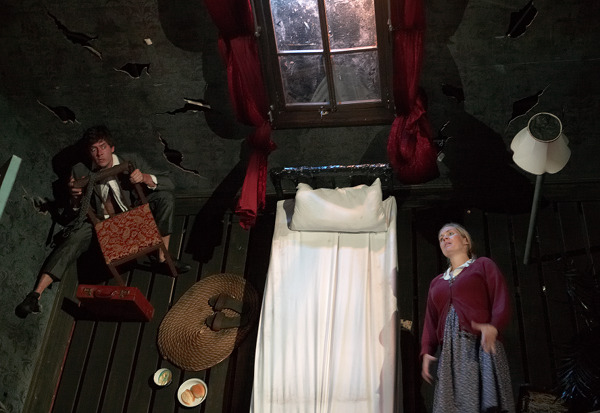
Pour peu que la programmation du Festival du Prix Europe, qui s’est tenu cette année à Saint-Pétersbourg, soit révélatrice des nouvelles réalités artistiques européennes, le jeune théâtre puiserait de quoi revitaliser les pratiques textuelles dans les arts du corps comme la danse et le cirque. C’est du moins la démarche qu’adopte la compagnie Vesturport de Reykjavik, qui présente une adaptation de la Métamorphose de Kafka, ainsi que du Faust de Goethe. Ce Faust à l’islandaise a pour cadre une maison de retraite, lieu du corps empêché et meurtri, où l’on s’acharne à combattre l’usure dans une scène réussie d’aérobic sur chaise roulante. L’illustre Professeur Faust au crépuscule de sa vie constate la vacuité de son existence et regrette de tout ignorer des plaisirs de la chair. Méphisto et ses sbires, acrobates de formation, interviennent alors pour lui laisser entrevoir ce qu’un corps jeune et sensuel pourrait lui offrir. La pièce fusionne avec les arts du cirque : un grand filet de trampoline surplombe la salle, les entrées diaboliques se font désormais par le plafond, et le trapèze devient l’outil d’expression de la sensualité de la jeune Greta, aimée de Faust. Ce n’est pas l’amour, mais le désir qui pousse le héros à la métamorphose, redoublant ainsi le jeu sur la transformation de l’acteur en un corps autre. La mise en scène propose une réflexion complexe sur le théâtre dans le théâtre, ouvrant une mise en abyme dans laquelle elle ne plonge pas. La voie tracée par le metteur en scène Gisli Örn Gardarsson, si elle n’est pas d’une nouveauté radicale, a le mérite de ne pas sombrer dans une performance tape à l’œil au détriment de tout propos dramaturgique, défaut majeur des compagnies portugaise et tchèque également primées. Cette lecture de Faust éclaire au contraire un point souvent obscur de l’œuvre, sa dimension charnelle, qui s’ajoute à cette métaphore de l’humanité tiraillée entre grandeur et faiblesse.
Les métamorphoses théâtrales
par Dorina Khalil-Butucioc
Moldavie
Le théâtre assiste toujours à de singulières métamorphoses qui renversent hardiment ses traditions et suscitent régulièrement de « nouvelles réalités théâtrales » – tel était le slogan du Prix Europe pour le Théâtre 2011. Un des prix est revenu à juste titre au Théâtre VesturPort, créé en 2001, qui s’attache à mettre en scène La Métamorphose de Kafka, et à mettre en verbe les « métamorphoses » du pacte entre Mephisto et Faust de la pièce homonyme de Goethe.
L’acteur/metteur en scène Gisli Örn Gardarsson, en collaboration avec David Farr (Lyric Hammersmith Theatre), se rallie à une nouvelle tendance théâtrale mondiale d’adaptation de textes non dramatiques. Ils inversent la direction initiale de l’idée kafkaïenne de la métamorphose homme-insecte et saisissent la métamorphose de la famille moderne standardisée. Dans Faust, le metteur en scène met à l’épreuve le texte traditionnel de Goethe en proposant à l’homme, rêvant ou fou, de vendre son âme au diable pour métamorphoser son corps vieux en un corps jeune.
La compagnie théâtrale d’Islande n’a pas besoin d’un pacte avec Méphisto pour étaler les possibilités des métamorphoses physiques de leurs corps. Acteurs, acrobates ou gymnastes nous fascinent dans ces spectacles par leurs ingéniosités acrobatiques, leurs compétences gymniques et leurs évolutions aériennes.
La scénographie aussi joue avec la notion de métamorphose : on passe du plan vertical au plan horizontal dans le premier spectacle et à la captation de la salle entière sous une toile d’araignée, étirée dans Faust. (quel rapport avec le thème de la métamorphose ? ce n’est pas explicite) Bjorn Helgason, Hartley TA Kemp métamorphosent aussi de leur côté les réfractions de la lumière…
La théâtralité brillante et poétique du premier spectacle, fantastique et terrifiante du second, est le résultat de toutes ces métamorphoses, la musique du tandem Nick Cave et Warren Ellis soutenant le rythme monotone, mais étonnant dans Metamorfosis, et le tempo rapide, explosif, mais harmonieux dans Faust. À Saint-Pétersbourg, le corps théâtral européen a reçu le choc d’une énergie nouvelle et « métamorphosante » par une troupe d’Islandais talentueux.
Plateau à cœur ouvert
par Caroline Châtelet
France
Parlant de sa création, Kristian Smeds dit s’être nourri de La Trilogie new-yorkaise de Paul Auster et avoir été mu par le désir d’inviter le public dans les coulisses du théâtre. Si, au final, c’est Mr. Vertigo du romancier américain que le metteur en scène finlandais adapte, Kristian Smeds et son équipe ouvrent bien, jusqu’au vertige, les portes de la fabrique du théâtre. Vertige de ce roman de la démesure, dans lequel le personnage éponyme maîtrisant la lévitation raconte son parcours, avec en toile de fond les étapes marquantes de l’histoire du XXe siècle. Vertige de la mise en scène, qui nous submerge de sons, d’images et d’esthétiques. Vertige, enfin, que produit la tension perpétuelle entre la double exigence de mise en jeu du fond et de la forme. Cette volonté de dévoiler au public l’envers du décor s’énonce d’emblée, par l’installation du gradin sur scène puis par la rotation de ce dernier. À l’image du parcours initiatique chaotique et touffu de Mr. Vertigo, le spectacle traverse de multiples atmosphères. À tel point que l’ensemble apparaît parfois comme un surenchérissement vain, un son et lumière enivrant jusqu’à la nausée au sein duquel les interprètes peinent à trouver leur place. Ce jusqu’à ce qu’un basculement s’opère doucement, transformant la tension forme/fond en articulation logique. Derrière le spectaculaire se dessine alors la tentative sincère d’une équipe de transmettre dans un laboratoire exubérant et fragile toute la complexité d’un récit.
Un « Voyage » très mal organisé
par Vita Khlopova
Russie
Cette année le prix « Les nouvelles réalités théâtrales » a été décerné à plusieurs compagnies, parmi lesquelles on trouve celle du metteur en scène tchèque Viliam Docolomansky. Son premier spectacle, Théâtre, a mis en exergue les capacités physiques de ses danseurs-comédiens-chanteurs, mais l’enjeu de la représentation n’était pas du tout clair. L’autre représentation, donnée très tard dans la nuit, montrait trois fragments de ses travaux : La Chanson des émigrants, Salle d’attente et Projet Lorca. Chacun d’entre eux était fort digne d’intérêt, tant par le sujet que par le travail réalisé. Pour La chanson des émigrants, V. Docolomansky s’est appuyé sur de vieilles chansons (vieilles de 200 à 300 ans) d’émigrants slovaques, retravaillées avec ses chanteurs. Travail remarquable, malheureusement présenté dans de mauvaises conditions. L’autre fragment, Salle d’attente, se déroulait dans la salle d’une gare où attendaient de futures victimes de l’Holocauste. Le troisième fragment du spectacle Journey tentait de restituer l’univers de Garcia Lorca, sa vie, ses voyages, son assassinat. Chants et danses étaient magnifiquement exécutés et atteignaient un rare degré de qualité.
La question est de savoir pourquoi n’ont été proposés que des fragments de spectacles au lieu d’une représentation entière. Autrement on aurait peut-être compris pourquoi Viliam Docolomansky a obtenu ce prix. Reste que l’impression de son œuvre reste aussi fragmentaire que la présentation de ses travaux.
Une lecture du roman d’Ulitskaya
par Anne Manyara
Kenya
La quête du sens de notre existence humaine, un thème qui transcende les frontières culturelles, a profondément marqué la mise en scène d’Andrzej Bubień de Daniel Stein, traducteur, pièce tirée d’un roman de Lyudmila Ulitskaya et représentée au théâtre de l’île Vasilievsky à St-Petersbourg, le 13 avril 2011.
Ce thème a été particulièrement accentué par le décor et la présence fantomatique de mannequins pendus par le cou, capes et capuchons drapant un corps invisible. Cela a créé une atmosphère sombre, renvoyant à la certitude prégnante de notre mortalité.
Au sujet des personnages représentés (Daniel Stein, son frère Avigdor, et d’autres personnages sur la vie desquels Daniel Stein a eu de l’influence), Bubień explique qu’il voulait « qu’une partie de ces vies soit présentée sur la scène afin de parler avec le public de ce que peut être la vie humaine ».
On le doit en grande partie au texte même du roman qui, par ailleurs, n’a pas été très bien adapté. En effet, la mise en scène ne parvient pas à vraiment transposer le roman en une pièce de théâtre. Le manque de lien entre chaque personnage et une interprétation figée ne permettent pas à la pièce de prendre toute sa dimension, et de proposer une lecture vive du roman d’Ulitskaya.
Correction : Marie-Cécile Fauvin
* Les critiques ont été écrites par les stagiaires du groupe français au sein du stage organisé par l’AICT (Association internationale de la critique de théâtre) et co-organisé par le Prix Europe, sous la direction de Jean-Pierre Han, vice-président de l’AICT, enseignant de critique dramatique, d’esthétique théâtrale et d’autres matières, au sein de l’Institut d’études théâtrales de la Sorbonne nouvelle, Paris III-Censier, mais aussi à Paris X-Nanterre et à l’université d’Evry.
2 p.m. A.S. Pushkin State Academic Russian Drama (Alexandrinsky) Theatre
EUROPE THEATRE PRIZE
Press conference dedicated to opening of Europe Theatre Prize events 2011
Greetings and welcome
6 p.m. Lensoveta Theatre
SPECIAL PRIZE
Honey by Tonino Guerra
directed by Yuri Lyubimov
with Taganka Theatre company
latest production
running time: 58 minutes
8 p.m. Baltic House Theatre-Festival
EUROPE PRIZE THEATRICAL REALITIES
Mr. Vertigo by Paul Auster
directed by Kristian Smeds (1st repeat)
produced by the National Theatre of Finland
international preview
running time: 3 hours 20 min., with one interval
Wednesday, 13th April
9 a.m. Big Hall, House of Actors
EUROPE PRIZE THEATRICAL REALITIES
Conference and meeting with Viliam Dočolomanský
Curator: Leszek Kolankiewicz, Professor of cultural studies, anthropology of performance, University of Warsaw (Poland)
Contributors, in alphabetical order: Miroslav Ballay, critic (Slovakia), Milos Mistrik, professor, critic (Slovakia), Jana Navratova, journalist (Czech Republic), Jana Pilatova, dramaturg (Czech Republic), Larisa Solntzeva, professor, critic (Russia), Hana Varadzinova, actress (Czech Republic), Eliska Vavrikova, actress (Czech Republic)
12 p.m. Theatre of S. Petersburg Theatre Academy
SPECIAL PRIZE
Conference with Yuri Lyubimov
Curator: Alexey Platunov, Foreign relations manager, Baltic House Theatre-Festival (Russia)
Moderator: Nikolai Svanidze, Political columnist for the Russia TV channel RTR (Russia)
4 p.m. Molodezhny Theatre on Fontanka
EUROPE PRIZE THEATRICAL REALITIES
Metamorphosis by Franz Kafka
directed by Gisli Ӧrn Garʠarsson (Vesturport Theatre)
original music score by Nick Cave and Warren Ellis
running time: 85 minutes, no interval
7 p.m. Baltic House Theatre-Festival
EUROPE PRIZE THEATRICAL REALITIES
Mr. Vertigo by Paul Auster
directed by Kristian Smeds (2nd repeat)
produced by the National Theatre of Finland
international preview
running time: 3 hours 20 min., with one interval
7 p.m. The Theatre on Vasilievsky Island
RUSSIAN ACCENT/ST. PETERSBURG PERFORMANCES
Daniel Stein. Translator
directed by Andrzey Buben
running time: 2 hours , no interval
Thursday, 14th April
9 a.m. Big Hall, House of Actors
EUROPE PRIZE THEATRICAL REALITIES
Conference and meeting with Kristian Smeds
Curator: Kirsikka Moring, Theatre critic (Finland)
Contributors, in alphabetical order: Eeva Bergroth, producer Smeds Ensemble (Finland), Ritva Holmberg, dramaturg (Finland), Kaarle Holmberg, director (Finland), Peeter Jalakas, director Von Krahl Theatre Tallinn (Estonia), Ivo Kuyl, artistic director KVS Theatre, Bruessels (Belgium), Audronis Liuga, journalist, director of production “Audronis Liuga” (Lithuania), Maria Liisa Nevala, former director National Theatre of Finland, professor (Finland)
11 a.m. Museum and Galleries of Modern Art ERARTA
RUSSIAN ACCENT
Conference of presentation
St. Petersburg culture policy in European context
4.30 p.m. Youth Audience Theatre
EUROPE PRIZE THEATRICAL REALITIES
The Theatre by Viliam Dočolomanský
directed by Viliam Dočolomanský
with Farm in the Cave company
running time: 75 minutes, no interval
7 p.m. The Baltic House Theatre-Festival
RUSSIAN ACCENT/ST. PETERSBURG PERFORMANCES
Moscow – Petushki
directed by Andrey Zholdak
produced by the Theatre-festival “Baltic House”
running time: 3 hours 45 min., with one interval
7.30 p.m. A.S. Pushkin State Academic Russian Drama (Alexandrinsky) Theatre
RUSSIAN ACCENT/ST. PETERSBURG PERFORMANCES
Your Gogol
directed by Valery Fokin
Friday, 15th April
9 a.m. Big Hall, House of Actors
EUROPE PRIZE THEATRICAL REALITIES
Conference and meeting with Vesturport Theatre
Curator: Michael Billington, Critic The Guardian (United Kingdom),
Contributors, in alphabetical order: Jane Edwardes, journalist (United Kingdom), Katherine Fahy, actress (United Kingdom), Jon Vidar Jonsson, critic (Iceland), James O’Quinn, journalist (USA), Gudjon Pedersen, artistic director Reykjavik City Theatre (Iceland), Jonathan Pryce, actor (United Kingdom), Alan Twitchell, Vesturport co-producer, artistic director (Switzerland/USA)
11.30 a.m. Komissarhevskaya Theatre
EUROPE PRIZE THEATRICAL REALITIES
Cabo Verde running time: 60 min.
Specialists running time: 20 min.
directed by Miguel Seabra (Teatro Meridional)
work in progress/world preview
4 p.m. Molodezhny Theatre on Fontanka
EUROPE PRIZE THEATRICAL REALITIES
Faust by J.W. Goethe adapted for the stage by Gisli Ӧrn Garʠarsson, Bjorn Hylnur Haraldsson, Nina Dogg Filippusdottir, Vikingur Kristiansson (Vesturport Theatre) and Carl Grose
directed by Gisli Ӧrn Garʠarsson, (Vesturport Theatre)
original music score by Nick Cave and Warren Ellis
international preview
running time: 2 hours, with one interval
7 p.m. The Maly Drama Theatre – Theatre of Europe
RETURNS
Three sisters by Anton Chekhov
directed by Lev Dodin
with Maly DramaTheatre company
latest production
running time: 3 hours, with one interval
10.45 p.m. Youth Audience Theatre
EUROPE PRIZE THEATRICAL REALITIES
Journey by Viliam Dočolomanský
containing an extract of Girlfriends, latest production in world preview
directed by Viliam Dočolomanský
with Farm in the Cave company
running time: 75 minutes, no interval
Saturday, 16th April
9 a.m. Big Hall, House of Actors
EUROPE PRIZE THEATRICAL REALITIES
Conference and meeting with Teatro Meridional
Curator: Maria Helena Serôdio, Professor, Faculty of Humanities, University of Lisbon, Theatre Critic (Portugal)
Contributors, in alphabetical order: Monica Almeida, administrative director producer (Portugal), Joao Carneiro, critic (Portugal), Rui Pina Coelho, journalist (Portugal), Ana Rita Delgado Martins, journalist (Portugal), Carla Ruiz Filipe, producer (Portugal)
11 a.m. Big Hall, House of Actors
PROJECT PRESENTATION
Permeability – projects 10-12
by Union of Theatres of Europe
Speakers: Alexandru Darie, President UTE (Romania), Ruth Heynen, General Delegate UTE (Germany), Matteo Bavera, Director Garibaldi Theatre Palermo (Italy), Dina Dodina, Intern. Relations Maly Theatre St. Petersburg (Russia), Alessandro Martinez, General Secretary ETP (Italy), Yuri Solomin, Director Maly Theatre Moscow (Russia), Giovanni Soresi, Dir. Communication and Marketing Piccolo Teatro- Teatro d’Europa (Italy)
12 p.m. Big Hall, House of Actors
EUROPE PRIZE THEATRICAL REALITIES
Conference and meeting with Katie Mitchell
Curator: Dan Rebellato, Lecturer, Department of Drama, Royal Holloway, University of London (United Kingdom)
Contributors, in alphabetical order: Katharine Bassett, journalist (United Kingdom), Dominic Cavendish, critic (United Kingdom), Martin Crimp, playwright,(United Kingdom), Stephen Dillane, actor (United Kingdom), Jeremy Kingston, critic (United Kingdom), Helena Lymbery, actress (United Kingdom)
3 p.m. Big Hall, House of Actors
EUROPE PRIZE THEATRICAL REALITIES
Conference and meeting with Andrey Moguchiy
Curator: Nikolai Pesochinsky, Professor, Academy of Theatrical Art of St. Petersburg, critic (Russia)
Contributors, in alphabetical order: Alexander Chepurov, dramaturg, vice director artistic programmes and research (Russia), Jovan Cirilov, artistic director BITEF (Serbia), Marina Davydova, critic, director Festival NET (Russia), Edward De Lumley, dir. Cultural Attaché, French Institute of St. Petersburg (France), Roman Dolzhanskiy, journalist, artistic director Festival NET (Russia), Valerij Fokin, stage director, director Alexandrinsky Theatre (Russia), Dina Goder, journalist, director Big Cartoon Festival (Russia), Anton Gubankov, Head of Committee for Culture City of St. Petersburg (Russia), Lilya Shitenburg, journalist (Russia), Sergey Shub, Genereral Director Baltic House Theatre-Festival (Russia), Eric Soderblom, director Helsinki Festival (Finland), Zhanna Zaretskaya, journalist (Russia)
5 p.m. Komissarhevskaya Theatre
EUROPE PRIZE THEATRICAL REALITIES
1974
directed by Miguel Seabra (Teatro Meridional)
produced by the Teatro Nacional Doña Maria II
international preview
running time: 80 minutes, no interval
8 p.m. The Baltic House Theatre-Festival
EUROPE THEATRE PRIZE
The broken jug by Heinrich von Kleist
directed by Peter Stein
with Klaus Maria Brandauer and Berliner Ensemble
running time: 2 hours, no interval
Sunday, 17th April
9.30 a.m. Big Hall, House of Actors
EUROPE THEATRE PRIZE
Symposium on Peter Stein – Part I
Curator: Peter Iden, Theatre and art critic (Germany)
Contributors, in alphabetical order: Arturo Annecchino, musician (Italy) Georges Banu, IATC honorary president professor, critic (France), Michael Billington, critic (United Kingdom), Gianfranco Capitta, critic (Italy) Maddalena Crippa, actress (Italy), Mark Fisher, critic (United Kingdom), Vladimir Koljazin, critic and essayist (Russia), Joyce Mcmillan, critic (United Kingdom) Evgeny Mironov, artistic director, actor (Russia) Elke Petri, actress (Germany)
1 p.m. A.S. Pushkin State Academic Russian Drama (Alexandrinsky) Theatre
EUROPE PRIZE THEATRICAL REALITIES
The blue bird
directed by Andrey Moguchiy
running time: 2 hours 40 min., with two intervals
4.30 p.m. Big Hall, House of Actors
EUROPE THEATRE PRIZE
Symposium on Peter Stein – Part II
curator: Peter Iden
7.30 p.m. A.S. Pushkin State Academic Russian Drama (Alexandrinsky) Theatre
PRIZE-AWARD CEREMONY
directed by Andrey Moguchiy and Emanuela Pistone
followed by
Faust Fantasia from J.W. Goethe
voice Peter Stein
piano Arturo Annecchino
running time: 55 min.
Ακύρωση της παράστασης « Ο Μεγαλέξανδρος και ο καταραμένος δράκος », κύριο σώμα του φετινού φεστιβάλ προβολής της σύγχρονης ελληνικής δημιουργίας στο εξωτερικό, προγραμματισμένη για τις 10 Μαρτίου 2011 στο Piccolo Teatro στο Μιλάνο, λόγω της τελικής στάσης του ΔΗΠΕΘΕ Βορείου Αιγαίου. Δημοσίευση της επιστολής του φεστιβάλ με την οποία απαντά στο διεθυντή του ΔΗΠΕΘΕ.
Ακυρώθηκε η παράσταση "Ο Μεγαλέξανδρος και ο καταραμένος δράκος"
ημερομηνία 2 Φεβρουαρίου 2011
Κύριε Ζαφείρη καλησπέρα σας! Θα θέλαμε να σας εκφράσουμε τα θερμά μας συγχαρητήρια για το τόσο άμεσο και αποτελεσματικό«χτύπημα» σας στην προβολή στο εξωτερικό της εικόνας σας και του θεάτρου του οποίου ηγείστε! Να πάρουμε όμως τα πράγματα από την αρχή.
Το φεστιβάλ σύγχρονης ελληνικής δημιουργίας «το Μιλάνο συναντά την Ελλάδα» έχει καθιερωθεί ως ετήσιος θεσμός όχι μόνο στο καλλιεργημένο ακροατήριο της πόλης του Μιλάνου, αλλά και σε σοβαρότατους φορείς στην Ελλάδα και στην Ιταλία που του προσφέρουν σταθερά την αιγίδα τους, όπως το Γενικό Προξενείο της Ελλάδας στο Μιλάνο, το Υπουργείο Πολιτισμού και Τουρισμού, καθώς και ο Δήμος του Μιλάνου και το Piccolo Teatro. Τα προηγούμενα χρόνια είχε την τιμή να φιλοξενήσει καταξιωμένους Έλληνες καλλιτέχνες όπως οι Λυδία Κονιόρδου, Θεόδωρος Τερζόπουλος, Σαβίνα Γιαννάτου, Γιώργος Κουμεντάκης, Μάρθα Φριντζήλα κ.α., των οποίων οι παραστάσεις ήταν sold out.
Οι επαφές μας με τον Δήμο Αβδελιώδη, τον οποίο εκτιμούμε, σεβόμαστε και θαυμάζουμε απεριόριστα, ξεκίνησαν με στόχο να παρουσιαστεί και στην Ιταλία το τόσο σημαντικό έργο του «ο Μεγαλέξανδρος και ο Καταραμένος Δράκος», που δημιουργήθηκε σε συνεργασία δική του με το ΔΗ.ΠΕ.ΘΕ. Βορείου Αιγαίου. Κατόπιν συμφωνίας με το Piccolo Teatro αποφασίσαμε να προσκαλέσουμε την συγκεκριμένη παράσταση στο φεστιβάλ που θα λάβει χώρα στο Μιλάνο το Μάρτιο του 2011 με τίτλο «Ώσμωσις».
Μη γνωρίζοντας παρασκηνιακές και -με την αρνητική έννοια- καθαρά ελληνικές μικροπρέπειες, σκεφτήκαμε με δική μας πρωτοβουλία να προσθέσουμε στους τίτλους της παράστασης και το όνομα του θεάτρου του οποίου ηγείστε, ως σημάδι της σύγχρονης δημιουργικότητας στην Ελλάδα και εκτός των μεγάλων αστικών κέντρων. Δεν μπορούσαμε όμως ποτέ να φανταστούμε ότι οι ενδεχόμενες εσωτερικές σας διαφορές θα σας οδηγούσαν σε ακραίες κινήσεις, όπως παραπλανητικά τηλεφωνήματα δημοσιογράφων από την Χίο και τον διευθυντή του ΔΗ.ΠΕ.ΘΕ. να εκφράζεται σε τέτοιο τόνο για έναν καλλιτέχνη, που αν μη τι άλλο έχει προσφέρει πολλά στην ιδιαίτερη πατρίδα του και στην πολιτιστική εικόνα της χώρας γενικότερα.
Κύριε Ζαφείρη, δεν θέλουμε να έχουμε καμία σχέση με ανθρώπους που ισχυρίζονται πως υπηρετούν τον πολιτισμό αλλά στην ουσία με τα μικροπολιτικά τους παιχνίδια τον υπονομεύουν. Κρατήστε τα σκηνικά και το προσωπικό σας, δεν ζητούμε καμία συνεργασία μαζί σας. Από ό,τι φαίνεται, εσείς ως διευθυντής του ΔΗ.ΠΕ.ΘΕ. αφήνετε κάποιες προσωπικές σας εμπάθειες να εμποδίσουν την αναφορά του θεάτρου στο ετήσιο πρόγραμμα του Piccolo Teatro. Συνεπώς υποθέτουμε ότι η καριέρα στο εξωτερικό του ΔΗ.ΠΕ.ΘΕ. Βορείου Αιγαίου επί των ημερών σας είναι τέτοια που θεωρείτε αξιοπεριφρόνητη την θετική προβολή του ονόματός του στο πιο καταξιωμένο θέατρο της Ιταλίας.
Εμείς από πλευράς μας οφείλουμε να ενημερώσουμε όλους τους φορείς που μας προσφέρουν την αιγίδα τους καθώς και τους 62.000 εγγεγραμένους συνδρομητές του Piccolo Teatro σχετικά με τους λόγους και πιο συγκεκριμένα την στάση σας που μας αναγκάζουν να κάνουμε μια τόσο βραχυπρόθεσμη αλλαγή προγράμματος. Φυσικά και θα συνεχίσουμε το έργο μας σε συνεργασία με ανθρώπους και καλλιτέχνες σαν τον Δήμο Αβδελιώδη. Το μόνο που ειλικρινά μας λυπεί, είναι για μια ακόμα φορά η συνειδητοποίηση, ότι αυτό που εμποδίζει την πατρίδα μας να πάει μπροστά δεν είναι η οικονομική κρίση αλλά η διχόνοια και τα μικροσυμφέροντα.
Η ομάδα της Σatellart
Αλεξάνδρα Παπαδοπούλου
Μαριέλλα Κεσίσογλου
Μυρτώ Ρογκάν
Το φεστιβάλ προβολής της σύγχρονης ελληνικής δημιουργίας
“Milano Incontra la Grecia”
παρουσιάζει στο Piccolo Teatro, στις 10 Μαρτίου 2011, ώρα 20:30
την παράσταση του Δήμου Αβδελιώδη
“Ο Μεγαλέξανδρος και ο καταραμένος δράκος”
Λίγα λόγια για το έργο
Ένας δράκος καταλαμβάνει το υδραγωγείο, τη μοναδική πηγή που τροφοδοτεί την πόλη. Εξαναγκάζει έτσι τους κατοίκους να πηγαίνουν να του ζητάνε νερό και αυτός να τρώει όσους θέλει. Ο φόβος καταλαμβάνει τους πάντες. Η τοπική εξουσία του Βεζύρη παρεμβαίνει ρυθμιστικά και αποφασίζει να κάνει κλήρωση για το ποιος θα είναι κάθε μέρα το θύμα του Δράκου, ώστε να μη διαταράσσεται η κοινωνική οργάνωση της πόλης από τον πάνδημο φόβο και πανικό. Μια μέρα ο κλήρος πέφτει στη μοναχοκόρη του Βεζύρη. Ο Χατζηαβάτης έχοντας ορισθεί να ειδοποιεί κάθε ξημέρωμα προσωπικά και μυστικά τα υποψήφια θύματα, έρχεται να το πει συντετριμμένος στη Βεζυροπούλα που υπεραγαπά. Φτάνοντας μπροστά στο Σεράι πέφτει πάνω στον Καραγκιόζη που κοιμάται φαρδύς πλατύς μέσα στο δρόμο. Το θορυβώδες ξύπνημά του προκαλεί την επέμβαση του Βεληγκέκα, υπεύθυνου της φρουράς, και τα πράγματα περιπλέκονται…
Η ταυτότητα της παράστασης
Η ιδέα του έργου στηρίζεται στο μοτίβο της δρακοκτονίας, προσφιλές θέμα των παραμυθιών και του θεάτρου Σκιών με πολλές παραλλαγές από τις οποίες οι πιο γνώριμες είναι «Ο Μεγαλέξανδρος και το καταραμένο φίδι» του Παναγιώτη Μιχόπουλου και «Ο Μεγαλέξανδρος και ο καταραμένος όφις», του Σωτήρη Σπαθάρη που ενέπνευσαν το σχετικό χορόδραμα της Ραλλούς Μάνου με την μνημειώδη μουσική του Μάνου Χατζιδάκι.
Η μήτρα αυτής της παράδοσης ανάγεται στην ελληνική μυθολογία όπου ο Απόλλωνας (αργότερα Άγιος Γιώργης) σκοτώνει το Δράκο στους Δελφούς και ιδρύει το Μαντείο, ως μνημείο και χώρο λατρείας της επικράτησης του φωτός και της γνώσης επάνω στο σκοτάδι και την άγνοια.
Η νέα συγγραφή του έργου επιχειρεί να αποδώσει το διαχρονικό και πάντα επίκαιρο χαρακτήρα αυτού του μύθου, που στην πραγματικότητα συμβολίζει την καθημερινή και ασταμάτητη πάλη που καλούμαστε να δώσουμε απέναντι σε κάθε φόβο που ορθώνεται μέσα μας, ή έξω μας, σα Δράκος, για να αναστείλει ή να ματαιώσει, ίσως τα πιο δημιουργικά και εμπνευσμένα μας όνειρα.
Η πλοκή ξεφεύγει από το ηθογραφικό πλαίσιο και γίνεται αλληγορική για να αγγίζει δομικά ένα ευρύτερο πεδίο σκέψης εμπεριέχοντας σημερινά ζητήματα, που μας προβληματίζουν και μας απασχολούν μέσα σ’ ένα νέο παγκοσμιοποιημένο κόσμο όπου κυριαρχούν ανεξέλεγκτα κάθε λογής Δράκοι.
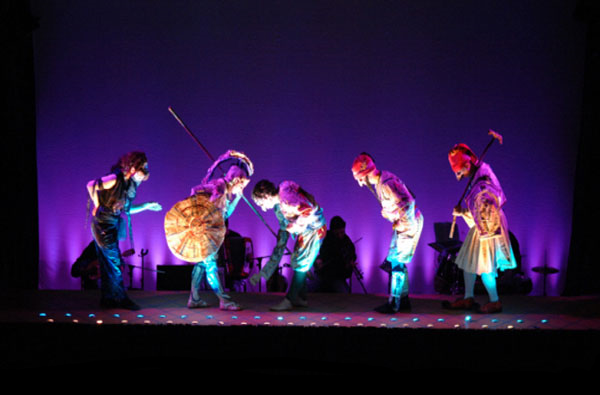
Η παράστασή μας αντλεί στοιχεία από τον Καραγκιόζη και την αισθητική του θεάτρου Σκιών, όμως είναι μια πρωτότυπη θεατρική πρόταση με πέντε ηθοποιούς και τέσσερις μουσικούς, σαν σύγχρονη λαϊκή όπερα.
Ο Κύκλος για το Ελληνικό Τραγούδι εντάσσεται σε ένα σύνολο πολιτιστικών παρεμβάσεων. Κινητήρια δύναμή του αποτελεί η Ομάδα Φίλων του Ελληνικού Τραγουδιού, μια συστράτευση Ελλήνων δημιουργών και διανοητών, που αποσκοπούν στον επαναπροσδιορισμό του χαμένου Κέντρου και των όρων του (έντεχνο, λαϊκό, ποιοτικό).
Η μουσική ως τέχνη είναι αυτοτελής, εφόσον μπορεί να μας συγκινεί απλώς και μόνον ως ένα ακουστικό, συμφωνικό γεγονός. Στο τραγούδι, όμως, που συνδυάζεται με το λόγο, ο βαθμός αυτής της συγκίνησης ρυθμίζεται πλέον όχι τόσο από την ποιότητα του μουσικού μέρους καθαυτού, όσο από την καίρια συνάρτησή του με τους στίχους· με το λογικό καμβά δηλαδή των στίχων, που θέτει όρους και κριτήρια της σκέψης.
Αυτού του είδους η σχέση της μουσικής με το λόγο μάς δίνει το ερέθισμα και τη δυνατότητα να δούμε και να ακούσουμε διαφορετικά ένα κείμενο, με σκοπό μια πλήρωση συγκίνησης μέσα από την ανάδειξη και άλλων πτυχών ενός λογοτεχνικού κειμένου, οι οποίες θα έμεναν πιθανόν άτονες ή αφώτιστες, αλλά προσδοκώντας παράλληλα και την ανάδειξη της ίδιας της μουσικής μέσα από την έλλογη αντανάκλαση του κειμένου.
Η διαλεκτική και αμφίδρομη αυτή σχέση μεταξύ μουσικής και λόγου γίνεται μάλιστα ακόμη πιο ενδιαφέρουσα στην περίπτωση ενός κειμένου όπως αυτό του Παναΐτ Ιστράτι (1884-1935) από την Μπραΐλα, φίλου του Νίκου Καζαντζάκη, τον οποίο ο Ρομαίν Ρολάν αποκάλεσε «Μαξίμ Γκόρκι των Βαλκανίων».
Η εναρκτήρια εκδήλωση του Κύκλου, με κεντρική θεματική τον Άγνωστο Ελληνισμό, είναι αφιερωμένη στο σπουδαίο Ελληνορουμάνο συγγραφέα. Σε αυτή την ξεχωριστή βραδιά το κοινό θα έχει τη σπάνια ευκαιρία να απολαύσει τον Δήμο Αβδελιώδη όχι μόνο να σκηνοθετεί, αλλά και να ερμηνεύει το κείμενο.
Σκηνοθεσία-Ερμηνεία: Δήμος Αβδελιώδης
Λογοτεχνική σύμβουλος, δραματουργική επεξεργασία, μετάφραση: Μπουμπουλίνα Νικάκη
Φωτισμοί: Δήμος Αβδελιώδης
Σκηνική επιμέλεια: Μαρία Πασαλή Μουσική επιμέλεια: Γιώργος Ευσταθίου Επιμέλεια κύκλου: Δημήτρης Παπαδημητρίου