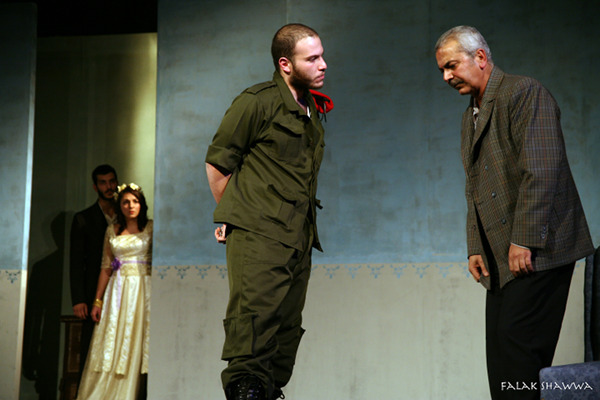
The Zionist attack on Palestinian cities, towns and villages, Safiyya and Said, a young Palestinian couple, are forced to leave their city, Haifa. The eviction is so brutal that they are not able to go back and get their infant son, still at home.
Twenty years later, right after the 1967 war, when Israel allows the expelled Palestinians to visit their former homes, Said and Safiyya return to Haifa to discover that their home is still intact.
Miriam, an Israeli of Polish origin is living there, along with her son Dov.
Dov is none other than Said and Safiyya’s son, Khaldun, whom they were forced to leave behind in 1948.
GHASSAN KANAFANI (1936-1972)
Ghassan Kanafani, Palestinian journalist, novelist and short story writer, was born in Acre, in the north of Palestine, on April 9, 1936. He and his family shared the fate of hundreds of thousands of Palestinians who were expelled from Palestine in 1948 as a result of the establishment of Israel.
In 1960, Ghassan settled in Beirut where he lived and worked. On July 8, 1972, he and his young niece, Lamees, were killed by Israeli agents in a car bomb explosion in Beirut.
By the time of his untimely death, Ghassan had published eighteen books and written hundreds of articles on culture, politics, and the Palestinian people’s struggle. His artistic talent also included visual art. Ghassan was always creative, and it gave him peace of mind to work on his paintings, illustrations and sculptures.
His literary works have been re-published in several editions in Arabic and translated to nineteen languages and published in more than twenty different countries.
Although Ghassan’s literary works were an expression of the Palestinian people and their cause, his literary talent gave his works a universal appeal.
« Return to Haifa »
Adaptation, Direction & Set Design Lina Abyad
Assistant Director Amahl Khouri
Costume Designer Claire Mishref
Lighting Designer Alaa Minawi
Print & poster design Dima Tannir
Photography Dalia Khamissy
Executive Producer Ghina Sibaii
Producer Ghassan Kanafani Cultural Foundation
Actors - in alphabetical order -
Sameera Al Asir
Sandy Chamooun
Ghannam Saber Ghannam
Hani Al Hindi
Aliya Khalidi
Azzam Mostafa
Hussein Nakhal
Raeda Taha
Date:  11th June to 16th June 2013 at 8:30 in the evening
Extra Matinee performances 15th Saturday and 16th Sunday at 5:00 pm
Place: Babel Theatre - Center Marignian, Cairo Street - Hamra, Beirut
Tickets will be sold at the theatre from 11:00 am
Tickets: 30,000 L.L. 20,000 L.L. and 15,000 L.L.
For reservations and information: 76/ 64 32 95 – 01/ 744033
A co-production of
Istanbul Theatre Festival and Theatre Pera
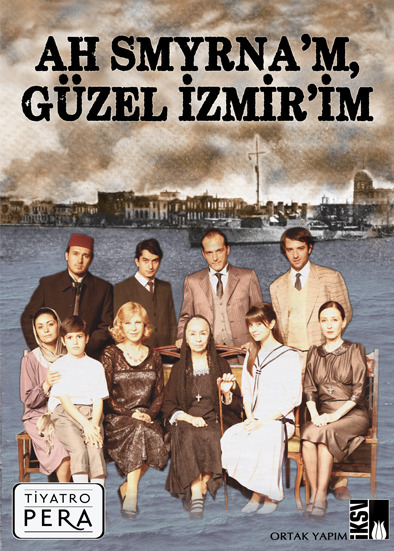
“Oh My Smyrna, My Beautiful Izmir” had premiered on May 20th 2012 and had been performed five times during “18th International Theatre Festival”. The play is a co-production of Istanbul Theatre Festival and Theatre Pera.
The play is in two acts and its total duration is two hours and ten minutes with the intermission. Cast consists of ten actors. With the technical crew, the complete group is 15 persons. Turkish and Greek songs that reflect the tradition of both societies are sung within the dramatic structure. Live music is made with mandolin, bouzouki, clarinet, bendir (type of a traditional drum), which are played by the actors. Both music and dance take place as parts of the story, in the dramatic structure of the play.
The play takes place in 1923 in Smyrna (İzmir), one year after “The Catastrophic Fire of İzmir” burned down the city. ‘The Turkish War of Liberation’ was over; the law requiring ‘Obligatory Exchange’ of Greek and Turkish populations went into effect and forced the communities to immigrate mutually. When the play begins the “Vlasto”s, a wealthy Greek Family with deep cultural roots in Anatolia, are preparing to migrate to Greece from their mansion in Bournabat (Bornova), İzmir. The “Vlasto”s had lived in the center of Izmir, Punta but by taking shelter in Bournabat, a wealthy suburban area, they were rescued from the catastrophic fire of 1922. The Turkish housekeepers, who have lived with the Vlastos, like a family, for decades, are sad witnesses of this migration.
Number of characters belonging both English and Turkish families is ten. The Greek family Vlastos has 7 members. All of them are Smyrneans from birth and have been living in Smyrna ever since. The Vlasto family’s old mother Eleni, is a fourth generation Smyrnean. Her husband died during the 1912 Balkan War. Her son Konstantinos is a famous merchant. He worked for Smyrna Greek Quarters during the war. Konstantinos’ twin had died in the war. Eleni’s little son Theodopulos was enslaved during the war and worked in the camps. Eleni, her sons, her daughter in laws Ioanna and Polyxeni and her grand children live all together. Grandchildren Ilias and Lefkothea are Ioanna’s children. Ilias is sick and has been hidden in the mansion in Bournabat throughout the war. During his three years of concealing, he translated the famous antique Symrnean writer Homer’s Iliad into Ottoman language. From the Turkish family only three are left. Muzeyyen, her seven-year-old son Ali Riza and her brother Mehmed. The elders of the Turkish family had died during different war periods and Greek Occupation.
Traumatic traces of war and the obligatory exchange, causes tension between the Turkish and Greek families. As they turn against each other living together becomes impossible. The characters who find themselves in the midst of this conflict are deeply saddened and must yield to a hopeless future, desperate longings, impossible loves. ‘The Catastrophic Fire of İzmir’ not only ruins the legendary and beautiful city of Smyrna and burns it down to ashes but also ends the centuries long tradition of diverse ethnic and religious communities living together peacefully and destroys their past and future, their hopes and dreams.
The great war was over and in the year of 1922, the catastrophic fire that lasted for three days, had destroyed and made disappear the fascinating, multi-cultural city, “the pearl of Aegean”, Izmir. The city was co-created by a cosmopolite society of Turks, Greeks, Armenians, Jews and Levantines who had been living together for nearly one century, with different religious beliefs, different languages. Memories of these people who had been celebrating even their religious festivals together are all left in pages of books. The silhouette of Izmir, the richest center of trade in Ottoman Empire, with its fabulous architecture, theaters, cinemas, libraries, entertainment venues, shops, is to be only found in postcards. The soil that gave birth to the ancient culture, mythological stories also witnessed a great destruction enforced by ethnical provocation of imperialist war gods. Withered away is our past, our culture. The people who were exiled from their birthplaces, the people who were forced to emigrate from their own lands, are our own people. To recall this very tragic end of Izmir, may contribute to the hope and effort for the idea of living together of nations.
After eleven years of performing Theatre Pera, with the same responsibility to the past and future, a small window to this tragic part of our recent history open.
IOANNAI can't even look that way, when I do, I feel like
I'm going blind. The Kordon is gone, Punta is black as ink! Gavurisa
Smyrni has disappeared completely. Our past has burnt, our future,
turned into ash. How will we live on, Kosta? How? Pos tha zis0ume Kosta? Pos?
OH MY SMYRNA, MY BEAUTİFUL IZMIR
Writer-Director Nesrin Kazankaya
Dramaturgy Şafak Eruyar
Stage Design Başak Özdoğan
Costume Fatma Öztürk
Director’s Assistant- Lighting Zeynep Özden
Music Director Ezgi Kasapoğlu
Music Arrangement Emil Tan Erten
Greek Translation Meri Madeleni
Choreography Cemal Atilla-Güneş Çağlar
Cast of Characters
ELENI Aysan Sümercan
KONSTANDINOS Muhammet Uzuner
IOANNA Nesrin Kazankaya
POLYXENI Defne Halman/Başak Meşe
ILIAS Emre Çakman
MEHMED Doğan Akdoğan
MÜZEYYEN Linda Çandır
THEODOPULOS İlker Yiğen
LEFKOTHEA Selin Sevdar
ALİ RIZA Asır Akkaya
Christian Lapointe takes on the founding text of anti-play – the playful and destabilizing Offending the Audience by Peter Handke. Nearly fifty years after its creation, Lapointe reinvents the play’s celebratory radicalism. Taking the show’s title and the line “This is not a play” quite literally, he casts the audience as the only living character in the piece, placing the spectators face to face with themselves. They are both the subject and the object of this unusual performance, where theatrical representation is turned inside out.
In this refreshing and fun-loving recreation, Christian Lapointe leads the affront using astonishing synthesized voices. Subjected to the orders of dehumanized robots, the spectators will be chased out of the theatre – we won’t tell you how! – by the infamous cascade of insults at the end of Handke’s play. Is it an object of live cinéma-verité, studio art or digital theatre? Who knows?
Théâtre La Chapelle
Length : 1 h
In French
June 3 – 7 at 9:00 pm
Tickets: $28
Under 30 / Over 65: $23
Sales taxes and order processing fees included
Between Doing and Portraying
Since founding Théâtre Péril in Quebec City in 2000, the writer and director Christian Lapointe has pursued a singular career, creating theatrical objects of demanding density where poetry, death and reality combine to question the existential emptiness of contemporary life. Inspired by the symbolism of William Butler Yeats – his first play was a trilogy consisting of Chien de Culann, Le Seuil du palais du roi (2003) and the triptych Calvaire / Résurrection / Purgatoire under the title Limbes (2009) – and by the textual density and relation to reality found in the work of Samuel Beckett, Lapointe gradually focused his research on the pressures of reality that any form of representation in the theatre demands. Whether it be his reworkings of symbolist writers (Yeats and Villiers de L’Isle-Adam, whose unpresentable Axel he staged in 2006), brutal contemporary texts (Vu d’ici, based on the novel by Mathieu Arsenault, 2008; L’enfant matière by Larry Tremblay at Théâtre Blanc, 2012) or his own writing (C.H.S., presented at the FTA in 2007 and at the Avignon Festival in 2009; Anky ou la fuite, opéra du désordre, 2008; Trans(e), 2010; and Sepsis, 2012), Christian Lapointe creates, to quote the critic Hervé Guay, “atypical experiences from which one rarely emerges unscathed”. He is associate artist with Recto-Verso since 2011 and was recently appointed artistic director at Théâtre Blanc, in Québec.
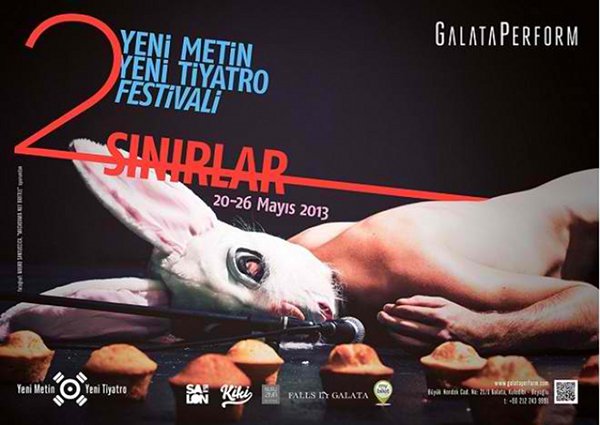
2nd Yeni Metin Yeni Tiyatro Festivali – this years’ theme of New Text New Theatre is
“Borders”
Dates for the Workshop
May 24 Fri 10.30 – 16.30
May 25 Sat 10.30 – 16.30
May 26 Sun 10.30 – 16.30
Workshop by Ricci/Forte: Beneath the Roses
New Text New Theatre Festival which is going to be executed by GalataPerform for the second time between May 20-26 entertains Ricci/Forte whom have considerably been debated in the recent years. This year’s theme of New Text New Theatre is: ‘Borders’. Proof readings, discussions and workshops of the first plays of novel playwrights will be carried out throughout the festival. The international guests of the festival are the divergent cronies Ricci/Forte.
Ricci/Forte who represent the Italian Contemporary Theatre in the international festivals with their own plays: “Macadamia Nut Brittle”, “Grimmless”, “%100 Furious”, “Abbastarduna”, “Pinter’s Anatomy” and “Imitation of Death” will be in İstanbul between May 23-27. In the New Text New Theatre Festival, “Macadamia Nut Brittle” is going to be presented as reading theatre; “Grimmless” will be played as a video; Ricci/Forte will realize a workshop called ‘’Beneath the Roses”. The workshop is available only for 20 participants and will be in Galata Hamursuz Fırını between 10.30-16.30 during May 24-25-26. The workshop will last 3 days and present a challenge to the players both physically and psychologically focusing on body, voice, and courage. Stated by them very concisely: ‘No more stories about characters, or events to be worn such clothes in a sale of Zara and H&M but fragments, our pure and simple skin to be removed to reveal the ferocity of our fallibility: a search of the tumults of our passions, understood as an escape from any gag of role.’
The workshop will be in Italian and consecutively translated into Turkish
Contact: Ferdi Çetin, yenimetinyenitiyatro@galataperform.com, 00 90 506 453 07 37
24 May 2013 , FRIDAY at 19:00
When in Rome & Language
(Staged Play-Reading)
When in Rome (7:00PM)
Written by: Öznur Şahin
Directed by: Mesut Arslan
Performers: Murat Karasu, Özden Çiftçi, Pervin Bağdat, Arda Çetinkaya
The boyfriend of a young woman who lives with her landlady in the same apartment, comes to stay with her for a short time. The young woman, Ayşen, has to hide this situation which her family knows from her neighbours. A jail-like life begins for her as the situation gets more complicated. The play discusses the notion of conservatism in the borders of private life and introduces an extraordinary point of view to an ordinary life by striking a blow at reality. ‘When in Rome’ is a critical comedy having the rhythym of vodvil.
Language(8:30PM)
Written by: Şenay Tanrıvermiş
Directed by: Yeşim Özsoy Gülan
Performers: Yeşim Ceren Bozoğlu, Şirvan Akan, Yağız Can Konyalı
A modern flat where a middle-class family lives, the day is like today. Arzu lost one of a pair of Marrylou mitt made of silk cashmere and is incessantly in search of it. What a weird country this is! Everything and everybody continuously disappear. ‘Language’ talks about the daily life of a social class which is about to disappear, from a grotesque perspective. The play mixes the colloquial language with the register of politics and scents out the loss in a fantastic atmosphere. ‘Language’ has a very keen understanding of humour and introduces a brand new and brave perspective to the field of playwriting.
*There will be a discussion with the playwrights after the performances
No:2/1 (1:00PM)
Written by: Duygu Süreyya Yalçın
Directed by: Yusuf Demirkol
Performers: Bertan Dirikolu, Emre Yetim, İnci Nur Daşdemir, Şafak Ersözlü
The government authorities announce that the ones who are older than 70 are going to be killed. They raid houses and take old people. The streets witness genocides. Everybody should give the old in their houses in charge of the government authorities. All descents living with their parents undergo a very hard examination. ‘No:2/1’, an experimentation on dystopia which does not forget the reality of Turkey, is a conflict between father and son wandering around the borders between hatred and conscience.
HSKTR (3:00PM)
Written by: Doğu Polat
Directed by: Beyti Engin
Performers: Emrah Eren, Bekir Çiçekdemir, Ozan Ayhan, Ali Kil, Bulut Akkale, Arzu Akın
Young clerk secretary comes to judicial court on the first day of his career but nothing is as he has imagined. All of a sudden, he finds himself in a court case in which he is being judged. As he speaks more and more, his speech turns into an exhibit against himself. Consequently, he is accused of being a terrorist in an organization called HSKTR. ‘HSKTR’ reminds us of a burlesque in folk tradition both in language and content. It also proposes a staging rehearsal between genres thanks to its grotesque atmosphere.
Sedat opens the doors of his house to Ömer whom he does not know well. Ömer is previously a court officer, Sedat a lawyer. They promote their relations in a way that they turn the necessary borders of social life upside down as well as testing the borders of private life in the same house. ‘Dam’, re-handles the relationship between property and power from a humanist perspective.
Stories, three different times, a house and 7 characters who have been guests of this house come together in this play written by Ahmet Sami Özbudak, a young Turkish playwright which came out of the workshops of New Text New Theater Project and who got « Best Young Playwright Prize » at Heidelberg Stückemarkt in 2011.
Markiz and Eleni, two Greek/Turkish sisters residing in Istanbul, who had to leave their house during the riots of September 6-7th in 1955, a revolutionist communist, Ahmet, who had to take refuge and hide in the same house as the tenant of a migrant from the Blacksea region of Turkey, Turgut Usta in 1980 and a transvestite, Sevengül and his lover Rizgar who live in the same house in the 2000s. All of these characters exist in the play in the same house all together. They all tell their stories and also talk about the stories that preside them. The house is a place of memory and identity where the traces of each era can be seen and experienced.
For the project GalataPerform’s space, including the foyer, the backstage and the entrance of the performance area was transformed in order to broadcast live the unseen parts of the house to the audience. In the end the audience experience what is on stage; which is the dining room and the kitchen of the house and what is backstage which is the entrance, the bedroom, the livingroom and other parts of the house. In this way the play demands a new way of experiencing theater combining and blending techniques of theatre and cinema all together.
Written by: Ahmet Sami Özbudak
Directed by: Yeşim Özsoy Gülan
Cinematographic Dramaturgy: Ceren Ercan
Performers: Okan Urun, Burak Safa Çalış, Batur Belirdi, Bertan Dirikolu, Yeşim Özsoy Gülan,
Ceren Demirel, Koray Kadirağa
Stage Design: Başak Özdoğan
Music Design: Özüm Özgülgen
Costume Design: Tülin Kermen
Cinematography: Ferhat Öçmen
Technical Director: Ömer Özkan
Technics: Halil Özok
Stage Manager: Mustafa Dileklen
Assistants: İrem Aydın, Merve Kalgıdım, Onur Çöçelli, Hazal Erulusoy
Administrative Director: Nilüfer Dönmez
Communications Coordinator: Ezgi Düzenli
Photography: Hande Göksan
Dates
MARCH21, 22, 23, 28, 29, 30
APRIL4, 6, 11, 13, 18, 20, 25, 27
MAY2, 4, 9, 11, 16, 18
Time: 8.30PM
GalataPerform
Address: Büyük Hendek Cad. No:21/1 Galata Kuledibi Beyoğlu / İstanbul
For receiving Theatre Cultures suggestions you can subscribe
to Theatre Cultures' newsletter on Home Page with your email,
then activate your subscription: click on the link that you
will receive in your email

Six invitations for "IZ/STAIN" by Theatre Cultures. Win one of the invitations by sending an email
at contact@theatre-cultures.com (for the Theatre Cultures newsletter and facebook subscribers)
March 18-19-20-21-22 at 20:30
March 25th at 20:30 Oyun Atölyesi
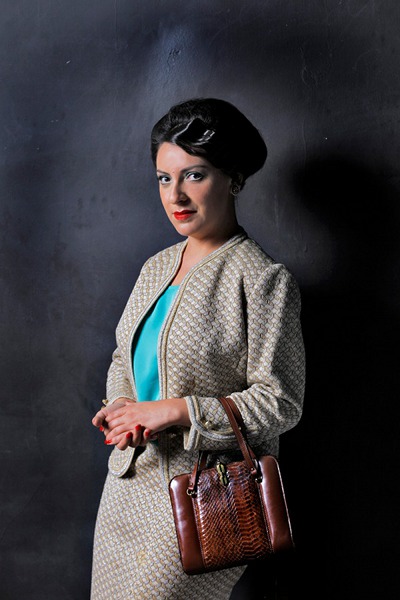
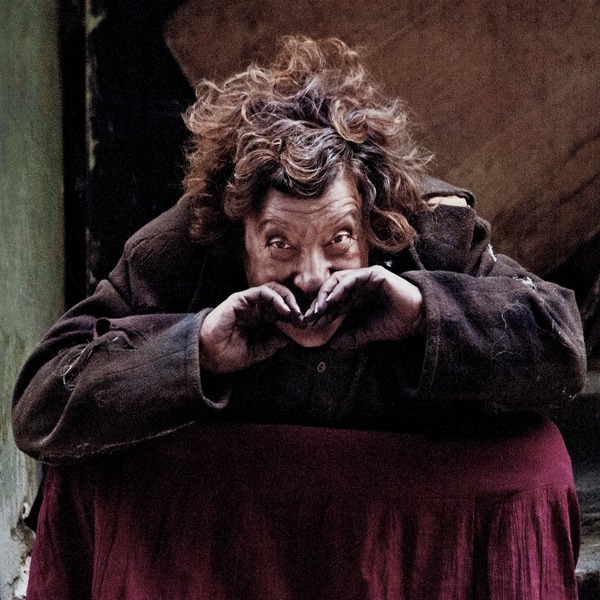
The second play of “6 Üstü Oyun” Project of Altidan Sonra Production’ “Evaristo” is written by playwright Civan Canova. The play made a premiere on January 28th and is directed by Nihal Koldaş.
Ayşenil Şamlıoğlu is on stage for « Evaristo ».
The play’s lighting design is by İsmail Sağır, stage and costume design by Başak Özdoğan, the photos of the play belong to James Hughes.
Comments of director Nihal Koldaş on the play:
“Evaristo« , is a play that attempts to speak about today, but sets its eyes on the past, present and even the future. The play greets the audience in a damp and dirty bunker and sways the expectance of the audience from one side to another. Evaristo, as defined by its playwright, is about the struggle of an ageless woman to hold on to life. It is an ambition to live… a story that lasts for decades. On the other hand, it is an observation on the recent social history of the world, gazing from an underground, dark bunker. It is both dark and brutal, but also crazy and fun at the same time. The playwright gives the audience an enormous freedom to position him/herself into the play.
Comments of playwright Civan Canova on the play
I wrote « Evaristo » with great joy. Writing some plays turns into a burden as the writing process lingers on. You strive to finish. But that was not the case this time. It was written “in a trice”, even though I was really busy with so many other things. If it were not for my dear friend Yiğit Sertdemir’s suggestion, I would have never written it. Six plays, six playwrights, six directors and six actors/actresses. It was a very appealing project. After seeing Kumbaraci50 stage I was even more eager to work. Affected by the space, all the thoughts and ideas I had been playing in my head for some time poured out of a woman’s mouth; a mad old, weary, somewhat familiar but very weird woman. “Indeed, when you look at the horizon you understand. There seems to be a weird redness… not only on the ocean side… but everywhere. The TV calls it “spring time”… but I can’t figure it out”. Like they say, “an onion makes you drink a whole bottle of raki”, this sentence in my head made me write a whole play.
“6 Üstü Oyun” Project
“6 Üstü Oyun” project is created by Altıdan Sonra Production. Some of the most productive Turkish playwrights got together within this project and every month starting from December one play will be making a premiere. Plays with the common theme of “TODAY” written by Ayşe Bayramoğlu, Civan Canova, Ebru Nihan Celkan, Mirza Metin, Yeşim Özsoy Gülan and Yiğit Sertdemir, will be performed by master actors and actresses.
“6 Üstü Oyun” project is created by Altidan Sonra Theater.
Art Director of the Project: Yiğit Sertdemir
For receiving Theatre Cultures suggestions you can subscribe
to Theatre Cultures' newsletter on Home Page with your email,
then activate your subscription: click on the link that you will
receive in your email
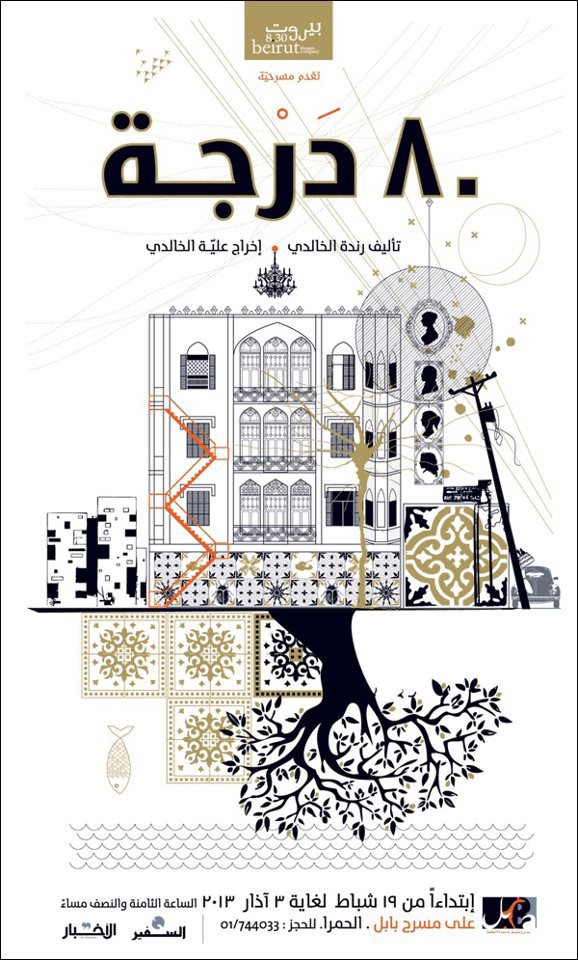
80 Steps is a comic, bizarre slice of life. The three main characters inhabit an apartment 80 steps above street level. They are a retired general, his wife and his elderly sister. They have one daughter and a male housekeeper.
The play revolves around the themes of old age, retirement, tolerance of others, and the acceptance of one’s life and death. The three main characters are eccentric and behave in startling ways. Old Egyptian movies, electric cables, medicines and lots of socks occupy this family’s dreamlike space. The spectator will be dragged into this family’s life and experience their emotional interdependence, which is always steeped in love. The outcome is a black comedy that is absurd and touching at the same time.
Everyone is sure to find something in this magical, amusing and fantastic journey of self-discovery.
Written by : Randa Khalidi
Director : Aliya Khalidi
Actors:
Ahmad: Faek Humaissi
Lamia: Raeda Taha
Fayzeh: Lina Abyad
Mounir: Ali Mneimneh
Laila: Nazha Harb
The performance is at Babel Theatre.
Ticket prices: 20,000L.L. and 30,000L.L.
Performance Nights: February 19th - 24th and February 26th – March 3rdth 2013. (Tuesday – Sunday)
The Performance is in Arabic
All shows start at 8:30 sharp.
Doors will be shut after 8:30
For Reservations, please call Babel theatre at : 00961 (0) 1 744033 after 3pm or
Cellphone: 00961 70058183
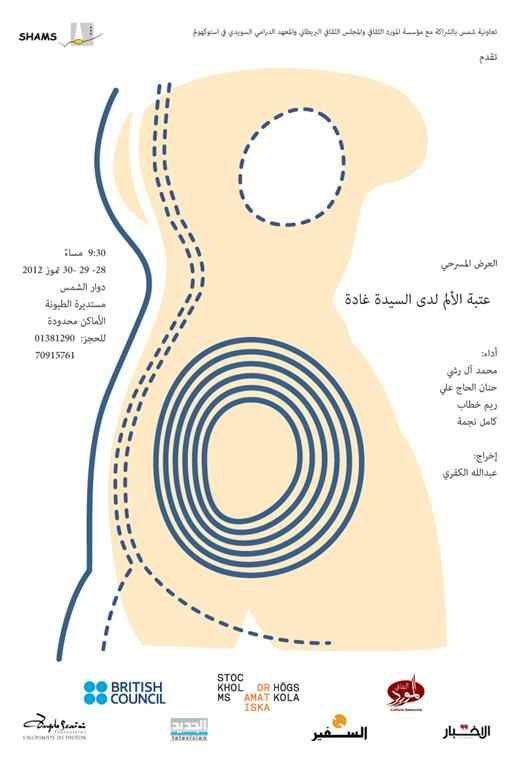
performed by Mohammad Al-Rashi, Hanan Hajj-Ali, Rim Khattab and Kamel Najmeh
28th to 30th July 2012, at 21.30 at the Theater Dawar Al Shams, at the junction Tayouneh.
Tel: 00961 (0) 1-381290
For forty years, Damascus kept on putting frustration in the memory of Ghada, the teenager, the young woman, and the woman. As the days pass by, Ghada feels yet more pain. Her past haunts her present, consumes it each and every moment and turns it into a play! Her toothache leads her to the basement of her building, where the new dental Clinique is. She falls in love with the dentist Anas, a prisoner of his own past. Mrs. Ghada, a woman in her forties, stands on the threshold of love and life. Her past impedes her of, so going on, so she decides to remodel her memory and sweep away the pain that Damascus has accumulated inside her during the years. Will Ghada succeed in her quest? Will she be able to make peace with her past or will her pain-intoxicated memory ignite Damascus’ nights with questions.
This performance is conducted with the support of the Cultural Resource Organization, in partnership with the British Council and the Swedish Institute of Drama at Stockholm (Sweden).
Chryssa Spilioti“My homeland is not a single town,
a single home.
Each
and every country
and every home
is homeland to me”
Comments on the play by the playwright from Greece
The cause for writing “Fire And Water” was twofold: On the one hand, the U.S. invasion of Iraq in 2003 and on the other, the increase of racism all over the West – a West that feels threatened by the steadily increasing numbers of foreigners from different ethnic backgrounds that flood it daily.
The title “Fire and Water” was chosen because these two elements can coexist fine, but if they are made to antagonize, they have the ability to destroy each other, and that is actually the way that the worst case scenarios predict a generalized conflict between East and West could end. We have entered their space and now they enter ours.
The play doesn’t make any attempts of political analysis. I don’t think that it is art’s role to do that. But art is naturally sensitive to whatever feels unfair. So I believe that the fanaticism and the fundamentalism that all Muslims are – indistinguishably – accused of recently, is not absent from the Westerner’s daily frame of mind. We often get as fanatic in matters religious, political or social and become less and less tolerant of anything different.
As Amos Oz says, “a fanatic is whoever wants to impose his/her value system on others.” Even if this “value” is something as simple as a healthy lifestyle, whoever tries to save us, whether we want it or not, through healthy eating, or doing yoga, or quitting smoking, would still be a fanatic, when in his absolute certainty of what is good for us, he is ready to punch our face in, in order to persuade us.
The immigrant, the one who is – by definition – the most different from us, is also the one most vulnerable to our furious attack on anything different. He is the punching bag.
Regarding “Fire and Water,” I would like to clarify that, although the beginnings of the play lie with the immigrant problem and with the conflict between east and west, the play’s primary concern is an entirely different issue. The play doesn’t deal with the differences, but rather with the similarities among people of all latitudes on earth. And not just with the similarities in those characteristics that can be called “positive” or “constructive.” For example the violence that creeps inside all people concerns me.
When this violence needs to be expressed, it usually finds expression through fanaticism of all kinds. What we really want is to devour the other, but we dress up this desire in an ideology, just so we can legalize our desire. This is a way to legalize aggression: the violent imposition of the “correct” religion, of the “correct” way of living.
There is no doubt that civilization manages to slightly “tame” this wild little animal we carry within us. Although my fear is that it might not be possible to entirely tame it (and this is a fear that is also expressed in the play). It is a matter of fact that no civilization competes or rivals with another. All great civilizations have always been the result of the confluence of many different traditions.
It is well known that until the end of the 10th century, an effort unparalleled in the history of civilization took place in Baghdad. This was the effort to translate all texts to Arabic, the result of which was the translation of the entire Greek literature that was available at the time into Arabic. Special attention was paid to the works of Aristotle and his commentators. There are more translations of Aristotle in Arabic than in any European language. Another very interesting point, that is perhaps not so widely known, is that the Arabs were the indirect cause for medieval Europe’s move to the Renaissance. When texts were not available, three hundred Arabic manuscripts of science and translations of ancient Greek literature moved to the west through Spain that was under Arab occupation.
And for all that, Baghdad, the birthplace of civilization once, is for many today a place of barbarians that should be obliterated.
Dunia Michael, an Iraqi writer, describes in her own, poetic way, some snapshots from the 2003 war:
The child woke up and asked the mother.
Mother, what does “enemies” mean?
It is the ghosts that lurk behind the line and turn their guns to the moon.
But the moon is both theirs and ours. Do they only aim our side of the moon?
Yes, sometimes, when they hit it, more than half of it falls off. Then the moon becomes a crescent. And sometimes it disappears all together.
So there are times when they shoot down the other half of the moon? Their own half?
Yes. It is what we call sacrifice. They sacrifice what is theirs, in order to destroy what is ours.
And when are we going to go away?
Where should we go?
Where the moon doesn’t fall.
But let us return to “Fire and Water” and attempt a small summary.
In the play’s storyline, Sahid, an Iraqi living in a European capital with Hayatt, his Iranian mate, imprisons a Westerner who accidentally knocks on his door. He takes him hostage and puts him through the torture of forcibly teaching him Arab history, Arab culture and of explaining to him, who he is.
The Westerner of course suffers through this out of fear and stays with them for seven days and nights, being forced to learn Arab history and poetry. He is forced to learn to speak some Arabic and becomes an expert on their favorite game: chess.
This constant closeness between the two men starts to create a strange friendship between them. A strong coming together of these two souls is the result of the extreme situation and of the ingenuity of the Persian Hayatt, who keeps building bridges of communication between them in every way.
Inadvertently though, she herself becomes the cause for a new clash between them, as the Westerner, who is desperately seeking a way out of his own personal dead ends, falls madly in love with her. When the Arab becomes aware of this, violence erupts.
The bridges between those two – so different from each other – worlds, crumble to dust, never to be built again. Now war seems the only way.
In the play’s last minutes, the Eastern man spreads the world map on the table and invites the Westerner to play a game of chess on it. The whole world and Hayatt is the prize. Hayatt, whose name means life.
Hayatt is dumbfounded from what she perceives as a betrayal by the two men and checkmates them both. She packs her bag, abandons them and goes in search of her freedom.
As far as the Westerner is concerned, he is depicted as just another immigrant in the play. This is the way many of us in the West feel nowadays. We feel immigrants from our own selves, in the words of the play’s main hero. It is the feeling of being a stranger in one’s own country. The Western man is not named in the play. He is only identified as the “Stranger” – a Stranger to himself, a Stranger to others. In the past, we used to say that someone was in the fringes of society – in the underground – but the number of people inhabiting this “underground” is ever increasing. We can of course say that there is some sort of “freedom,” but – more often than not – our freedom is merely a freedom to consume. And not just objects, but also ideas or concepts. It is common knowledge that in the current lack of values, people need to invent their own value system in order to survive.
Hayatt is the only one who still manages to escape the two poles of the conflicts, just like the life she is named after. It is a fact that women are in a better standard in the West than in the East, no question about it. But no matter where a woman lives, there is one thing in common: Even to this day, she manages to survive mostly through indirect means, even when she is professionally a leader, since she still doesn’t get the direct spotlight. Eastern women know this well, since their great-grandmother Scheherazade who managed to save her life for a thousand and one nights from the sultan, by telling him stories and keeping the end from him until the following day.
In closing I would like to mention a phrase by an ancient Greek, Crates of Thebes: “My homeland is not a single town, a single home. Each and every country and every home is homeland to me”. I feel that such a way of thinking can help people into finding the proper proportion for loving with their own place, their personal homeland.