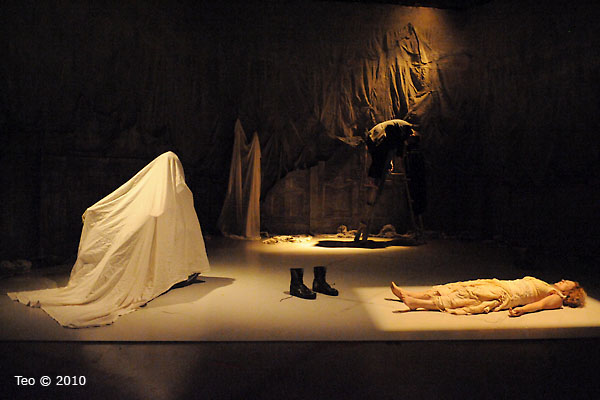
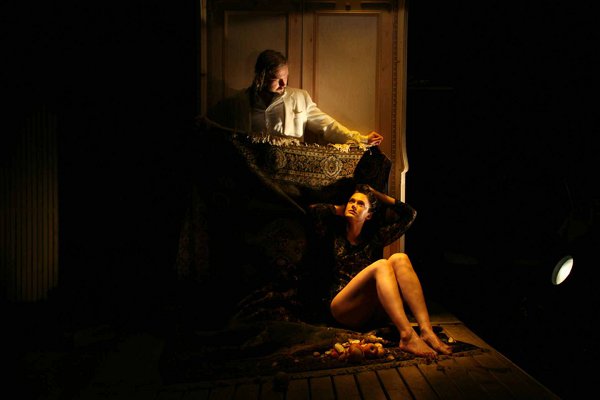
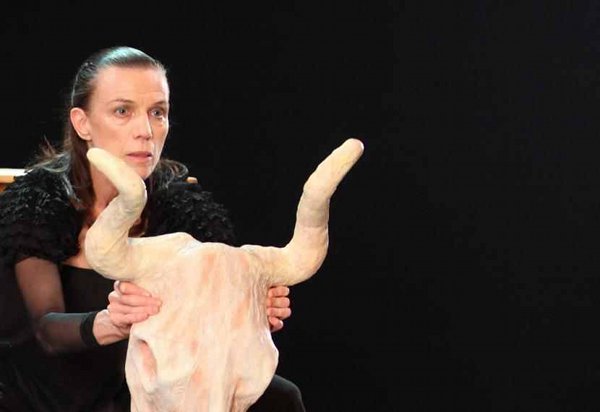
The narrative of the crucifixion is explicitly present in the staging of the play (at least as a possible story). The performance, which consists of a series of individual acts and alludes to undetermined desires via metonymy, reaches as far as the metaphorical image of the pronouncedly Western and Christian story: to the crucifixion, to the acceptance of the father’s will. According to a secular interpretation, following Lacan’s terminology, we can say that the individual finds his own way, his own story, and that he submits himself to his father’s law and the symbolic. By passing through the mirror the individual’s realm of imagination, his symbiotic relationship with his mother in the pre-verbal stage of life transforms into a symbolic relationship in which he connects with language and with his father’s law.
Before this crucifixion, the man’s life was a pre-verbal experience. He needed no words because he lived in symbiosis with his mother. Leaving behind the world of imagination, he enters the world of symbols, the world of his father’s law, the world of his father’s name and gender (non/nom) where the child is no longer alone with his mother, but has to share the world with others, with the needs, desires and fears of others. Governed by his unconscious desire, from now on the subject will be looking for the lost object of desire, for the missing one, for the mother whom he knew in his pre-verbal life.
If we suppose that the story of identification through the mirror-phase corresponds, even if partially, to this process of staging, we need to examine further how the story is embodied in the actors’ and on the stage.
Patrice Pavis
With: Enikő Györgyjakab, Csilla Albert, Ferenc Sinkó, Kristóf Dimény
directed by Gábor Tompa
choreography Yolande Snaith
music composed by Shahrokh Yadegari
set design Ian Wallace
costume design Jaymee Ngerwichit
director's assistant Levente Borsos
stage manager Levente Borsos
Date of opening: 19 September 2012
Duration: 1 hour
Other performance dates:
November 	5 	Monday 	20:00
November 	25 	Sunday 	20:00
Ticket reservation:
tel: +40-264-593468, between 10-13.00 and 16.30-19.00 and before the performances


Address: Str. E. Isac nr. 26-28, 400023 Cluj-Napoca, Romania
With
Ari Fliakos, Koosil-ja, Alessandro Magania, Greg Mehrten,
Daniel Pettrow, Scott Shepherd, Casey Spooner, Kate Valk.
The Festival is proud to welcome The Wooster Group, one of the most innovative theatre companies in the world, for its first time in Dublin. Led by visionary director Elizabeth LeCompte, The Wooster Group and its associates have constantly reimagined classic and devised texts through its groundbreaking work.
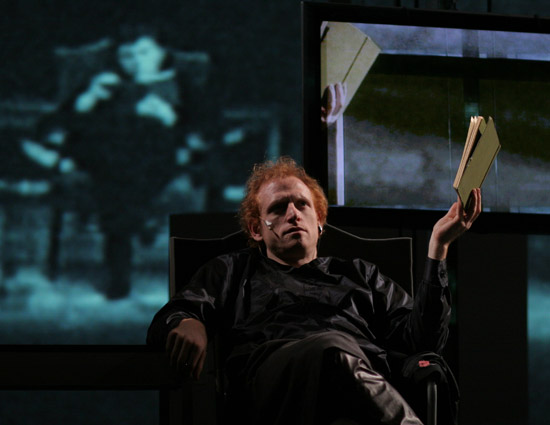
The Group’s HAMLET repurposes the film version of Richard Burton’s legendary 1964 Broadway version of Hamlet —a production that was screened in cinemas across America. In a rapturous and often hypnotic production, they reverse the process, reconstructing the show from the fragmentary evidence of the edited film, and channelling the ghosts of the 1964 performance. With songs by Casey Spooner (Fischerspooner) and performances by long-time Wooster members Ari Fliakos, Scott Shepherd and Kate Valk, prepare to be enthralled as this iconic tragedy is transformed.
HAMLET IS A CO-PRODUCTION OF THE WOOSTER GROUP AND
THE 30 FESTIVAL OF BARCELONA GREC-INSTITUTE DE CULTURA, AJUNTAMENT OF BARCELONA.
"American theater's most inspired company"
The New York Times
GalataPerform is active since 2003, in a second floor apartment, in the historical district of Galata. It has been the production space and main stage of Ve Diğer Şeyler Theatre Company (VEDST), founded by the playwright and theatre director Yeşim Özsoy Gülan, and has been open to artists and audiences of different disciplines. Recently its main axe is concentrated on providing a space for new writing in contemporary theater and performance while keeping its concentration on providing an independent alternative space. Various projects include Performance Art Days, Exchange Projects, Visibility Projects and New Text New Theatre Projects.
Since 2005, Visibility Project has been creating a special dynamism in the district of Galata; a special place for artists, visitors and belief systems. The project pushes the artists into the streets, out of their work spaces to interact with the public. The concept of visibility is operating between the artists and the people and also in between the different disciplines of the art itself, bringing great emphasis on the independent expression in theatre and also dynamism to the region while making the region and its agents visible to the general public.
This year Visibility Project 8 will take place on November 3rd. The Project involves a workshop period with end results being exhibited in just one single day; November 3rd 2012. The project aims to present 12 different stories in relation to Galata district’s current cultural situtation bringing together works of performance executed in public sphere.
We would like to invite for Visibility Project 2012 three artists specifically working in public sphere with the community in the fields of performance and sound art from Romania, Poland and Egypt between October 25th and November 4th to create orks for the Project.
The works can be adapted to Istanbul and the project but preferably we request the artists to create work specific to the project. The project aims to open a discussion through panels, workshops and presentations to aspects of community art.
Artists interested could send to the e-mail below a short biography with samples of their works.
GalataPerform will cover travel and accomodation fees (plane ticket – hotel – per diem).
  22.9.2012 at 8.30 pm
 Mini Theatre
  Ljubljana, Slovenia


Directors: Dritero Kasapi & Dino Mustafic

Socrate: Bajrush Mjaku

Plato: Besfort Idrizi

Cameraman: Ibrahim Xhemaili

Set design: Krste S. Dzidrov

Costumes: Bllagoja Micevski

Music: Samir Durguti

Camera: Fejmi Daut

Editing: Betim Zeqiri

Production: Theatre of an actor – Skopje & Intercult – Stockholm
Children's Theater Center - Skopje
Theatre contact: tel +38923290111, email info@ctc.org.mk
Str. Evlija Celebija nr. 1, Old Bazaar, Skopje, F.Y.R.O.M
Why Socrates as a theatre?
The apology of Socrates is Plato’s masterpiece and one of the most valuable apology of a critical views, moral responsibility of citizens to society and freedom of mind.
Socrates was the first scholar for whom we know that was sentenced to death for « corupting the youth, misbelief and sabotaging of the government. » In this way Socrates was the first known dissident of the western European history.
This brilliant speech that Socrates held before being sentenced to death is his attempt to defend himself against the charge and explained that he had no evil intentions but just looking for the truth. Those who are afraid of the truth are those who have sued him. But who are they?
The reality of the young Athenian democracy that suffers from corruption, nepotism, race of fast profit of money in which appears the new wealthy elite who effectively manipulate the fragile Athens’ democracy is very similar to the reality today.
The difference is that Athens had Socrates and his followers as Plato, Xenophon etc.. who stood for an intellectual alternative to the social and moral depravity. While other philosophers wrote treatises and speeches, Socrates was chating with citizens in the Agora – a public space where people of all backgrounds meet with eachother.
Today the public space is fragmented and usurped by politics, media corruption and narrow ethnic, partisan and personal interests of the « new elite ».
The space for real intellectual critique of modern life – Agora today hardly exists. The only hope is that theater as the Agora is a space in which citizens of all backgrounds can meet and where rules the dialogue, the spoken word – Socrate’s favorite form of communication for the search for truth, justice and moral responsibility.
Dritero Kasapi


SOCRATES DEFENSE OF FREEDOM
Freedom is, in general, the starting point for everything we do in life, it is not given to us not even established forever, every day we need to keep an eye on, to review and keep it in ourselves and the in the government that we choose.
We must never claim that we live in a flawless democracy that was established forever and has no end. Freedom without democracy is not possible. Therefore the need to nurture it and to react immediately when it is threatened. About this warns us the experience 20th century through the scenes of the holocaust, concentration camps and wars, exile and the liquidation of those who thought differently against majority. Pluralism of opinions is a fundamental prerequisite of human freedom, because if there isn’t, then dominate the apparent imbalance, ideological terrorism, racism or nationalism. Intellectuals have developed a sense to feel aove all the spiritual discomfort when freedom disappears, when appears radicalism and totalitarianism as a historicall refrain of the horror of authoritarian countries. The true thought has always resisted such regimes, the only space of freedom that gives thoughts and feelings by which we discover and listen to the world around us.
Dino Mustafic


I dedicate the performance « Socrates’ defense » to the great Albanian intellectual, Ukshin Hoti, whom even the powerful arm of the destructive forces (Miloshevich’s) could not silence his righteous mission to fight for human rights and freedoms …
Similarities between Socrates and Ukshini Hoti are visible not just in their defense before the court and their tragic end, but their understanding of the free world and the vision for the future of humanity makes these men alike.
I’m saying that dedicating this performance to Ukshini Hoti, actually I dedicate this performance to all that generation of schollars who sacrificed their lives fighting against injustice and wickedly in the country, says Socrates.
Bajrush Mjaku
ABOUT THE PRODUCTION
« Theatre of an actor » – Skopje, with its activities has started since 2001, and has so far produced four performances: « Diary of a madman » by Gogol, directed by Ivan Popovski (2001), « The father » by Strinberg, directed by Slobodan Unkovski (2003), « Zoo Story » by Edward Olby, directed by Bajrush Mjaku (2005), « Uncle Vanya » by Chekhov, directed by Slobodan Unkovskit (2006) as well as a TV movie 60 min. « Father’s Books » by Luan Starova, directed by Rusomir Bogdanovski.
With performances « Diary of a madman » by Gogol and « The father » by Sryndberg, « Theater of an actor » has been introduced successfully in many theater festival as:
- Fair of chamber theatre in Krakow, Poland in 2001
- Festival of Experimental Theatre in Cairo, Egypt 2003
- Budva City – Theatre, Budva, Montenegro 2003
- Exponto 2003 International Festival in Ljubljana, Slovenia
- Festival of monodrama and pantomime 2003 in Pristina, Kosovo
- Festival of European Actor 2004 – Prespa FYROM
- Festival of the actor in Fier, R. Albania
- Festival of classical Butrint 2004, in Butrint, Albania
- Kosova in Fest 2004 in Pristina, Kosovo
- Winter of Sarajevo, Sarajevo 2005, BH
- 4 presentations of the show "Diary of a madman" in the theater "P. Fomenko" in Moscow, Russia 2004
- Week of Albanian Culture in Paris 2004, 2005
- Days of FYROM culture in the Russian Federation, Moscow and St. Petersburg in 2005, etc.
- International Theatre Festival Istanbul – Space – Stage, in Istanbul, Turkye 2005
Awards:
– In the Festival of Monodrama and Pantomime in Pristina in December of 2003, Ivan Popovski was declared the best director for directing the « Diary of a madman », and Bajrush Mjaku was declared the best actor of the festival for the interpretation of the role of Poprishchin;
– In the Festival of the Panalbanian Actor in Fier, Albania 2003, Bajrush Mjaku was declared the best actor of the festival;
– In the Festival of European Actor 2004 in Prespa, Bajrush Mjaku proclaimed « Actor of Europe 2004 »;
– The International Festival of Mono-spectacles in Kiev, Ukraine, Bajrush Mjaku was awarded with The Grand Prix
– In the 39th edition of the Festival of the Professional Theatres in FYROM “Vojdan Chernodrinski” – Prilep, in 2004 the performance “The father” – Strindberg, won those prices: best performance, best director (Slobodan Unkovski), best actor and actress (Bajrsuh Mjaku and Arta Mucaj) and best set design (Blagoja Micevski).
Actors:
Anders Larsson, Krista Kosonen / Linda Zilliacus,
Alma Pöysti, Janina Berman, Jussi Johnsson / Dan Henriksson,
Jan Korander and Anders Slotte
Director's assistant: Jesper Karlsson
Stage technician: Niklas von Weissenberg
Sound technician: Ludvig Allén
Translators: Sofia "Fia" Molin & Katja Bashlovka
The performance will include surtitles as an integrated part of the set design.
General production assistant: Kathya Zholdak Producer: Robin Sundberg
PR & Tour Manager: Christoffer Allén Theatre Manager: Dan Henriksson
Audience education & sales: Paulina Nickström
After Anna Karenina, Director Andriy Zoldak has taken Chekhov’s love-thirsty characters who are mourning their wasted lives in his powerful grasp. The outcome is a magnificent, uncompromising Uncle Vanya.
“Zholdak’s theatre is first and foremost theatre of grand images and emotions. He is a master of constructing multi-layered stage imagery. He is constantly striving to create the most accurate illusions of reality while at the same time drilling deep into the many layers of the surreal and the subconscious.” (Irmeli Haapanen, Turun Sanomat)
The emotional power of the play is superbly channelled to the audience by the actors. Among others, Krista Kosonen and Alma Pöysti’s work is breathtakingly skilled. Their characters’ all-embracing love struggles to reach out to the unreachable; they yearn, they lust, they rage with passion.
*
Uncle Vanya (Morbror Vanja) directed by celebrated and controversial director Andriy Zholdak, was hailed as a world class performance by both press and public after its premiere in November 2011. The dramatic art of Zholdak is marked by repetition and expressions blown up on all levels: in performing, in music as well as in pictures. His theatre resembles a richly orchestrated symphony in molto furioso. It is great theatre. Uncle is one of Anton Chekov’s most beloved plays, a moving tale of passion and of love, and of that gnawing feeling that life is passing you by. Through the eyes of Zholdak we are confronted with the misfortune, the passion and the humor of Chekov in the most unexpected ways Uncle Vanya (Morbror Vanja) directed by celebrated and controversial director Andriy Zholdak, was hailed as a world class performance by both press and public after its premiere in November 2011. The dramatic art of Zholdak is marked by repetition and expressions blown up on all levels: in performing, in music as well as in pictures. His theatre resembles a richly orchestrated symphony in molto furioso. It is great theatre. Uncle is one of Anton Chekov’s most beloved plays, a moving tale of passion and of love, and of that gnawing feeling that life is passing you by. Through the eyes of Zholdak we are confronted with the misfortune, the passion and the humor of Chekov in the most unexpected ways.
*
Andriy Zholdak’s theatre is volatile and precise in its scrutiny. His marks are the repetitions and the expressions blown up on all levels: in performing, in music as well as in pictures. The passion and extreme emotion rips through the pictures; the audience is drawn into a storm of associations. No one exits the theatre untouched – neither they who leave halfway through, nor they who stay to give standing ovations for his dedicated actors. The theatre of Zholdak resembles a richly orchestrated symphony in molto furioso. It is great theatre.
In Uncle Vanya you’ll see performances of some of the hottest names in Finnish theater. Linda Zilliacus and Krista Kosonen alternate in the role of coveted Jelena. Alma Pöysti plays the part of young Sonja and the role of the charming but miserable doctor Astrov is played by Jan Korander. Anders Larsson plays professor Serebrjakov, Janina Berman the widow Maria Vasiljevna, Anders Slotte « Wafer » Telegin and the role of Uncle Vanya is played by Jussi Johnsson.
*
“The potent atmosphere of the impressive imagery follows you into your dreams”.
- Suna Vuori/HS
“A theatre experience that will stay with you for the rest of your life”.
- Egil Green/Bbl
“Now this world class performance is presented at Klockriketeatern.
A rare, unique opportunity that should not be passed up”.
- Maria Säkö/Skenet.fi
”I have now also witnessed it in Swedish speaking Finland. A complete attitude on stage”.
- Tomas Jansson/YLE
“While Chekov brings the human being down to earth, Zholdak will show us her grandeur”.
- Isabella Rothberg/Hbl
*
« My performances are not startling. My performances are just dream splinters. Sometimes these dreams are realistic, sometimes – surrealistic. Sometimes they are understandable, sometimes – tangled. Sometimes they are verbal. They may have a plot. They may shock. Sometimes they are human, sometimes – brutish. »
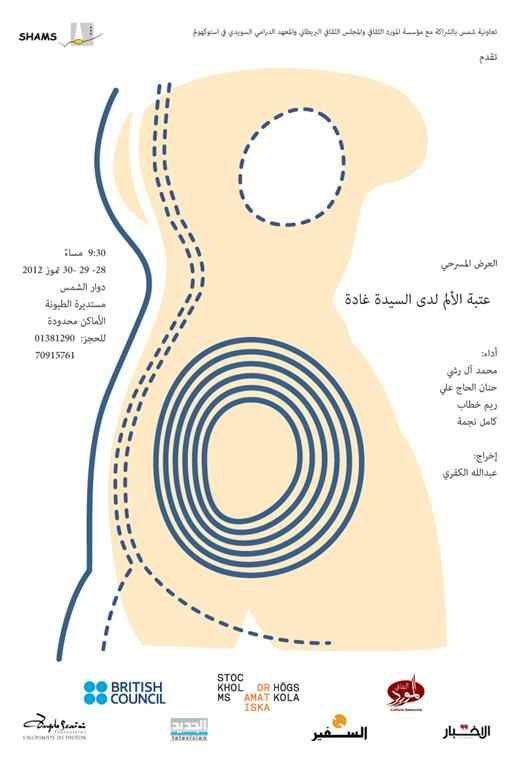
performed by Mohammad Al-Rashi, Hanan Hajj-Ali, Rim Khattab and Kamel Najmeh
28th to 30th July 2012, at 21.30 at the Theater Dawar Al Shams, at the junction Tayouneh.
Tel: 00961 (0) 1-381290
For forty years, Damascus kept on putting frustration in the memory of Ghada, the teenager, the young woman, and the woman. As the days pass by, Ghada feels yet more pain. Her past haunts her present, consumes it each and every moment and turns it into a play! Her toothache leads her to the basement of her building, where the new dental Clinique is. She falls in love with the dentist Anas, a prisoner of his own past. Mrs. Ghada, a woman in her forties, stands on the threshold of love and life. Her past impedes her of, so going on, so she decides to remodel her memory and sweep away the pain that Damascus has accumulated inside her during the years. Will Ghada succeed in her quest? Will she be able to make peace with her past or will her pain-intoxicated memory ignite Damascus’ nights with questions.
This performance is conducted with the support of the Cultural Resource Organization, in partnership with the British Council and the Swedish Institute of Drama at Stockholm (Sweden).
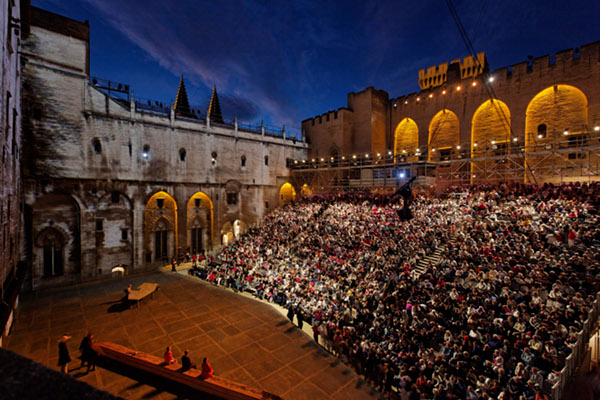
How can a masterpiece be recognized? Unquestionably by the fact that it is played and replayed, year after year, because it always arouses the curiosity of the artists that seize on it and that of the spectators who come to hear it again, its questions still appearing topical. The Seagull remains in history; it is still active and undoubtedly necessary and unique. It is obviously so for Arthur Nauzyciel, who wanted to have it performed in the Cour d’honneur of the Popes’ Palace, a venue that has become an emblem of the artistic practice of the theatre, but also the historic venue of a bi-millennial spiritual adventure. This play that speaks – using the director’s words – about “art, love and the meaning of our existences”, written at the end of that 21th century that was dying without clearly imagining what the 20th century, nonetheless so near, would be, is also haunted by memories, melancholy, ruins and hope. Faith in art, the expectation of reciprocal love: these feelings would not resist the reality of a world in which death stalks, the one of seagulls abandoned at the edge of lakes and of idealistic artists who, like Tréplev attempting to dream of another theatre, are brutally rejected. What might be nothing but a melodrama built around a sarabande of impossible loves – since no one loves the person who loves him or her –, becomes a funereal and metaphysical ball, a genuine parable on man’s condition. Arthur Nauzyciel once again wished to “talk about resuscitating the dead”, persuaded that the author Anton Chekhov “consoled souls” like the doctor Chekhov saved suffering bodies. By going through The Seagull again, he will cross ghosts in it, those of the Russian writer, but also Hamlet and the heroes of the Oresteia, who witness the link with the past to build theatre that is done in the present, a theatre of urgent necessity. JFP
“I am writing it, not without pleasure, even if I am going against all the laws of the theatre”: this was how Anton Chekhov (1860-1904) described in 1895 to his friend Suvorin the play he was writing. The Seagull was the first of the great plays of Russian dramaturgy and sealed the beginning of his collaboration with Stanislavski and Nemirovich-Danchenko. After the fiasco at its premiere in Saint Petersburg, the play was enormously successful, especially when they staged it at the Moscow Art Theatre in 1899. Next came Uncle Vanya, The Three Sisters and The Cherry Orchard, which put the finishing touches on the aura of this doctor by training, who probed as no one else, the tragic aspect of our existences. Anton Chekhov is one of the most often staged playwrights in the world today.
Distribution
direction Arthur Nauzyciel
translation André Markowicz, Françoise Morvan
scenography Riccardo Hernandez
lighting Scott Zielinski
choreography Damien Jalet
music Winter Family, Matt Elliott
sound Xavier Jacquot
costumes José Lévy
masks Erhard Stiefel
with Marie-Sophie Ferdane of the Comédie-Française, Xavier Gallais, Vincent Garanger, Benoit Giros, Adèle Haenel, Mounir Margoum, Laurent Poitrenaux, Dominique Reymond, Emmanuel Salinger, Catherine Vuillez
and the musicians Matt Elliott together with Ruth Rosenthal and Xavier Klaine (Winter Family)
Production Centre dramatique national Orléans/Loiret/Centre
coproduction Festival d’Avignon, Région Centre, Theater of Lorient, National Drama Center of Brittany, Theater of Saint-Quentin-en-Yvelines National Stage, Maison des Arts de Créteil, Le Parvis National Stage Tarbes Pyrénées, Le Préau regional arts centre for theatre of Basse-Normandie Vire, Le phénix National stage of Valenciennes, the National Theater of Norway, Maison de la Culture of Bourges National stage and France Télévisions
with the support of the Institut français and of the Town of Orléans
Through its support, the Adami helps the Festival d’Avignon to get involved in coproductions.
Cour d'honneur of the Popes Palace
Creation 2012
Duration : estimated running time 3h30 including intermissions
The show will be broadcast live on France 2 on 24 July
Arthur Nauzyciel
It was his encounter with Antoine Vitez, at the École du Théâtre National de Chaillot, that resolutely brought Arthur Nauzyciel into the world of theatre, whereas his University education would have naturally led him to the plastic arts and cinema. He became an actor, then an associate artist at the CDDB -Théâtre de Lorient, where he founded his own company, Compagnie 41751/Arthur Nauzyciel. Right from his first show, The Imaginary Invalidor the Silence of Molière, he has been offering his strong and unquestionably disturbing vision of classic works that we all know today. This shifting of texts to territories where they are not expected, marks the entire body of Arthur Nauzyciel’s work, who decides to anchor his theatre in other realms prohibiting the simple reproduction of style or technique. He regularly works in the United States, where he successively premiered, in Atlanta, Black Battles with Dogs and Roberto Zucco, giving these two works by Koltès translated into English new strength, dangerousness and violence. Then, he presented in Boston Julius Caesar by Shakespeare, immersed into the Kennedy years. In Dublin, he presented The Image by Beckett, showed Heroes’ Square by Bernhard at the Comédie Française, before tackling the writing of Kaj Munk (Ordet), by Marie Darrieussecq, when he staged her first play, The Sea Museum, at the National Theatre of Iceland. Later, he presented Jan Karski (My Name is a Lie), by Yannick Haenel. In 2011, in Rouen, he staged Red Waters, the first opera composed by the Lady & Bird duo (Keren Ann Zeidel and Bardi Johannsson). He was invited to create in 2012, Abigail’s Party by Mike Leigh at the National Theatre of Oslo. Director of the Centre Dramatique National in Orléans since 2007, Arthur Nauzyciel continues to work for a theatre that speaks about today, without ever forgetting the shadows of the past. Apart from participating several times at the Festival as an actor, he presented his work at the Festival d’Avignon, with Black Battles with Dogs in 2006, Ordet in 2008 and Jan Karski (My Name is a Lie) in 2011.
When my brother, sister, and I were young, my father bought a video camera. He taped us all as we grew up. A few years ago, he gathered all the tapes into a single collection. It is both good and bad that he did this. Good because it is a wonderful family record. But bad because these tapes can be very embarrassing. You watch them and you think, “God, did I really wear THAT striped shirt with THOSE yellow shorts? I NEVER cut my hair that way!” Yet you cannot deny these unfortunate things–you’re seeing them right there on the TV, after all. So the real question becomes, “What do these things mean?” Then, and now. A striped shirt, yellow shorts, and a haircut that looks like a dead animal: a dollar for any man who can connect those dots.
This is a gathering of a man’s family, and his stuff, and the people he knows. Welcome to the party.
Tom Dugdale
Willy Loman: András Hatházi
Linda: Emőke Kató
Biff: Ferenc Sinkó
Happy: Balázs Bodolai
Bernard: András Buzási
The woman: Csilla Albert
Charley: Attila Orbán
Ben: Loránd Váta
Howard:	Gábor Viola
Stanley: Alpár Fogarasi
Miss Forsythe: Tünde Skovrán
directed by	Tom Dugdale
dramaturg	Eszter Biró
scenic and video design	Ian Wallace
costume design	Eszter György
stage manager	Imola Kerezsy
Studio performance
Date of opening: 10 May 2011
Duration: 2 hours without intermission
Prohibited under the age of 15!