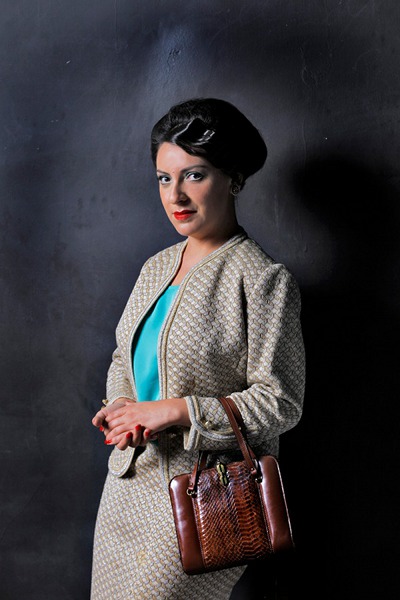
«STAIN» by Ahmet Sami Özbudak, directed by Yeşim Özsoy Gülan

İZ / STAIN

teaser here

Stories, three different times, a house and 7 characters who have been guests of this house come together in this play written by Ahmet Sami Özbudak, a young Turkish playwright which came out of the workshops of New Text New Theater Project and who got « Best Young Playwright Prize » at Heidelberg Stückemarkt in 2011.

Markiz and Eleni, two Greek/Turkish sisters residing in Istanbul, who had to leave their house during the riots of September 6-7th in 1955, a revolutionist communist, Ahmet, who had to take refuge and hide in the same house as the tenant of a migrant from the Blacksea region of Turkey, Turgut Usta in 1980 and a transvestite, Sevengül and his lover Rizgar who live in the same house in the 2000s. All of these characters exist in the play in the same house all together. They all tell their stories and also talk about the stories that preside them. The house is a place of memory and identity where the traces of each era can be seen and experienced.

For the project GalataPerform’s space, including the foyer, the backstage and the entrance of the performance area was transformed in order to broadcast live the unseen parts of the house to the audience. In the end the audience experience what is on stage; which is the dining room and the kitchen of the house and what is backstage which is the entrance, the bedroom, the livingroom and other parts of the house. In this way the play demands a new way of experiencing theater combining and blending techniques of theatre and cinema all together.

Written by: Ahmet Sami Özbudak
Directed by: Yeşim Özsoy Gülan
Cinematographic Dramaturgy: Ceren Ercan
Performers: Okan Urun, Burak Safa Çalış, Batur Belirdi, Bertan Dirikolu, Yeşim Özsoy Gülan,
Ceren Demirel, Koray Kadirağa
Stage Design: Başak Özdoğan
Music Design: Özüm Özgülgen
Costume Design: Tülin Kermen
Cinematography: Ferhat Öçmen
Technical Director: Ömer Özkan
Technics: Halil Özok
Stage Manager: Mustafa Dileklen
Assistants: İrem Aydın, Merve Kalgıdım, Onur Çöçelli, Hazal Erulusoy
Administrative Director: Nilüfer Dönmez
Communications Coordinator: Ezgi Düzenli
Photography: Hande Göksan

Dates

MARCH 21, 22, 23, 28, 29, 30

APRIL 4, 6, 11, 13, 18, 20, 25, 27

MAY 2, 4, 9, 11, 16, 18

Time: 8.30PM

GalataPerform
Address: Büyük Hendek Cad. No:21/1 Galata Kuledibi Beyoğlu / İstanbul
Contact us:
Tel./ Phone: +90.212.243.99.91, +90.530.260.25.24
Email: info@galataperform.com

VEDST & GalataPerform

Here you can "Like" and join Theatre Cultures facebook page
For receiving Theatre Cultures suggestions you can subscribe
to Theatre Cultures' newsletter on Home Page with your email,
then activate your subscription: click on the link that you
will receive in your email

Six invitations for "IZ/STAIN" by Theatre Cultures. Win one of the invitations by sending an email 
at contact@theatre-cultures.com (for the Theatre Cultures newsletter and facebook subscribers)
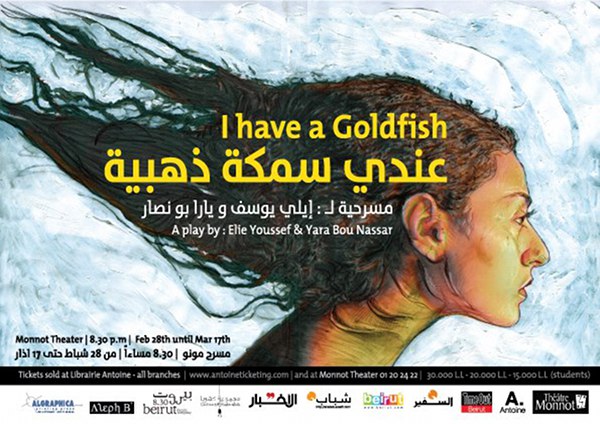
I have a goldfish

I HAVE A GOLDFISH

video

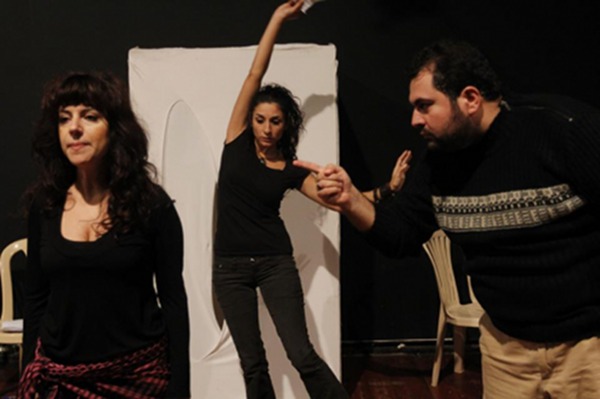
Written, directed and performed by Elie Youssef and Yara Bou Nassar

Monnot Theatre, in Beirut

Thursday, Friday, Saturday, Sunday
28.02 - 17.03.2013 at 8.30pm

A man, a woman, a memory.

They reunite years after their first encounter. They share their stories of immigration and their quest to find a sense of belonging that could hopefully help determine their identity.

Her: I have found you… you are my home!

Him: …

To what extent can the human mind filter and remodel memories, thus creating another “reality” to escape to, after continuous failure in integrating his individual identity in a collective one?

Music: Khaled Yassine
Set design and lighting: Tarek Mourad
Costume design: Michella Bteich
With the assistance of Collectif Kahraba and Beirut 8.30
Tickets 
available in all branches of Librairie Antoine and in Monnot Theatre
www.antoineticketing.com
Ticket Prices: 30 000 LBP | 20 000 LBP | 15 000 LBP (for students)
The play is in Arabic with English subtitles
For inquiries and reservations: 00961 (0) 1-202422 (starting 3.00pm)

THE ARTISTS

Elie Youssef

An actor/writer, Elie youssef is a graduate of the Lebanese University- institute of fine arts. As a professional actor he took part in several theater productions such as “The Emigrant of Brisban” directed by Nabil Al ozon within the activities of Baalbeck International Festival, “Jebran and The Prophet”, “The Return Of The Phoenix” and “Saif 840” by Mansour Rahbani within the activities of Byblos International Festival, “Hamam Omoumi” by Aida Sabra, “Come Back To Bed, Love” directed by Lina Abyad.

He wrote and directed for theater “Alpha B”, “Shesh Besh” and “Adam In An Unfruitful Paradise” (original script by Raymond Gebara). For TV, he wrote the sitcom entitled “The Adventures of Jad and Nour” and took part as an actor in several mini-series.

Yara Bou Nassar

Graduate of the Lebanese university of fine arts, Yara is a Lebanese actress and professional clown doctor. She was part of different acting, improvisation, dance and mime workshops. In 2006, she attended a summer workshop in Escuela de Mimo in Barcelona and in 2010 she attended a long summer workshop in « The Lee Strasberg Institute » in New York. She has been actively working in theater since 2005 and participated in major roles in plays such as « 7emmem 3oumoume » by Aida Sabra, « Al Zeer Salem wa dr. Faust » by Shakeeb Khoury, « Mechy Online » by Khouloud Nasser »,  » Shesh Besh” by Elie Youssef, Fouad Yammine and Marilyse Aad, « Le Premier Jour » by Wissam Arbache… In 2011, she co-directed and performed (along with Elie Youssef) « Adam Fi Janna Bila Thamar », a text by Raymond Gebara.

She was also an actress in different short films: « Mercredi » by Talal Khoury and « Beit Byout » by Joseph Khallouf and TV series: « Shahroura », « Zaman al Shawk » and « 3ajez Nafse ». Since 2009, she has been doing an ongoing training as a clown doctor with Rodrigo Morganti (IT). Yara has been teaching dramatic arts since 2009.


Click here to "Like" and join Theatre Cultures facebook page
For receiving Theatre Cultures suggestions you can subscribe
to Theatre Cultures' newsletter on Home Page with your email,
then activate your subscription: click on the link that you will 
receive in your email


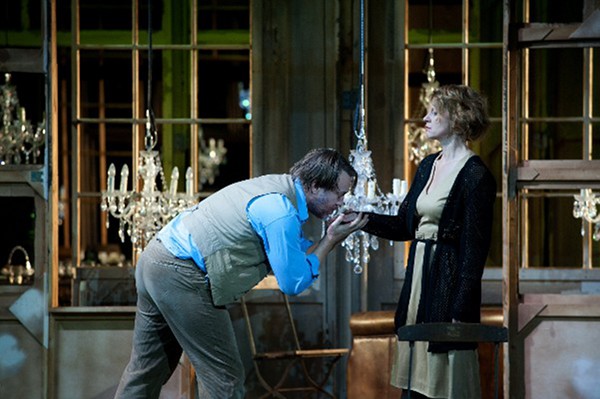
UNCLE VANYA at Vienna’s Akademietheater

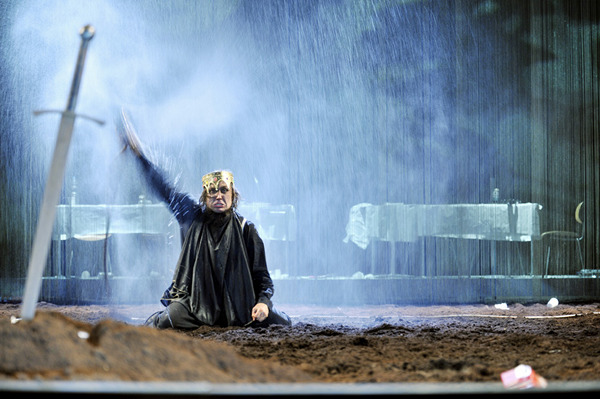
Photo © Reinhard Werner. Nicholas Ofczarek (Uncle Vanya), Caroline Peters (Helena Andreyevna)

UNCLE VANYA  by Anton Chekhov

directed by Matthias Hartmann

Stage design: Stéphane Laimé
Costumes: Tina Kloempken
Light: Peter Bandl
Dramaturgie: Andreas Erdmann, Ursula Voss
Cast
Aleksandr Vladimirovich Serebryakov, professor in retirement: Gert Voss
Helena Andreyevna, his young wife: Caroline Peters
Sofia Aleksandrovna, his daughter from the first marriage: Sarah Viktoria Frick
Maria Vasilyevna Voynitskaya, mother of the professor's first wife: Barbara Petritsch
Ivan Petrovitch Voynitsky, her son ("Uncle Vanya"): Nicholas Ofczarek
Mikhail Lvovich Astrov, doctor: Michael Mertens
Ilya Ilych Telegin, former landowner: Branko Samarovski
Marina Timofeevna, an old nanny: Elisabeth Orth

25 years ago Iwan Petrowitsch Wojnizkij gave up his part of the parental inheritance in favor of his sister Vera. In order to dismortgage his sister’s estate, he administers it for 25 years, somewhere in the Russian province. In the meantime, the beloved sister dies and her daughter comes into the inheritance of the estate. However, the true beneficiary of Wojnizkijs’ work is her father, professor Serebrjakow, at his time a very good looking man of science. His remarriage to another woman who is thirty years younger (a woman which is also to the liking of Uncle Vanya) is a real eye-opener to Vanya: The professor is an impostor and a cheater. Wojnizkijs’ best friend is another disappointed idealist: Doctor Astrow arrived sometime ago in the province in order to improve people’s life and protect the forests – not an easy task. At least he is successful with women.

Duration of the performance: 165 minutes

Dates

14.03.2013, 19:30
22.03.2013, 19:30
24.03.2013, 19:00
26.03.2013, 19:30

11.04.2013, 19:30
16.04.2013, 19:30
18.04.2013, 19:30

Location: Akademietheater, Lisztstraße 1, 1030 Viena

Ticket Sale

Online ticket sale HERE or www.culturall.com

Telephone ticket sale with credit card: +43 1 513 1 513 (all credit cards accepted)

Ticket Offices:
Bundestheater ticket office
Phone: +43 (0)1 51444-7880
Operngasse 2, 1010 Vienna
Burgtheater ticket office
Phone: +43 (0)1 51444-4440
Universitätsring 2, 1010 Vienna
Volksoper Wien ticket office
Phone: +43 (0)1 51444-3318
Währinger Straße 78, 1090 Vienna

Last Minute and Reduced Ticket

One hour prior to the performance all remaining tickets can be bought 25% off the full price (as marked on the online-schedule or at the box office, except matinees and special events).

Reduced tickets for 8€ are available at the ticket offices for students, apprentices and unemployed (necessary identity card).

web BURGTHEATER Viena

Click here to "Like" and join Theatre Cultures facebook page
For receiving Theatre Cultures suggestions you can subscribe
to Theatre Cultures' newsletter on Home Page  with your email,
then activate your subscription: click on the link that you will 
receive in your email

«Evaristo» with Ayşenil Şamlıoğlu, in Kumbaracı50…

Ayşenil Şamlıoğlu in "Evaristo"

“6 Üstü Oyun” No: 2, Continues through March!

March 18-19-20-21-22 at 20:30
March 25th at 20:30 Oyun Atölyesi

The second play of “6 Üstü Oyun” Project of Altidan Sonra Production’ “Evaristo” is written by playwright Civan Canova. The play made a premiere on January 28th and is directed by Nihal Koldaş.

Ayşenil Şamlıoğlu is on stage for « Evaristo ».

The play’s lighting design is by İsmail Sağır, stage and costume design by Başak Özdoğan, the photos of the play belong to James Hughes.

Comments of director Nihal Koldaş on the play:

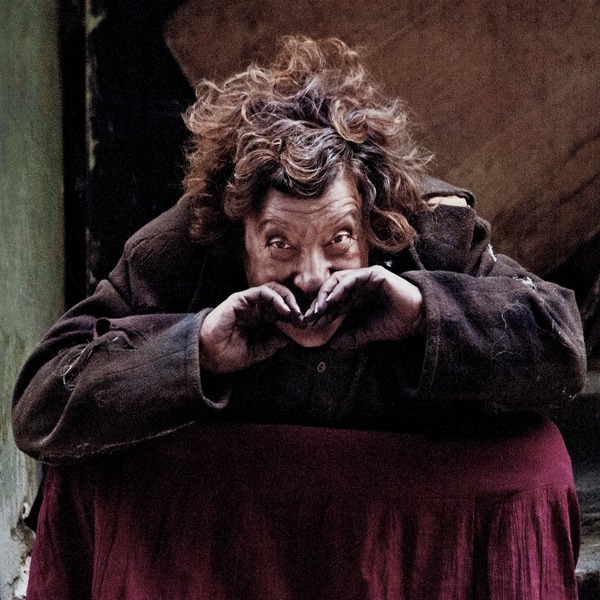
“Evaristo« , is a play that attempts to speak about today, but sets its eyes on the past, present and even the future. The play greets the audience in a damp and dirty bunker and sways the expectance of the audience from one side to another. Evaristo, as defined by its playwright, is about the struggle of an ageless woman to hold on to life. It is an ambition to live… a story that lasts for decades. On the other hand, it is an observation on the recent social history of the world, gazing from an underground, dark bunker. It is both dark and brutal, but also crazy and fun at the same time. The playwright gives the audience an enormous freedom to position him/herself into the play.

Comments of playwright Civan Canova on the play

I wrote « Evaristo » with great joy. Writing some plays turns into a burden as the writing process lingers on. You strive to finish. But that was not the case this time. It was written “in a trice”, even though I was really busy with so many other things. If it were not for my dear friend Yiğit Sertdemir’s suggestion, I would have never written it. Six plays, six playwrights, six directors and six actors/actresses. It was a very appealing project. After seeing Kumbaraci50 stage I was even more eager to work. Affected by the space, all the thoughts and ideas I had been playing in my head for some time poured out of a woman’s mouth; a mad old, weary, somewhat familiar but very weird woman. “Indeed, when you look at the horizon you understand. There seems to be a weird redness… not only on the ocean side… but everywhere. The TV calls it “spring time”… but I can’t figure it out”. Like they say, “an onion makes you drink a whole bottle of raki”, this sentence in my head made me write a whole play.

“6 Üstü Oyun” Project

“6 Üstü Oyun” project is created by Altıdan Sonra Production. Some of the most productive Turkish playwrights got together within this project and every month starting from December one play will be making a premiere. Plays with the common theme of “TODAY” written by Ayşe Bayramoğlu, Civan Canova, Ebru Nihan Celkan, Mirza Metin, Yeşim Özsoy Gülan and Yiğit Sertdemir, will be performed by master actors and actresses.

“6 Üstü Oyun” project is created by Altidan Sonra Theater.
Art Director of the Project: Yiğit Sertdemir
www.altidansonra.com
http://kumbaraci50.com
 

Click here to "Like" and join Theatre Cultures facebook page
For receiving Theatre Cultures suggestions you can subscribe
to Theatre Cultures' newsletter on Home Page with your email,
then activate your subscription: click on the link that you will
receive in your email

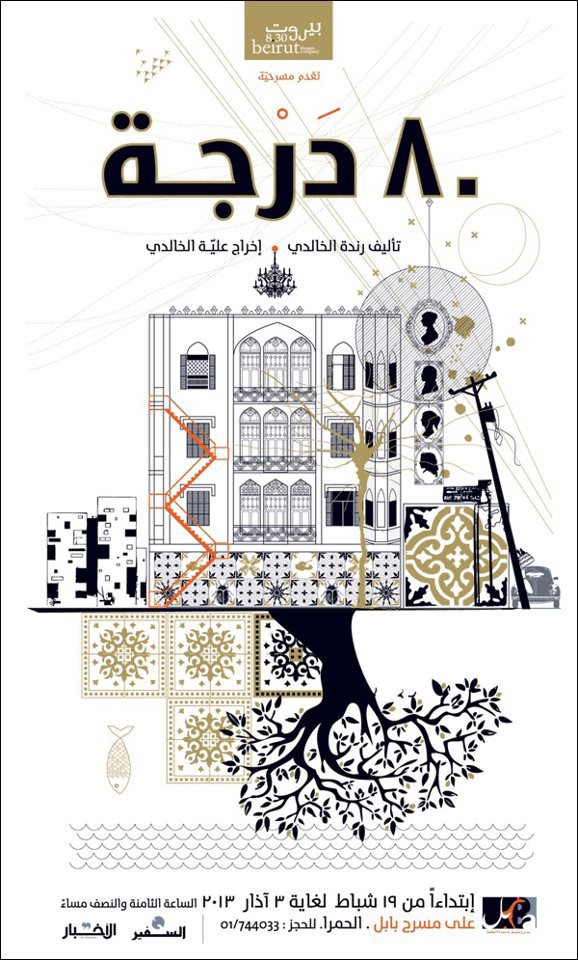
« 80 Steps » by Randa Khalidi

80 Steps is a comic, bizarre slice of life. The three main characters inhabit an apartment 80 steps above street level. They are a retired general, his wife and his elderly sister. They have one daughter and a male housekeeper.

The play revolves around the themes of old age, retirement, tolerance of others, and the acceptance of one’s life and death. The three main characters are eccentric and behave in startling ways. Old Egyptian movies, electric cables, medicines and lots of socks occupy this family’s dreamlike space. The spectator will be dragged into this family’s life and experience their emotional interdependence, which is always steeped in love. The outcome is a black comedy that is absurd and touching at the same time.

Everyone is sure to find something in this magical, amusing and fantastic journey of self-discovery.

Written by : Randa Khalidi
Director : Aliya Khalidi

Actors:

Ahmad: Faek Humaissi
Lamia: Raeda Taha
Fayzeh: Lina Abyad
Mounir: Ali Mneimneh
Laila: Nazha Harb

The performance is at Babel Theatre.
Ticket prices: 20,000L.L. and 30,000L.L.
Performance Nights: February 19th - 24th and February 26th – March 3rdth 2013. (Tuesday – Sunday)
The Performance is in Arabic
All shows start at 8:30 sharp.
Doors will be shut after 8:30
For Reservations, please call Babel theatre at : 00961 (0) 1 744033 after 3pm or
Cellphone: 00961  70058183

Click here to "Like" and join Theatre Cultures facebook page

Tribute to Dimos Avdeliodis’ theatre

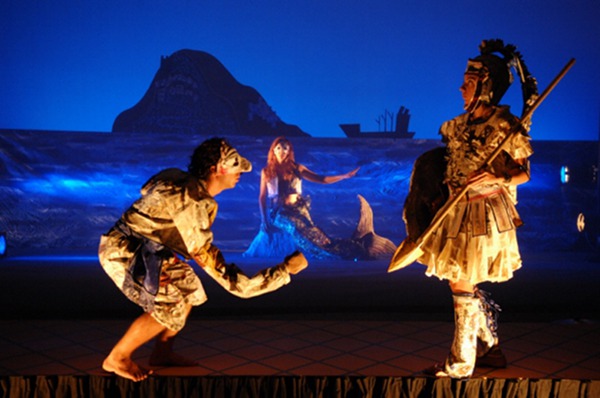
"Alexander the Great and the cursed Dragon" by Dimos Avdeliosis

January 11th to February 26th 2013

The theatrical presence of Dimos Avdeliodis at the Michael Cacoyannis Foundation

5 different plays of the last 3 years in 8 nights

Five different and notable theatrical performances, directed by Dimos Avdeliodis during the last three years will be presented afresh by the Michael Cacoyannis Foundation during January and February 2013.

Dimos Avdeliodis has been identified with two emblematic performances of Greek theatre, the Forms of the Viziinos work, in 1992 and Alexander the Great and the Cursed Dragon, in 2007.

The extraordinary common character which all of his performances have, is the designation of the word, as main factor towards the understanding of the meaning as well as the peculiar use of the visual arts elements and the lighting within this spirit.

Avdeliodis himself supports that “Aim of every performance is the designation of the feelings and the notion which overflow the mind and the heart of the writer. Therefore we have to consider that every single text is just like an orchestral score, which has to be “read” properly, in order to be listened the way its creator would wish.”

The Michael Cacoyannis Foundation offers the opportunity to the ones who haven’t attended any of the five performances of D. Avdeliodis and his partners to enjoy them in an extraordinary “festival”.

The Program

1. “Maranatha”, theatrical adaptation by Dimos Avdeliodis on the novel by Thomas Psyrras, with Yasemi Kilaidoni, Friday, January 11th 2013, at 21:00, Theatre Hall

2. “Homesick” by Alexandros Papadiamantis, with Mairi Iglesi, Saturday, January 19th 2013, at 21:00, Theatre Hall

3.  “The only Journey of his life” by Georgios Viziinos, Monday 28 and Tuesday 29 January 2013, at 21:30,

Hall 1

4. “Ichneutae” by Sophocles, Saturday, February 9th 2013, at 21:00, Theatre Hall

5. “Persae” by Aeschylus, February 16th 2013, at 21:30, Hall 1

Halls: Theatre Hall & Hall 1

6. “The only Journey of his life” by Georgios Viziinos, Monday 28 and Tuesday 29 February 2013, at 21:30,

Hall 1

www.anagnosis.info

Tickets: €10, General Admission & 8€, special price [available for advance ticket purchase for all the 5 performances]

www.mcf.gr


You can subscribe to Theatre Cultures' newsletter by email here
"Like" Theatre Cultures on facebook here

« Hamlet » by Thomas Ostermeier


"Hamlet" directed by Thomas Ostermeier. Photo © Arno Declair

HAMLET

by William Shakespeare
directed by Thomas Ostermeier (165 min.)
German translation by Marius von Mayenburg
A co-production with the Hellenic Festival Athens and the Festival d’Avignon

Hamlet is going crazy. His father has died suddenly of a strange disease, and his mother has married her deceased husband’s brother, of all people, after just one month. Hamlet has nighttime visions of his father, who claims his brother poisoned him, and exhorts Hamlet to take revenge and kill his new stepfather. Hamlet acts the part of the crazy man in order to hide his plans, and loses his grip on reality in the process. The whole world becomes a stagnant swamp to him. Desire and sexuality become a threatening abyss. The friends surrounding him turn out to be spies deployed by his stepfather to keep an eye on him. Even Ophelia, his beloved, is a part of the scheme. The avenger becomes the prey, with an informer listening behind every curtain, as Hamlet’s paranoia proves to be not unfounded. The insane act turns to actual insanity, and Hamlet kills the wrong man: Polonius, Ophelia’s father. His mother and stepfather cover up the murder and keep Hamlet out of the public eye, and Hamlet’s plans for revenge seem to evaporate. He loses control of himself, his goals, and his life. Ophelia falls apart in the face of this and kills herself. When his stepfather decides finally to silence Hamlet, Hamlet seizes the opportunity at hand and with one final rampage forces his world to its knees.

Shakespeare represents the Danish royal court as a corrupt political system which becomes a paranoid maze for Hamlet. Murder, betrayal, manipulation and sexuality are the weapons used in the war to preserve power. Not able to take on and fight the cynical rules of the game at the court, Hamlet stagnates and turns his aggressions against himself. His gift of distinguishing pros and cons becomes an insurmountable hindrance in accomplishing his goals, and as the last person with scruples in a system without any, he is finally doomed. With its central paradox of the incapacitated protagonist, Hamlet remains today a valid analysis of the intellectual dilemma between complex thinking and political action. Shakespeare serves up over twenty characters, allowing a political biosphere to arise out of differing interests and intrigue. In Ostermeier’s production, just six actors will play all these characters, constantly changing roles. Hamlet’s progressive loss of touch with reality, his disorientation, the manipulation of reality and identity are mirrored in the acting style, which takes pretence and disguise as its basic principle.

Cast

Autor: William Shakespeare
Regie: Thomas Ostermeier
Bühne: Jan Pappelbaum
Costumes: Nina Wetzel
Music: Nils Ostendorf
Dramaturgie: Marius von Mayenburg
Video: Sébastien Dupouey
Lights: Erich Schneider
Kampfchoreographie: René Lay
Claudius, Geist: Urs Jucker
Hamlet: Lars Eidinger
Gertrud, Ophelia: Judith Rosmair
Polonius, Osrik: Robert Beyer
Horatio, Güldenstern: Sebastian Schwarz
Laertes, Rosenkranz: Stefan Stern

Dates

01.01.2013, 19.30 h

02.01.2013, 19.30 h

31.01.2013, 19.30 h

01.02.2013, 19.30 h

02.02.2013, 19.30 h

13.02.2013, 19.30 h

Tickets

Booking hotline:
0049 (0) 30.890023
email: ticket@schaubuehne.de

By Internet
Click on Kartenkauf
(Please note that it is not possible to buy tickets online for up to 20 minutes after midnight due to data protection.)

By telephone
Monday to Saturday from 11 – 18:30
Sundays and bank holidays from 15:00.
Tel 0049 (0) 30.890023

By email
ticket@schaubuehne.de

By fax
Fax 0049 (0) 30.89002 295 300

By mail
Schaubühne am Lehniner Platz
Theaterkasse
Kurfürstendamm 153
10709 Berlin

Approach


You can subscribe to Theatre Cultures' newsletter by email here
"Like" Theatre Cultures on facebook here

« Delete » adapted and directed by Aida Sabra


DELETE

Adapted and directed by : Aida Sabra
Featuring : Patricia Nammour – Zeinab Assaf – Bassel Madi – Elie Youssef
Representation dates: 3-4-5-6- of January at 8:30 pm
Place: Monot Theatre
Yessouiyeh Street Monot, Beirut	Tel.: +9611202422.

Synopsis :

Where are we today feminism s achievements that Henrik Ibsen s play Doll s House contributed to realizing ?

How do youth living in societies that block the establishment of a more equal status for women deal with the issue of equality between the sexes ?

This play intends to question these issues through a hyperlink that transmits the play  » Doll s House  » on a social network site . The play instigates a serious conflict between the youth that meet daily in a café.

Where will things lead ??

For Reservation: + 961 (0) 1-202422 / (0) 1-421875 after 3:00 pm at Librarie Antoine

Ukchuk-Ga

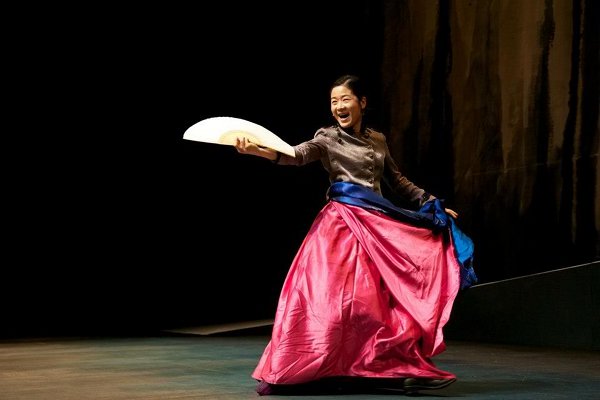
Pansori Brecht UKCHUK-GA

based on ‘Mother Courage and her children’ by Bertolt Brecht


Sorikkun(Singer): JaRam LEE
Musicians: HyuckJoe JANG,  HyangHa LEE,  HongSik KIM
Director * InWoo NAM
Writer/Composer * JaRam LEE
Dramaturge * HyeJeong HAN
Stage Director * JiMyeong KIM
Stage Designer * YeoJeong WON
Costume Designer * JungHwa KANG
Lighting Designer * YuJin LEE
Sound Designer * TaeSoon JANG
Plannig Manager * SoonWoo NAM
Production Manager * EunYoung SON
Pansori (A genre of Korean traditional narrative songs)
Running Time: 140 min. (Intermission 15min. included)
Grade: suitable for ages 6 +
Group/Country: Pansori Project ZA / South Korea


SYNOPSIS

Born in Korea, Soon-jong got deserted by her strict family in law because of the rumor that she had loose and easy conduct. Kicked out of her family in law, she arrived in Yanbian with her baby and met her second husband who was obsessed with gambling, women, and drinking. So she left her second husband chocking down tears. Entering the Han, she met third husband, but this guy as well bullied and hit her. Finally, she ended up leaving her third husband and changed her name into Anna in the intention of changing her tough fate. Then she became a war merchandise to survive with her three kids who sold things scraped by at the battle ground. The first son left the cart secretly from Anna to fight in a war and second son, Jegal Jungjik also left Anna becoming an accounting soldier under the General Son Gyung. Then one day, the second son Jungjik appeared in front of Anna’s cart caught up by Dongtak’s soldiers and Anna lost her second son just before her eyes, and had to deny the identity of the dead body, saying it’s not her son’s, trying to keep her cart which was the means of her family’s living. Losing her son, Anna changed her name Anna to Ukchuck

Ukchuck and her last kid Choo Sun were pulling their cart and getting around when they reached a farm house to rest. Ukchuck entered a castle to buy something and Choo Sun was staying at the cart alone when Won sool’s soldiers dropped in the house to do the night attack. Choo Sun rose to the roof and started to hit the drum to alarm the people in the castle. The soldiers shot Choo Sun to stop her. The shot saved the people in the castle but Choo Sun faced the death. Left alone, Ukchuck’s singing started.


About UKCHUK-GA

Modernity of Tradition

Designated as a UNESCO Intangible Cultural Heritage of Humanity in 2003, pansori which originated in Korea in the 17th century is a genre of musical storytelling (musical drama) performed by only one vocalist(sorrikun) and a drummer. This popular tradition, characterized by heavily vibrato singing, dramatic narration, a repertory of narratives and gesture, embraces both elite and folk culture. It has the wit, the fun, and the poetic and dramatic elements in it because it was used for satire in the past. During performances lasting up to eight hours, a male or female singer, accompanied by a single barrel drum, improvises on texts that combine rural and erudite literary expressions. In the 19th century, Pansori reached a high level of professionalism and artistic maturity and became hugely popular.

The second experiment was a success, even greater than the first piece, Sacheon- ga. Standing ovations every night!

Pansori Project ZA’s second challenge of the Brecht’s epic drama, ‘Ukchuk-ga’, smashed Korean audiences last June, far more successful than expected. Inspired by Brecht ‘The Mother Courage and her children’, They molded it into a complete new version of Pansori. Ja Ram Lee wrote the script, composed the songs, and played more than 15 characters. All the tickets were sold out far before than the premier and the audiences gave her standing ovations five times almost everyday. The audiences in the auditorium seemed deeply touched by her excellent vocal and improved acting technique. Especially, she played all the characters in a story, more than 15 roles from a mom to three children and to all the different soldiers. According to the characters, she transformed completely, changing voice, nuance and gesture. Compared to the traditional Pansori, there are many rhythmic and percussion instrument used for building-up the tension.

The running time, 2 hours and 20 minutes, seems so quick to audiences with their active encouragement (Chuimsae). When the performance completed, audiences had tears on their eyes.

Ukchuk-ga was transformed into the Legendary Chinese wars in the Three Kingdoms era in the 2nd century from the Wars of Religion in the 17th century. The story follows how the innocent Korean woman, Sun-Jong Kim (meaning obedient) became a vicious business woman as three children’s mom. In turn, audiences laminate their own lives today in the end, fighting everyday for their survival.

Pansori Project ZA’s initiative experiment, the modernity of the traditional genre of Pansori, stands on a peak. Of course, their exquisite ability could make international audience enjoyable and touching.

14.12.2012  at 20:00
15.12.2012 at 17:00
29.12.2012 at 15:00

Info:

email: pansoriza@gmail.com, (+82) 10.9853.3555

http://eng.yicf.or.kr/ 
http://yicf.or.kr/modules/rent/rent_view.html?no=27
http://www.artgy.or.kr/Foreign/english/index.html
http://www.artgy.or.kr/PF/PF0201V.aspx?showid=0000003678

Lambrakis LivZ

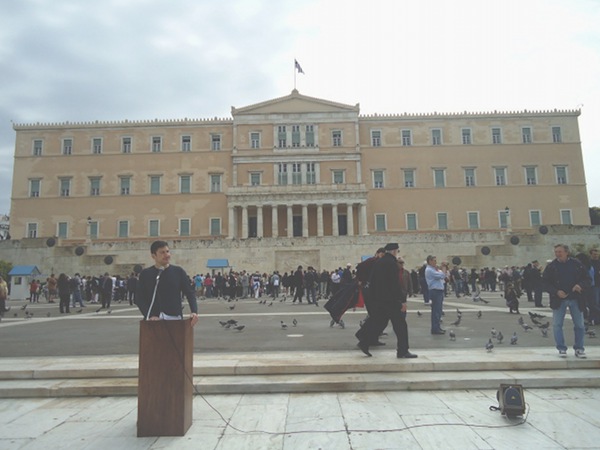
Does the political speech of Grigoris Lambrakis appeals to an international audience and especially to the contemporary audience of the ex-socialist countries? The political speech of Grigoris Lambrakis could be universal?

Grigoris Lambrakis’s political speech adopts the doctrine of Nikita Khrushchev’s Soviet Union which promoted the concept of “peaceful coexistence” (between socialist and capitalist countries). In the Baltic countries this concept presumably was received with suspicion and perceived as a hoax. As stated on a label at the ‘Museum of Occupations’ in Riga, “arming of the USSR is done under the banner of fighting for peace.”

The presentation of the proposed performance/re-enactment of Grigoris Lambrakis’s political speech will highlight the ambivalence of such a performance in Tallinn, Estonia, a country that has historically dealt with the consequences of the ex-Soviet Union’s political and social repression, recently though an adopter of the Euro currency and a strong supporter of the Western, European Union and Eurozone neoliberal politics.

The speech in Tallinn will be presented in Greek with supertitles in English and Estonian.

Credits:
Concept-Direction: Stefanos Mondelos
Performance: Spyros Zoupanos
Set Design: Nafsika Tzanou
Art Direction: Nafsika Tzanou, Stefanos Mondelos
Speech's Translation in English: Stelios Koutelis
Text Editing: Maria Mondelou
Documentation: Sergios Tsitakis

October 20, 2012
Culture Factory Polymer
Madara 22, 10613 Tallinn, Estonia
http://kultuuritehas.ee/?p=743
October 21, 2012
Kumu Art Museum
Weizenbergi 34/ Valge 1, 10127 Tallinn, Estonia
http://www.kumu.ee/en

More Information:
Dimance Rouge