Seminar for young critics in Bucharest, Romania, October 30 to November 4, 2013 – Invitation
The IATC is pleased to announce that a seminar for young theatre critics will take place during the 23rd edition of the National Theatre Festival of Romania, in Bucharest from October 30 to November 4. Applications are now open for two seminar groups (one French-speaking and one English-speaking). To apply, you must be a professional critic and aged between 18 and 35. All candidates are invited to send, as soon as possible, their registration form with a brief CV (just one page, please), two or three examples of their work (i.e. critical articles published in professional media), and a letter of recommendation from the person in charge of the IATC section in their country (if your country is an IATC member). All these documents should be sent in a single PDF file if possible. Please make sure of the following:
1) The registration form must be sent by the candidate, not by the IATC section officers.
2) The candidate must have a good proficiency in one of the two working languages (please indicate clearly whether you wish to be considered for the Francophone or the Anglophone group).
Participants in the seminar will be provided with accommodation, meals, theatre tickets, and, for participants travelling by plane, transportation to and from the airport. Participants are required to meet the cost of their travel to Bucharest. Please note that participants may be required to share a hotel room with another participant of the same sex.
The date of arrival for the seminar is October 30, and the date of departure is November 4.
The working groups will be monitored by experienced theatre critics Jean-Pierre Han (France) and Mark Brown (Scotland, UK), both of whom are members of the IATC executive.
Applications will be accepted until September 15. They must be sent to the Director of Seminars, Jean-Pierre Han: jp.han@free.fr. A final list of all selected participants will be announced as soon as possible, in order to allow participants to prepare for their trip and obtain any necessary visa for Romania.
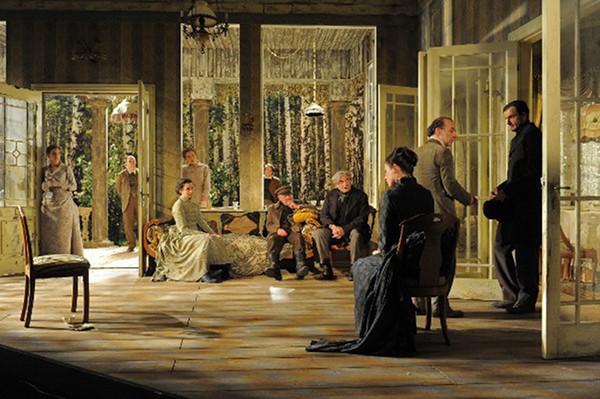
Chekhov’s Platonov under Alvis Hermanis’s direction, a production of Vienna’s Burgtheater, has been acknowledged as an outstanding performance. One year after its premiere, in May 2011, it was invited to participate in the Berliner Theatertreffen 2012. Germany’s most important theatre festival brings together the ten most remarkable productions of one season from the German-language theatres. Three performances of Platonov crowned the end of the 2012 edition of the Berlin festival.
Alvis Hermanis, the Latvian master of ambiance, “manages to retain in Platonov an authentic Russian atmosphere located at the beginning of the 19th century. Furthermore, gorgeous costumes were designed by Eva Dessecker to emphasize the genuine setting. However, this is still a very modern performance, proving Hermanis’s deep understanding of an epoch and a world region,” as cited in the review of www.nachtkritik.de (Christian Desrues). The magnificent stage setting is praised in ORF.at (Sophia Felbermair) as follows: “Monika Pormale’s stage design is naturalistic and coherent down to the finest details.” In its turn, Deutschlandfunk (Michael Laages) amplifies: “Pormale’s detailed reproduction of a Russian manor is simply breath-taking: wooden floors above and below show an open salon, towards the right through transparent glass doors the dining room and behind, leading to the stage depth the terrace decorated with a most realistic wallpaper reproducing a birch forest.”
Chekhov was 19 years old when he wrote this play in 1879. After his death, it was discovered as a handwritten manuscript. Of the 134 pages, the title page was missing. Today, Platonov is considered the early masterwork of the famous playwright. The action focuses on the village teacher Platonov who returns after 15 years to his home place. Simultaneously adored by four women (Dörte Lyssewski, Johanna Wokalek, Yohanna Schwertfeger, Sylvie Rohrer), Platonov (Martin Wuttke) constantly battles cynicism and the fear of being loved. Unhappy love stories evolve through glances or touches exchanged through the glass doors. Moreover, the play also deals with two father-son dramas. One of the memorable scenes in the third act, a discussion between Platonov and the student Isaak, the idealistic and timid son of the rich Jew Abram Abramovic Vegerovic (the superb Fabian Krüger), in which the latter tries to gain Platonov’s friendship by all means, manages to draw hearty laughs from the otherwise slightly confused spectators. The confusion is created by the low level of audibility which lasts throughout the performance. It is not only that the action takes place almost always in parallel in several places, but also lots of people on the stage talk simultaneously. However, the director is cautious in this respect: a recorded tape, before the beginning of the performance, repeats the following text: “You will encounter during this evening text parts which you will not understand. This is not because of the actors or the acoustics of the theatre hall, but it is my doing.” Though it may seem annoying to some spectators, Hermanis’s “mutter-theatre” fascinates because of its hyperrealism: crickets chirp, blackbirds sing, roosters crow. The action stretches only over 24 hours during which impressive ambient light changes (Gleb Filshtinski) take place. Thus, the spectators literally get to feel the “oppressive heat” of Russian summer.
Despite of the extensive length of the performance of five hours, the daily newspaper Die Presse (Norbert Mayer) concludes: “Hermanis’s Platonov with 15 excellent actors of the Burgtheater is a celebration of Chekhov and his decadent idlers.”
Since the 1990s, “in-yer-face theatre”–or “new European theatre” has become one of the predominant phenomena of Western theatre: it originated in Great Britain, and then spread throughout Western and Eastern Europe. This banal and violent form of theatre has been pouring blood and sperm onto stages, relying heavily on the aesthetics of the ugly. Logocentric language has long disappeared from this new stage, which has become the representative theatrical form of this post-dramatic era.
Korean theatre has been influenced by this in-yer-face theatre practice, although to a somewhat lesser degree than in Europe. That influence seems almost inevitable due to the fact that European performances are played so frequently in Seoul. Already since 2000, many such productions have been invited and were well received and well liked. These have included, for example: Fire Face, written by Germany’s representative in-yer-face dramatist, Marius von Mayenburg, and directed by Oskaras Korsunovas of Lithuania; Sara Kane’s Cleansed, directed by Krzysztof Warlikoswki of Poland; The Story of Ronald, Clown of McDonald, written and directed by the Spanish/Argentine director, Roderigo Garcia; and Hamlet, directed by German director Thomas Ostermeier.
The first influence of this new European theatre was seen in works by some established dramatists, who began to portray men in today’s eschatological situation in a violent, even gory, way. One of the very first and best examples of this new trend is The Masculine Drive (1997), written and directed by CHO Kwang-Hwa. The play depicts the political tension between masculine values, such as power and loyalty, and feminine values such as love and emancipation. In the course of the play, the children of a crime organization exert uninhibited violence on their enemies using baseball bats, sashimi knives, bicycle chains, metal pipes, etc. The violence climaxes when CHANG Jeong, the protagonist and boss of the crime organization, cuts the wrist of his gambling-addicted father, onstage with a sharp knife. (In Korea, gun possession is illegal.) Homosexual violence and rape are also graphically represented.
Since The Masculine Drive, Korean stages have been flooded with more and darker violence. Female playwright KIM Myung-Hwa, who used to write literary plays, recently presented a new play, The End of the Royal Palace Restaurant (2008), in this new trend. The play, directed by LEE Gi-Do, focuses on the story of the Master Chef of the Royal Palace Restaurant, who uses human meat to create his best dish, only to end up throwing himself into a big oven with boiling water. Director LEE makes the scene even more graphic. He cheerfully invites an obese woman to the front of the audience, but then puts her into a gigantic freezer. In the very next scene, people bring in a huge chunk of fresh meat, weighing at least 20 kg, and we can easily guess that the chunk has been cut from the helpless victim. The nausea you experience here is not very different from what you feel during Sara Kane’s scenes of cannibalism, or from her scene in which rats carry severed human parts here and there on the stage. Even LEE Kang-Baek, who has long been the frontman for cerebral drama, depicts a similar landscape in his recent play, entitled Yellow Inn (2007). People gather at an inn, located in the middle of a desert frequented mostly by dusty winds. In this apparent oasis, people become divided by their differences in social, political and economic status, and kill each other. Then the innkeeper steals the valuables from the pockets of the dead people. As soon as he finishes his business, gravediggers remove the dead bodies to make room for new guests. Its exaggerated grotesquery, physical violence, dark caricature, and mythic tone are in a direct line with in-yer-face theatre.
II
Starting in the 1990s, it was the feminist theatre–which seems rather archaic today—that made up the most popular stream in Korean theatre. Feminist ideas had long been suppressed in Korea’s Confucian, patriarchal society—but once unleashed, they exploded all at once. The most successful achievement in this vein, in terms of aesthetic and thematic approach, was Lady Macbeth (1998), restructured and directed by HAN Tae-Sook. She remained faithful to Shakespeare’s narrative frame, but refocused it on Lady Macbeth’s reactions, resulting in a form of hypnotic or therapeutic theatre. She reinforced Lady Macbeth’s subconscious with the performance art of LEE Young-Ran’s object theatre, and accompanied these with a live band, Gong-myung, which plays traditional Korean music, to make a hybrid theatre. Since the premier, Han has revived the play in a different version almost every year, and continues to experiment in search of new forms of hybridity.
Writings and stagings related to homosexual love used to be as marginalized as feminist theatre was as a subject for the theatre, but it has also become a theme of contemporary Korean theatre. There have been several Korean plays dealing very cautiously with this subject matter. Among them, The Train for Seo-An (2003), again written and directed by HAN Tae-Sook, is by far the most successful. The play is set against the story of Emperor Qingshi Huang, who filled his tomb with clay soldiers and horses to protect himself from ageing and death, and highlights a man’s desire to possess another man by confiscating all his documents and memory, that is, his whole being. Director HAN invited artist LIM Ok-Sang to sculpt contemporary versions of the clay figures and, as with her Lady Macbeth, employed Gong-Myung, the traditional percussion band, confirming once again the identity of her theatre. As we saw previously, HAN has a keen interest in the lives of the marginalized, and has demonstrated her great talent in translating that interest into theatrical form.
III
Korea is a country sharply divided by ideologies and conflicts of interest, and one might expect such a country to have the theme of socio-politics on its main theatrical menu. Recently, however, especially since the LEE Myung-Bak government has been in office, political theatre has been drastically reduced. In fact, the only socio-political theatre in recent years has been The Case of President LEE’s Murder (2010), written and directed by KIM Kwang-Lim. The play’s main character, LEE, is strongly associated with Samsung’s president, LEE Gun-Hee. It deals with murderous corruption at both the individual and corporate levels, and employs dark comedy and highly choreographed movements, along with Korea’s traditional one-person opera form, pansori, and shamanic singing.
At the same time, “history theatre” stands exceptionally at the center of contemporary Korean theatre. It does not approach history with facts, but looks back with a revisionist’s eye on errors in history and calls for a new history, or history as it should have been. OH Tae-Seok and LEE Yun-Taek are in the forefront of this movement. OH’s main concern is conciliation of history’s mistakes. Plays belonging to this vein are Bicycle (1987), Why Did Shim-Cheong Throw Herself into the Sea Twice? (1990), A Chinese Balloon Flower (1994), and I Love DMZ (2002), among many others. For instance, Along the Moonlit Baek-Ma River of 1993 deals with the historical King Eui-Ja of the Baek-Je Kingdom, who lost his country due to his blind love for Keum-Hwa, a beauty sent from the Shilla Kingdom, his nemesis. The play alters this episode in history: a contemporary shaman becomes the beautiful Keum-Hwa through a ritual communion with spirits, meets the spirit of King Eui-Ja, lingering in limbo, and discusses with him the wrongs he committed. Permanent Prisoners of 1998 deals with the Kwang-Ju Massacre of 1980, in which the military junta killed hundreds of civilian freedom fighters. In this play, OH employs the aesthetic principles of the Korean traditional puppet theatre and the shamanic ritual, or gut, to bring about a reconciliation in which the victims forgive their murderers. Regarding this relatively recent, tragic historical event, such a pacifist impulse hardly rings true, socially or emotionally, among Koreans even now.
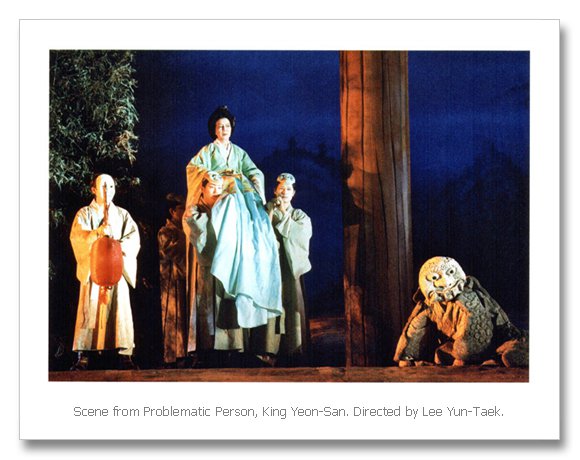
LEE Yun-Taek consistently questions the social responsibility of intellectuals in his dealings with history. His first history play, Problematic Person, King Yeon-San (1995), looks into this question. In the play, intellectuals easily change sides according to where power lies. The ruling aristocracy’s orientation towards power is skillfully woven into the story of King Yeon-San, who was arguably the most vengeful and womanizing king in the history of the Yi dynasty, which lasted from 1392 until 1910. LEE’s second history play, Provincial Scholar, CHO Nam-Myung (2001), differs from his earlier vulgar, physical plays, and takes a highly semiotic approach to the sophisticated culture of the scholar and the aristocrat. LEE’s A Beautiful Man (2006), directed by NAM Mi-Jeong, employs elements of traditional acrobatics and gut to express LEE’s persistent questions about the intellectual’s participation in society.
IV
In this post-modern time, the tradition of literary theatre is barely surviving in the hands of a few established dramatists. Playwrights of the 1960s, such as LEE Kang-Baek, LEE Man-Hee, and KIM Kwang-Lim, have attempted a philosophical theatre beyond the immediate issues of our daily lives. LEE Kang-Baek makes an existential question out of the divine indifference towards humanity, and the human denial of divinity in his The Head of Dried Pollack (1993), directed by KIM Kwang-Lim. In his Heavenly Feeling (1998), directed by LEE Yun-Taek, he delves in a mythic manner into the relation between content and form in art and religion, juxtaposing the three temporal dimensions of past, present, and future.
KIM Kwang-Lim adopts an intellectual rather than a physical theatre, and an epic or meta-theatrical rather than an indicative approach, digging into the relativity of human existence with his call for liberation from any kind of regulation or confinement. In Search of Love (1993), House (1994), and Come and See Me (1996) are examples. He has recently, however, focused on experimenting with using the Korean theatre as a frame for his plays, such as Puppet Play (1996), Uturi (2002), Why Has the Nymph…? (2007) and shifted his artistic focus from a thematic approach to formalistic experimentation.
Since 2000, the presence of literary theatre has become even more reduced. It may be because the zeitgeist of our time disparages text. Recently, however, two young dramatists, BAE Sam-Sik and KIM Ji-Hoon, have written heavily literary plays, such as The Diary of Yol-Ha (2007), and The Original Copy of a Will (2008), respectively, and won not only raves from critics but also enthusiastic responses from audiences. The Diary of Yol-Ha transforms the historical figure of PARK Ji-won into an unidentifiable animal and has him visit a long-isolated village, tell the villagers grotesque and exotic stories, and stir up confusion and change among the people there. With this, PARK delineates the defensive human instinct to stay complacently in the system, and the contrasting human desire to explore the world outside the system, to obtain freedom. Director SOHN Jin-Check employs a minimalistic form for this text, and succeeds in transforming a literary text into a theatrical piece.
The Original Copy of a Will, directed by LEE Yun-Taek, is four hours long. Its playwright, KIM, is one of the youngest dramatists in Korea. My colleague, KIM Hyung-Gi described this work in the Spring 2009 issue of the Korean Theatre Journal: “[Kim is] exploring, from the eco-feminist viewpoint, the various types of violence that lurk behind capitalism, our social system, and gender discrimination.” Director LEE Yun-Taek translates this heavily literary text into a strong theatrical spectacle by enhancing its performativity through vivid physical violence, sudden and complete demolition of the entire set, which is a shack on a dumpsite. It is a mythic version of the human community after post-eschatology.
V
The most distinguishable and important dramatic form in Korea since 2000 is the theatre of everydayness. PARK Keun-Hyung, another dramatist who directs his own plays, has been the main catalyst in this vein. Beginning with Homage to Youth (1999), he has been writing a couple of plays every year that are mostly centered on disintegrating families: fathers that have lost their power, mothers that are either dead or deadly aloof from their children, and children that already miss their families even before they disintegrate. Nobody Breathes in the Water (2000), The House (2002), Kyung-Sook, Kyung-Sook’s Dad (2006) are good examples of this track. Don’t Panic Too Much (2009), the most recent play, is by far the best in terms of dramatic form and its thematic contemporaneity. With the situation and characters similar to those of Sam Shepard’s Buried Child, or Harold Pinter’s Homecoming, PARK continues his portraits of absurd worlds. With Father as present absence, Mother as absent presence, an irresponsible first son, his wife flirting extra-maritally and in front of her brother-in-law, the second son suffering from constipation and missing Mother who has deserted the family—the composition of the family itself foregrounds the disintegration of the family. PARK is very good at epitomizing familial disintegration through the minutely detailed everydayness of the dramatic actions; he also transcends the limits of realism and moves toward absurdism or modified realism by employing highly expressive devices. In Don’t Panic Too Much, for example, the father hangs himself in the bathroom in the beginning of the show, but continues to communicate with his family members while hanging, asking each family member to bury him. KIM Han-Gil, KIM Myung Hwa, and the late YUN Young-Son are the most visible dramatists who have written a significant number of plays in
this direction. CHOI Jin-A has recently joined this group with her 1-28, Cha-Sook’s House (2010), in which she lectures about house construction by way of her characters, who are trying to build a new house on the site of their old house. No particular dramatic purpose is revealed. They just recollect their memories of the old house and their late father who built it, and try to realize their concept of how a house should be designed. The dramatic action flows from the discussion to the completion of the house’s construction.
One common feature of these writers is that they write these everyday plays in order to highlight the absurdity of our daily lives, which have already become absurd enough.
VI
I cannot deny the global theatre trend that disparages linguistic communication. Very uniquely—or at least unlike Eastern Europe, to which the power of European theatre seems to have shifted—there are still many, maybe too many, playwrights in Korea, and most of them direct their own plays. There are quite a few universities that have various programs for the education of the playwright. I believe this has something to do with Korean culture, which has a deep respect for writers. Unlike the director-dominated European theatre, Korean theatre will continue to follow the leadership of its dramatists, at least for a while. This is good, on the one hand, because they will continue to remind us that theatre was, is, and will be language, or communication, if you will. This is dangerous, on the other hand, because most of the practicing dramatists have turned to directing and begun to write their plays as production scripts, rather than as independent, literary-dramatic works. In other words, these playwrights are becoming more directors than dramatists. Even though they are directing their own plays, they have lost a considerable amount of their linguistic skill. This is why I worry about Korean theatre. But I have to admit that critics are best at worrying. It is simply their job to worry. Isn’t it?
[1] Yun-Cheol Kim is President of IATC; recipient of the Cultural Order of Korea; Professor in the School of Drama, Korean National University of Arts; and editor of The Korean Theatre Journal, a quarterly. Two-time winner of the « Critic of the Year Award, » he has published nine books so far, two of which are anthologies of theatre reviews.
For receiving Theatre Cultures suggestions you can subscribe
to Theatre Cultures' newsletter on Home Page with your email,
then activate your subscription: click on the link that you
will receive in your email
THEATRE FROM THE EDGES OF EUROPE IN AN INTERNATIONAL CONTEXT
by Gordana Vnuk *
Talking today about performing arts in the Balkan region (I will concentrate on former Yugoslavia and, being highly selective, on its creative highlights), takes into account, more seriously than elsewhere, the unreliable edges of historical contexts which have multiplied in the last 30 years.
After the death of Tito and Titoism thirty years ago, ex-Yugoslavia was passing through a tumultuous period of political disorientation. The arts, and theatre as its most vital branch, tried to stop this disorientation by either taking part in the national homogenization or in the transnational symbolization. Both paths looked anachronistic from the European point of view, but, if only somebody was willing to deal with it, also authentic.
While the theatre in Western Europe, in the sense of Badiou, turned towards totalitarianism, meaning self-referentiality, here the theatre still counted on playfulness and theatricality as an interspace between artistic use and political abuse. It had a sense for grandeur of a theme and some of the best Yugoslav directors were skilled in carrying these themes through a dialectical procedure, in contrast to self-referential purism which, instead of the deideologisation of social themes, abolished the social dimension altogether by putting a mediocre individual into a centrifuge, after which all laundry had to be white.
In the history of secondary cultures, as the Yugoslav ones were, we can find numerous art works that were created out of reach of artistic authorities, which enabled the creators to work with greater artistic freedom and, in this way, often come to radical and unique solutions which preceded the ruptures within a dominant style. (In Croatia there are examples from the Church of St. Cross in Nin and the Šibenik Cathedral to the visual arts movement of the fifties, EXAT, the 20th century poet Nikola Šop, etc.).
In the most influental discourse of the time it seemed that the new theatre of the eighties (later post-dramatic theatre), which rebelled against logo-centric statements in favour of media syncretism that opened the theatre towards new technology, other media, visual arts, dance and movement, was limited in its phenomenological aspect to Western Europe, which provided the examples for the theory of post-dramatic theatre. Although it pretended to be “European”, its promoters who tried zealously to devise a theoretical and critical background for this new generation of artists, did not move further than the western capitals (and let’s not mention non-European cultures).
The theatre in ex-Yugoslavia did not have a problem with the articulation of these post-dramatic aesthetics but had to accept playing with a reduced deck of cards. This kind of theatre would serve the purposes which Badiou refers to as étatiques and it would make a political and intellectual difference in Eastern Europe, however, mostly in its representational dimension through festivals. For a more serious and fundamental cultural purpose, it lacked the permission for a bigger stake.
No wonder that in the Yugoslav culture of festivals Robert Wilson appeared in Belgrade only a year after his European début in Nancy. The German hyper-realism (Stein, Peymann, Zadek, ..) was awarded many times at the same festival. We can say that Yugoslavia “kept pace,” though the best examples of Yugoslav theatre were created outside the governing trends and in opposition to the technology of selfishness which was already taking root in our soil as well.
The fall of the Berlin Wall took place at the right moment, just as post-dramatic theatre formalized its informality through institutions (IETM, cultural strategies of EU, etc.), so there was no time to listen to the Other and the Otherness. In this way East European theatre was supposed to smell of the reiteration of Kantor and Grotowski (Purcarete & Co.), and Russia of the Slavic soul and mysticism (Vasiljev & Co.), while the field of action was directed towards those who experienced the fall of the Berlin Wall as a gift from above and not as a result of deep, uncompromising, social and aesthetic battles led by previous generations. These young ones (like Arpad Schilling, Grzegorz Jarzyina, Krzysztof Warlikowski, Alvis Hermanis, etc.) were easy to uproot from their countries’ theatre traditions, with which they could no longer establish a dialogue. On the other hand, these traditions became politically hibernated, and furthermore, they showed a certain naivety, and aesthetically they were very fragile (for example, the video documentation of Grotowski’s performances were barely or not at all available, and the book Towards PoorTheatre was written in an impressionistic way with apologetic amendments and with only a very small number of Grotowski’s own texts).
So it was in the nineties, but in more recent times the approach has not been more profound either, as was shown by the notorious Theorem1 programme, which was never interested in taking the local context and meta-text into account. It could not exert a minimum of ethnological concentration on the variety of different culturological references – this was too much work for the European post-dramatic theatre.
The decisions about what is contemporary and innovative, and likewise the decisions about currency rates and the value of shares, were taken in the centres of economic and cultural power (Brussels, Amsterdam, Berlin, etc.) where several production and presentation organizations and theatres gathered, just as in the world of economics, in order to promote and protect their common interests. These were supported by invited critics and theoreticians whose task was to back up the aesthetics, coming mainly from Belgium, which were in the focus of the producing and touring funds. In the early nineties, one of these “clusters” was gathered around the magazine Theaterschrifft (1992 – 1995), edited by some of the major “players” on the scene in those times (Kaaitheater, Theater am Turm, Hebbel Theater, Wiener Festwochen, Felix Meritis), and who were connected by “like-minded interest” in certain artists. They started something that, in the course of the following years, would grow into a well organized and heavily funded platform for the inflated names (mostly from Belgium, Germany, etc.) whose artistic value has never been questioned because behind them stood the powerful structures and markets created by the consensus of producers and opinion-makers. The work of Jan Lauwers, Jan Fabre, Meg Stuart, Alain Platel, Lloyd Newson, Thomas Ostermeier, Rene Pollesch, etc., never posed perception problems, and so they became regular guests at festivals all over.
In those days the cultural West was quickly expanding its market towards the East of Europe, where it found another lucrative area for the export of its aesthetic concepts, its workshops and seminars, and its technology, giving in this way its contribution to the overall uniformity of the European theatre landscape.
Today these processes have gone even further, in the form of countless networks which work on creating a circle of artists who are then touring everywhere; the festivals provide alibis to one another (because what is good for Wiener Festwochen must also be good for Kunstenfestival or Festival d’Avignon). Everywhere we encounter the same names; the festivals neglect their creative potential and do not work on authentic selection decisions and programming concepts, what is, furthermore, highly supported by funding bodies and distribution organizations (like ONDA in France). If before everybody grabbed from the same sack, now they are all eating from the same plate.
But let’s get back to the eighties: ideas about the European Union were still in infancy, artistic exchange and information flow between the East and the West were almost symbolic and limited to a small number of festivals (in Yugoslavia, before the eighties, it was BITEF in Belgrade, and in Zagreb in the sixties and seventies, there was the propulsive festival of students’ theatre, IFSK, however these belong to another time period and would require a separate text). Thanks to its specific, eccentric position – neither in the East nor in the West – and to Tito’s political dystopia of the so called The Third Way (the movement of non-aligned countries, self-managed socialism as a milder variation of communism), Yugoslavia was one of the rare places where the West could encounter the East and where The Living Theatre could meet Grotowski, tête à tête.
In the eighties, after years of intelligent adjustments of Peter Stein-Botho Strauss models (in which the Serbian director Ljubiša Ristić and the Slovenian playwright and director Dušan Jovanović were at the forefront), there was a rupture – a new generation of Yugoslav directors (then all younger than 30) was running towards its creative peak. Among them we have to point out the Croatian Branko Brezovec, the Slovenians Dragan Živadinov and Vito Taufer, the Bosnian Haris Pašović, and into this group, following its aesthetic and dramaturgic affinity, we can also add the early performances of the Bulgarian Ivan Stanev. They were educated in the institutions of a rigid theatre system, but thanks to a free flow of information and cultural mobility (that allowed interesting aesthetic, cultural, and multilingual leaps) they could have produced strong concepts and erudition of the highest order comparable to any relevant European “generation” project (the generation of German directors in the seventies, the Flemish wave in the eighties). These directors did not belong to the so-called independent scene, the context in which the majority of new theatre in Western Europe was produced in often modest conditions, but they directed astoundingly radical performances in big repertory and national theatres, where the themes of social and political responsibility could be tested without the pressures of commercial exploitation.
About the semiozis of their work we have already said something at the beginning of this text. It was a socially relevant, we might say, engaged theatre of high budgets which, almost perversely, dared to include into its wild and amazing synthesis a ritual, almost cathartic memory of the Balkan region, an element that the European theatre had forgotten, although not renounced. They jumped with superiority through different, sometimes incompatible dramatic levels within one performance, where it was possible to create communication between the theatre of image and ancient ritual, Bosnian sevdah and Robert Wilson, emptied, recycled historical styles and technological schizophrenia. This gave a contaminated style that stood out against the formalism and hygiene of the theatrical languages that burdened the West European market.
The war which led to the break-up of Yugoslavia dispersed this generation which had experienced Yugoslavia as one cultural space. Newly formed states closed themselves inside national borders, within which these directors continue to provoke social and aesthetic claustrophobia, systematizing their own multiplicity (Brezovec carries on with the tradition of trans-national projects, as in his Slovenian-Croatian-Macedonian production of Caesar, and employs pop stars in the staging of Croatian literature; Živadinov radicalises his cosmic theatre by moving its visions into outer space; Taufer in his Psyche and Pašović in his Hamlet transcode and transform different dramatic myths either by destroying their pathos or turning them into pathology).
Although today many of the above mentioned proceedings are close to the usual stylistic repertory of so called multicultural projects, at the time when, in the eighties, this generation was applying them in their performances as an authentic theatre expression, their shift from the horizontal towards vertical multiculturalism2 was neither understood nor recognized on the European level.
At that time Europe decided to radicalise the protestant flavour of its theatre praxis and, under the aegis of the Flemish wave, insisted on aesthetic purity and hygiene, cold self-referentiality, epidemic of geometry, narcissism and cynicism, irony when it wants to be political, overdone wittiness. All these can be viewed today as overripe procedures that, in the meantime, have multiplied into thousands of variations in both Western and, without asking why, Eastern Europe.
In the nineties when Yugoslav theatre swiftly fell apart, a number of talented epigones made their way through by adapting their work to the aesthetics coming mainly from Belgium. The Slovenians were at the forefront: Betontanc and Matjaž Pograjc, Tomaž Štrucl, and Emil Hrvatin to whom the Croatian company Montažstroj and its director Borut Šeparović can also be added. European new theatre mainstream has had no problem with such performances – their contexts were minimized, their meta-text did not exist; you see what you watch.
The nineties are also the war years in the Balkans. The interest for the theatre from this region increased, but this interest would take us back towards The Living Theatre – La MaMa – like lyricism, the quasi-engagement of Eugenio Barba, and the theatre of political correctness. Here are the Serbs and Macedonians at the forefront. The Macedonian playwright Dejan Dukovski gains a European reputation with plays about the likeable, untamed savagery of the Balkans (Balkan is not Dead), and the Belgrade based Center for Cultural Decontamination interprets serious plays like Macbeth as a political-critical parallel (Milošević = Macbeth). Close to this understanding of theatre we can also place the Serbian playwright with European recognition, Biljana Srbljanović.
The late nineties bring onto the stage generations from the Balkans who take part on an equal level with other countries in the process of rendering uniform the European theatre landscape. They gain education with foreign bursaries, secured from all sides by workshops and seminars, and they do not mind the homogenization of global projects. They buy in one place and sell in another; sensation stands before confidence. Today they all dance to the same score, in Slovenia and in Macedonia (though here the influence of Russian neoclassicism causes some disturbances), just as in, for example, Portugal and Norway; it is impossible to determine the country of origin.
The romantic charm of the Balkans as a place of authentic energies, in the nineties, still inspired a generation of older artists, to whom the war gave a sporadic European alibi (the Roma director Rahim Burhan, the Macedonian Aleksandar Popovski, the Slovenian Eduard Miler). There were also a few intelligent directors who, with self-conscious refinement, imitated the heroic phase of the innovative theatre of the seventies and eighties and its authentic traits. In Slovenia Tomaž Pandur relies on the rigid monumentality of German theatre, in Croatia and Serbia, Paolo Magelli, in his early works, almost anticipated the procedures later used by Peter Sellers, and in Macedonia Slobodan Unkovski uses elegance after the model of Antoine Vitez.
Outside the formal parameters of new theatre but close to the concept of self-referentiality, the Croatian author duo who appeared in the mid nineties, Bobo Jelčić and Nataša Rajković, are tied to narratives cleared of their archetypal vocabulary. It is a theatre of spending time on stage in a very noble meaning of the phrase. Narrative structures are neglected, presentation is in the constant process of postponement, theatricality does not incite an event, the event is expected due to its dramatic absence in an interspace between sincerity and conditionality.
We are in the 21st century; among the generation of directors singled out above, only Brezovec has not lost his breath. In Živadinov’s cosmic-Orphic concepts we can identify self-irony, which comes in place of the aesthetic narcissism and prophetic character of his early projects in the eighties. Pašović and Taufer, on the contrary, lose their irony and, without any special liveliness, put an emphasis on the elegance of their performances. In the ZKM theatre Brezovec staged three politically vehement projects (Great Master of All Villains, Kamov, Necrology/Moulin Rouge and The Fifth Evangelium) that employ an immense energy and complex transpositions – it is a political theatre based on entirely new assumptions and perspectives.
In the past decade Slovenian theatre, with the exception of the hybrid performances of Bojan Jablanovec and his company Via Negativa, has lost that what made it interesting in the last twenty years of the 20th century. Serbian theatre has had very self conscious actors, but we cannot single out any particular director as important. In Macedonia, also with actors of exceptional quality and broad intuition, a young director Martin Kočovski uses Brecht’s texts and elements of Meyerhold’s constructivism. Bosnia, Montenegro and Kosovo se débrouillent.
But all these countries do not have shortage of festivals, which are abundant; here too, we can spot promiscuity on a European level.
And in the end – my Croatia: I can say that twenty years ago Croatia had strong festivals (among them, without false modesty, Eurokaz, which celebrated its 25th edition this year, but also summer festivals in Split and Dubrovnik), and weak theatre (especially in comparison with Slovenia).
Nevertheless, it seems that a new generation of directors (Oliver Frljić, Anica Tomić) who received their diplomas in recent years at the Zagreb Theatre Academy, is willing to engage on a social and political level, so hopefully the Croatian theatre will acquire a new sway. Among them Anja Maksić Japundžić shows a superiority on a formal level that can be seen in her performance Njarabum, where she starts from vertiginous concepts coming from spaces which are not yet occupied.
The Croatian director from the first half of the 20th century Branko Gavella said once: “I think that an uneven line of development is a characteristic of the literature of small countries and not their quantitative backwardness”.
Unfortunately, this diagnosis is still valid. It looks as if the new theatre in this region was more influential twenty or twenty five years ago than it is now. Today, in a majority of its achievements it is epigonic (meaning, it keeps pace only in relation to its quantity), though not many people in Europe, especially younger people, could tell where the originals of these copies are, or who their predecessors were. They are the relapses of unknown roots.
This was the worst thing that could have happened to European theatre as well as to the theatre of this region.
The best statement which could help this diagnosis could be summarized in the following: if there are no originals, then this theatre follows the matrix of deep sub-consciousness after Lacan who sees the subconscious as a translation without original.
* Gordana Vnuk is founder and artistic director of Eurokaz (international festival of new theatre)
Croatia

2001-2007 she was artistic director of Kampnagel in Hamburg, Germany.
Author of theatre reviews, texts on performing arts, symposium papers etc.
1. Theorem was a multi-annual programme conceived in 1998 by around 14 European festivals and theatres (among them: Festival d’Avignon, LIFT London, Hebbel Theater Berlin, Intercult Stockholm, de Singel Antwerpen, Berliner Festspiele etc.) and supported by the European Commission. In its essence it was an organized hunt for East European directors who would then be produced under the label of Theorem. Particular attention was given to a new generation of artists, but mainly to those who could be easily tamed and exhibited in the market, who would not question the criteria of Western taste but would work on low level provocation which, by its context and the tourism of its tradition, could produce charming results. Theorem managed, in only few years, to destroy all possibilities for an authentic East European theatre by closing the door to any aesthetic which was different from the one upon which the West agreed as the only one which corresponds to the « contemporaneity ».
2. Eurokaz articulated and inaugurated vertical multiculturalism during its symposiums on post-mainstream in 1994 and 1995. A distinction between vertical and horizontal multiculturalism should have helped in clarification of the multicultural fog that had been hovering over West Europe since the time of Peter Brook. Horizontal multiculturalism, means cultural and social activity focused on minorities or the decorative use of traditional forms of mostly non-European cultures (Brook, Barba, Mnouchkine), a musaka that, with a little Indian make-up, magnificent Japanese costumes, or the screams of a few black actors, tries to convince us that it is engaged with the rest of the world, while in fact its manner of piling up sensations is intrinsically Western. In opposition to this, to name it clearly, colonial approach, artists of vertical multiculturalism, working at the intersections of different cultures and penetrating through the simultaneity of different cultural identities by using a kind of schizo-analyticalapproach, build a unique, innovative artistic form. That kind of actor manages to keep together a multitude of different archaic combinations and procedures within his mental habitus. At the same time his physis emanates the gesture of modern theatre responsible for giving vertiginous dimensions to the inner ritual element and the ritual sense of time. The same can be said about the aforementioned directing procedures. (from the book: 20 Years of Eurokaz, 2006)