Istanbouli Théâtre à la 3e édition du Festival International de Théâtre de Salé, au Maroc

Le Festival International de Théâtre de Salé a invité Istanbouli Théâtre à la 3e édition du Festival, qui aura lieu à la ville de Salé, au Maroc, du 29 mai au 2 Juin 2013.

Koum Yaba est une pièce de théâtre réalisée par l’artiste Libanais Kassem Istanbouli, une comédie noire qui parle de l’histoire du peuple palestinien depuis 1948 jusqu’à nos jours et inspiré par les textes de l’écrivain palestinien Salman Natour. Avant, Koum Yaba a eu lieudans les rues et les théâtres du Liban, les camps de réfugiés palestiniens, la Syrie,l’Espagne, l’Algérie, le Chili, le Koweït, la Tunisie, et maintenant sera representée au Marocpour la première fois.

Le Festival International de Théâtre de Salé, organisé par l’Association pour le Développement et la Coopération dirigé par Mr.Abdoullah Moussaoui, a invité les compagnies de théâtre de nombreux pays, le Maroc, Emirats Arabes Unis, l’Irak, l’Algérie, l’Égypte, le Mexique, la Tunisie, la Palestine et Istanbouli Theatre, représentant du Liban.

Cette année, un accent particulier sera mis sur la Palestine par le Festival, eu égard à son nouveau statut international, et Koum Yaba contribuera à cette célébration.

La Newsletter de Theatre Cultures
Facebook Theatre Cultures (nouveau)

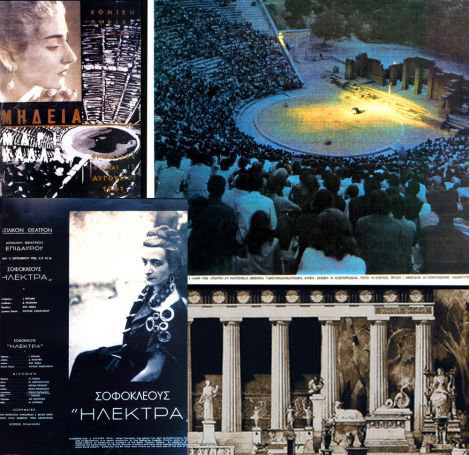
Exhibition «All about Epidaurus»

From Tuesday 11th of June to Sunday 28th of July 2013

Exhibition

« All about Epidaurus »

Archive-Collection, Curator
Vassilis Kavvathas

Library-Gallery of Epidaurus


Before going there,
you should learn
what is Epidaurus,
what is Asclepion,
what does “dream therapy” mean…


Michael Cacoyannis Foundation presents an exhibition under the general title “All about Epidaurus”. It is an exhibition of the archival material of Epidaurus’ performances and activities that is collected by the journalist-author-artist Vassilis Kavvathas and whose curator is Vassilis Kavvathas. The exhibition aspires to present Epidaurus thoroughly and effectively, especially to the young generation. Epidaurus’ magical greatness will be revealed.

Epidaurus was a referential point of antiquity and a notional place that was connecting apprenticeship with the Sanctuary of Asclepius (Asclepion). That was a place where thousands of pilgrim-patients were swarming in order to live the experience of a miracle; there one could follow the ritual of “sleep”, meet God and potentially be resurrected…

Vassilis Kavvathas’ archive
is going to be partially exhibited at Michael Cacoyannis Foundation for the first time, while the ultimate goal of the collector is the creation and the establishing of a Library-Gallery dedicated to Epidaurus.

The unique collection of Vassilis Kavvathas includes: rare editions of books, posters and promotional material of past theatre performances, gravures, etchings made of wood and copper, paintings and photographs, always concerning Epidaurus.

During the exhibition and in dates that will be soon announced, Vassilis Kavvathas will have conversations with theatre personalities, academics and archaeologists. These special interviews with people that have experienced Epidaurus (the Epidaurians) will be open to public.

Instead of an official opening event, on Tuesday 11th of June 2013, Vassilis Kavvathas talks about the archeologist Panagis Kavvadias and Asclepion’s excavation. In parallel, there will be a presentation of the collective editions of his books: “O ton Epidaurion Thiasos (The Troup of Epidaurus)”, “Ego echo paixei stin Epidauro (I have performed in Epidaurus)”, “I Epidauros ef’olis tis ylis (All about Epidaurus)”, “Thea Epidaurou (Epidaurus View)”, “Theas Axion (Worth Seeing)”, “Anaskafi sto Iero (Asclepion’s Excavation)”, “Epidaurion Anathima – Selides Patridognosias (Epidaurus Votives)” and “Toixografies Epidaurou (Epidaurus Frescos)” (KAKTOS publishing).

The Exhibition is organized under the support of Educational Foundation of ESIEA (Union of Editors of Daily Athenian Press)

Piraeus 206, Tavros, Athens
Information +30 210-3418550

Theatre Cultures
Subscribe to Theatre Cultures email updates (newsletter)
Join us on Facebook Theatre Cultures community & network
(new)

Istanbouli Theatre to the 3th International Theater Festival of Salé, Morocco

The International Theater Festival of Salé has invited Istanbouli Theatre to participate with its theater play Koum Yaba in the 3th edition of the Festival, that will be taking place at the city of Salé, Morocco, from 29th May to 2nd June 2013.

Koum Yaba is a theater play directed and performed by Lebanese artist Kassem Istanbouli, a black comedy speaking about the story of the Palestine people since 1948 until our days and inspired by the texts of Palestinian writer Salman Natour. Koum Yaba has been performed in the streets and theatres of Lebanon, Palestinian refugees camps, Syria, Spain, Algeria, Chile, Kuwait, Tunisia, and now will be performed at Morocco for the first time.

The International Theater Festival of Salé, organized by the Association for the Development and Cooperation leaded by Mr.Abdoullah Moussaoui, has invited theater companies from many countries, Morocco, United Arab Emirates, Iraq, Algeria, Egypt, Mexico, Tunisia, Palestine, and Istanbouli Theatre, representing Lebanon.

This year an special focus will be put on Palestine by the Festival, having regard to its new International status, and Koum Yaba will contribute to this celebration.

Istanbouli Theatre

Theatre Cultures
Subscribe to Theatre Cultures email updates (newsletter)
Join us on Facebook Theatre Cultures community & network
(new)

Athens & Epidaurus Festival 2013

Eugène Ionesco, "Rhinoceros". Ensemble Artistique - Emmanuel Demarcy-Mota.

Program of June – theatre

 
5-6 June, 21:00
“Oh my Smyrna, my beautiful Izmir”
Tiyatro Pera – Nesrin Kazankaya
Peiraios 260, Building H
4-8 June, 20:00
“Iliad”, by Homer
Stathis Livathinos
Peiraios 260, Building D
19-20 June,21:00
“Elli Papadimitriou, Common Tale”
Vangelis Theodoropoulos
Peiraios 260, Building H
19-23 & 26 June & 3-7 July
Sophocles, “Antigone”
Natasha Triantafylli
Benaki Museum
22-23 June, 23:00
“Alexanderplatz”
Kanigunda Theatre Company
Peiraios 260, Building E
23-28 & 30 June, 1-5 & 7-12 July, 20:00
Elias Kounelas
Kolonos
27-28 June, 21:00
Dionysios Solomos, "The woman of Zakynthos"
Demos Avdeliodis
Peiraios 260, Building D
29 June, 00:00
Samuel Beckett, Mercier and Camier
Yiannis Kakleas
Peiraios 260, Building H
30 June - 1 July, 21:00
Eugène Ionesco, Rhinoceros
Ensemble Artistique - Emmanuel Demarcy-Mota
Onassis Cultural Centre
30 June & 1-3 July, 21:00 
Friedrich Schiller, Love and Intrigue
Akyllas Karazisis - Nikos Hatzopoulos
Peiraios 260, Building E

TICKETS

Theatre Cultures
Subscribe to Theatre Cultures email updates (newsletter)
Join us on Facebook Theatre Cultures community & network
(new)

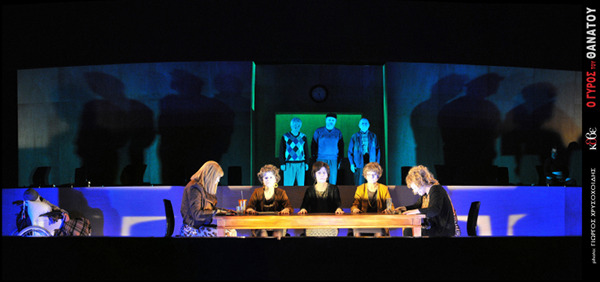
«Ο γύρος του θανάτου», σε σκηνοθεσία Ν.Μαστοράκη

Το μυθιστόρημα του Θωμά Κοροβίνη με κεντρικό θέμα την υπόθεση Αριστείδη Παγκρατίδη, του φερόμενου ως «Δράκου του Σέιχ Σου», μεταφέρεται στη θεατρική σκηνή, σε σκηνοθεσία Νίκου Μαστοράκη.

VIDEO

Εννέα πρόσωπα που συνδέονται με τον Παγκρατίδη, εξομολογούνται τη ζωή τους: ο συμμαθητής και φίλος του, η πλύστρα φίλη της μητέρας του, ο παρακρατικός γείτονας, ένας χωροφύλακας δημοκρατικών φρονημάτων, ο δοσίλογος περιπτεράς, ένας συντηρητικός αστός της παραλίας, το αφεντικό του στον «Γύρο του θανάτου» και δύο περιστασιακοί του έρωτες, η τραβεστί Λολό και μία λαϊκή τραγουδίστρια, καταθέτοντας τη θέση και τη στάση τους για τη δική τους ζωή, φωτίζουν τις σκοτεινές πτυχές της τραγικής προσωπικότητας του νεαρού Αριστείδη και μεταφέρουν την κοινωνικοπολιτική ατμόσφαιρα που διαμορφώθηκε στη Θεσσαλονίκη μετά την κατοχή και τον εμφύλιο.

«Ο γύρος του θανάτου», που τιμήθηκε με το Κρατικό Βραβείο Μυθιστορήματος το 2011, μέσα από την ιστορία του «Δράκου», μας μεταφέρει στις φτωχογειτονιές και τις αλάνες, στα άδυτα του λιμανιού, στα μικρομάγαζα και τα μπουζουξίδικα της παλιάς Θεσσαλονίκης, αναδεικνύοντας έναν κόσμο περιθωριακό, ταπεινωμένο και φοβισμένο και κατορθώνει με αριστοτεχνικό τρόπο να θίξει ευαίσθητες χορδές της ελληνικής κοινωνίας και να φέρει στο φως το ηθικό κατρακύλισμα μιας εποχής που αναζητούσε τρόπους για να ξεπλύνει τις δικές της πληγές, που ακόμη και σήμερα καλά κρατούν.

Σημείωμα συγγραφέα

Ο «Γύρος του θανάτου» γεννήθηκε από ανάγκη βαθύτατου χρέους. Η Θεσσαλονίκη δεν λέει να βγάλει τους σκελετούς απ’ τη σαρακοφαγωμένη ντουλάπα της. Κάθε τόσο η σεμνότυφη κόρη του Βορρά χρήζει κάποιον νέο ανάλγητο Καίσαρα που με τον μανδύα του σωτήρα την ξεγελάει με «άρτον και θεάματα» και τη ρίχνει ξανά στα λιοντάρια. Τη δεκαετία του ’50 είχε διαμορφωθεί στη χώρα μας ένα ανθρωποφαγικό σκηνικό όπου, όποιος πολίτης δεν είχε συμπεριφορά δουλική ή προσαρμοστική τουλάχιστον στις εξουσιαστικές και κοινωνικές νόρμες της εποχής, όφειλε να λογοδοτεί ή να κολάζεται. Μικρό παιδί σφραγίστηκα από το κλίμα απαξίωσης του αυτοπροσδιορισμού και της αυτοδιάθεσης των ανθρώπων. Στη Θεσσαλονίκη ήταν κοινή συνείδηση ότι ο Παγκρατίδης υπήρξε ένα βολικό θύμα του ενοχικού εκείνου καιρού που εξέθρεφε ποικίλους δράκους. Συχνά πίσω από το προσωπείο των μεγαλώνυμων δρακοντοκτόνων κρύβονταν έντεχνα οι καθαρόαιμοι δράκοι. Ο Αριστείδης ήταν ένα παιδί του πάθους και της μοίρας, η ιστορία του με βασάνιζε χρόνια και το μυθιστόρημα που έφτιαξα γύρω από εκείνη την τραγωδία προέκυψε σαν φυσιολογική γέννα.

Σκύβω πάνω απ’ τα απολωλότα, μαζεύω τα τσαλαπατημένα άνθη που απομένουν απ’ το ποδοβολητό και το σάρωμα. Η πλούσια γλωσσική ποικιλία που χρησιμοποιώ δεν είναι φτιαχτή, έτσι μιλούσαν πριν από μισόν αιώνα οι άνθρωποι. Ένας σπουδαστής ή διορθωτής κειμένων μπορεί να ξενίζεται. Οι εποχές μοιάζει να αλλάζουν, μα επαναλαμβάνονται με άλλη φορεσιά. Ο βρόγχος που μας έπνιγε τον καιρό των Θεσσαλονικιών δράκων και του φονικού του Λαμπράκη, –τότε που η κοινή ελληνική πιεζόταν από την αναγκαστική καθαρεύουσα, αλλά πλουτιζόταν από λαϊκά και αργκότικα τσαλίμια– ξανασχεδιάστηκε, σε νέο λουσάτο ντιζάιν, για τον μέχρι χθες επαναπαυμένο και ξεγελασμένο σβέρκο μας. Χαίρομαι που ένας τόσο άξιος θεατρικός μάστορας με ανοιχτούς ορίζοντες και ανατρεπτικό ταμπεραμέντο, σαν τον Νίκο Μαστοράκη, ανεβάζει το έργο στην κρατική σκηνή της πόλης μας.

Θωμάς Κοροβίνης

«Ο ΓΥΡΟΣ ΤΟΥ ΘΑΝΑΤΟΥ»

ΣΥΝΤΕΛΕΣΤΕΣ:
Συγγραφέας: Θωμάς Κοροβίνης
Σκηνοθεσία: Νίκος Μαστοράκης
Σκηνικά-κοστούμια: Νίκος Μαστοράκης
Φωτισμοί: Στέλιος Τζολόπουλος
Βοηθός σκηνοθέτη: Δημήτρης Διακοσάββας
Βοηθός σκηνογράφου-ενδυματολόγου: Κατερίνα Παπαγεωργίου
Οργάνωση παραγωγής: Ηλίας Κοτόπουλος

Διανομή (με σειρά εμφάνισης): Βασίλης Ευταξόπουλος (Ένα φιλαράκι για την αλάνα), Ρούλα Παντελίδου (Η γυναίκα του), Κατερίνα Γιαμαλή (Η παραδουλεύτρα), Αννέτα Κορτσαρίδου (Μια άλλη γυναίκα), Βασίλης Σπυρόπουλος (Ένας αχθοφόρος για τον Μαμουνά), Δημήτρης Κολοβός (Ένας χωροφύλακας δημοκρατικών φρονημάτων), Βασίλης Σεϊμένης (Ένας παρακρατικός γείτονας του Αρίστου για τη δράση του), Κώστας Ίτσιος (Το αφεντικό του Αρίστου στον γνωστό «Γύρο του θανάτου»), Γιάννης Σιαμσιάρης (Λολό), Φωτεινή Μπαξεβάνη (Η Συλβάνα).

Παίζει πιάνο επί σκηνής ο μουσικός Παναγιώτης Μπάρλας.

ΠΡΟΣΟΧΗ: Η ΠΑΡΑΣΤΑΣΗ ΕΙΝΑΙ ΚΑΤΑΛΛΗΛΗ ΓΙΑ ΘΕΑΤΕΣ ΑΝΩ ΤΩΝ 18 ΕΤΩΝ

ΗΜΕΡΕΣ ΠΑΡΑΣΤΑΣΕΩΝ: Πέμπτη, Παρασκευή, Σάββατο, Κυριακή
Πέμπτη 21.00
Παρασκευή 21.00
Σάββατο 21.00
Κυριακή 19.00

Τιμές εισιτηρίων:
Κανονικό εισιτήριο: Πλατεία 15 ευρώ, εξώστης: 12 ευρώ
Κανονικό εισιτήριο στις λαϊκές παραστάσεις (Σάββατο 18.00) πλατεία & εξώστης: 12 ευρώ
Φοιτητικό- Ομαδικό: 10 ευρώ
Άνεργοι: 5 ευρώ

Προπώληση εισιτηρίων:
Ταμεία ΚΘΒΕ
Kαταστήματα Public Θεσσαλονίκης, www.public.gr
Τηλ: 13855 viva.gr

Ώρες λειτουργίας ταμείων

Eταιρεία Μακεδονικών Σπουδών (Εθνικής Αμύνης 2): Τρίτη-Κυριακή: 9.30 π.μ.-21.30 μ.μ
Βασιλικό Θέατρο (Πλατεία Λευκού Πύργου): Τρίτη-Κυριακή: 9.30 π.μ.-21.30 μ.μ

Τηλ. κρατήσεων: 2315 200200
ΒΑΣΙΛΙΚΟ ΘΕΑΤΡΟ (Πλατεία Λευκού Πύργου)


Theatre Cultures
Μπορείτε να εγγραφείτε με email στις προτάσεις του Theatre Cultures
ΕΔΩ μπορείτε να λαμβάνετε πληροφορίες του Facebook Theatre Cultures
(νέο)

Festival Transamériques, 7ème édition

Marie Brassard : "TRIESTE". Photo : Minelly Kamemura

Festival Transamériques, 7ème édition, à Montréal

22.05 – 8.06.2013

Programme – Théâtre

22, 23, 24 mai
Un ennemi du peuple
Video
Thomas Ostermeier | Schaubühne am Lehniner Platz
Berlin
24, 25, 26, 27 mai
Nella tempesta
Video
ENRICO CASAGRANDE + DANIELA NICOLÒ | MOTUS
Rimini
25, 26, 27 mai
Trieste
Infrarouge | Marie Brassard
Montréal
27, 28, 29 mai
Winners and Losers
Video
James Long + Marcus Youssef | Neworld Theatre + Theatre Replacement
Vancouver
28, 29, 30 mai
Conte d'amour
Video
Markus Öhrn | Institutet + Nya Rampen
Malmö + Helsinki + Berlin
30, 31 mai, 1, 2 juin
Ganesh Versus the Third Reich
Video
Bruce Gladwin | Back to Back Theatre
Melbourne
31 mai, 1, 2 juin
L’homme atlantique
Video
Christian Lapointe | Théâtre Péril
Québec
2, 3, 4 juin
La Jeune-Fille et la mort 
Video
Laurence Brunelle-Côté + Simon Drouin | Bureau de l'APA
Québec
3, 4, 5, 6, 7 juin
Outrage au public
Peter Handke + Christian Lapointe | Recto-Verso
Québec
5, 6, 7, 8 juin
Ainsi parlait…
Video
Frédérick Gravel
Étienne Lepage
Montréal
7, 8 juin
La grande et fabuleuse histoire du commerce
Video
Joël Pommerat | Compagnie Louis Brouillard
Paris

BILLETS

La Newsletter de Theatre Cultures
Facebook Theatre Cultures (nouveau)

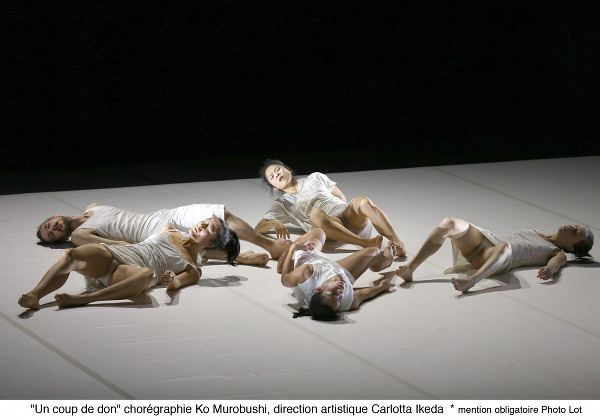
La blancheur des corps irradiés

« La blancheur des corps irradiés »

Carlotta Ikeda et Ko Murobushi mettent le butô sur la voie du nucléaire

par Thomas Hahn

Tenace et indélébile, un mythe refuse de lâcher prise. Il veut que la danse qu’on appelle butô serait née en réaction aux bombes atomiques qui ont dévasté Hiroshima et Nagasaki. C’est faux. En vérité, le butô est né dans les années 1960, au sein d’une mouvance s’opposant à la présence de bases militaires américaines au Japon, principalement par les performances déjantés e Tatusmi Hijikata. C’est pourquoi on se frotte les yeux quand aujourd’hui, Carlotta Ikeda et Ko Murobushi, deux des artistes vivants des plus emblématiques de cette danse théâtrale, présentent une création sous empreinte nucléaire. Evoquer, par une pièce de butô, Hiroshima, Nagasaki et Fukushima, c’est à la fois revenir au malentendu évoqué et rejoindre la dynamique originelle du butô, qui était lié au désir de transformer la société. Mais les temps ont changé. Trente ans après la mort de Hijikata, le butô s’exprime rarement dans le registre grotesque propre au fondateur du genre. Aujourd’hui la poétique l’emporte largement. Et Ikeda, qui travaille à Bordeaux, sollicite Ko Murobushi, qui la rejoint du Japon pour créer « Un coup de don », pièce pour sept danseurs, déclinée en autant de tableaux, où les corps rayonnent dans une blancheur éclatante. Jamais la pièce ne délivre un discours didactique. Toute critique intervient ici dans une discrétion toute japonaise, dans une dimension métaphorique et si subtile, si poétique qu’elle pourrait passer inaperçue.

Les habits blancs des interprètes, dont Ikeda, illuminent la scène. A la fin des premiers tableaux, le public est ébloui par un flash soudain, suivi d’un noir profond. Aussi, « l’autre face de la lune s’enfonce dans l’obscurité. » Ainsi débute la chanson « Dernière nouvelle » de Yosoui Inoue, écrite comme réaction au cataclysme de Fukushima. On l’entend à la fin, en japonais et sans surtitres. La traduction du texte est distribuée au public à la sortie. Car, bien sûr, la pièce est avant tout une œuvre, pas un tract. Et le butô est le fief de la métaphore.

Les costumes sont comme irradiés, dans des tableaux très stylisés, en noir et blanc, épurés et pourtant troublants, jusqu’à devenir angoissants. Debout, les personnages font penser à ceux de « May B » de Maguy Marin, couchés à certains tableaux vus chez Sankai Juku. Les déplacements dans l’espace sont très limités. Les corps tremblent, on entend la chair et les os claquer. Un duo rappelle l’épure et la poésie spécifiques à Raimund Hoghe. Si ces réminiscences soulignent la porosité entre l’Europe et le Japon, l’inspiration concrète vient ici de « Hiroshima, mon amour » de Marguerite Duras et Alain Resnais, et plus particulièrement de l’image de la silhouette d’un homme, gravée dans un escalier en béton, instantanément, sous l’empreinte du choc thermique de 10.000°C. Notons cependant que Murobushi signe ses réflexions le16 juin 2011, trois mois après le tsunami et la destruction de Fukushima. Le nucléaire tue, soit en une fraction de seconde, soit au fil des décennies. Tableau par tableau, « Un coup de don » explore ces deux rapports au temps et au trépas, au choc et à l’attente. En japonais, « don » est l’onomatopée qui décrit le son d’une déflagration. Et Murobushi de s’interroger sur la troublante beauté de la vague géante et de « l’éclat de mille soleils ».

S’interroger sur la mort et les spectres, voilà un des axes qui constituent la « danse des ténèbres ». Ikeda et Murobushi reprennent ici le flambeau, dans des images qui jouent sur l’opposition d’une extrême esthétisation et la mort multipliée à l’infini. Oui, le butô peut aujourd’hui s’opposer aux technologies de la mort, tout en créant une poétique universelle.

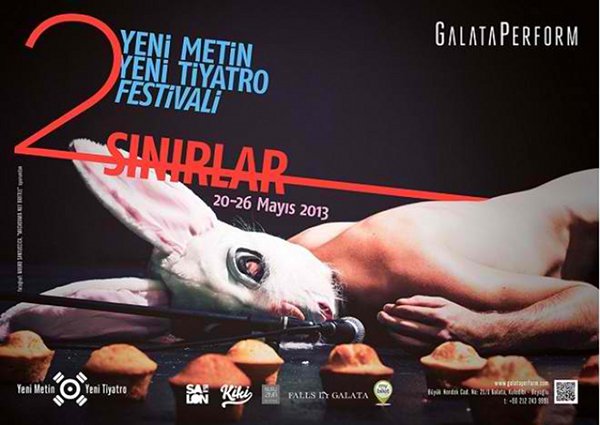
2nd New Text New Theatre Festival, Yeni Metin Yeni Tiyatro Festivali

2nd Yeni Metin Yeni Tiyatro Festivali – this years’ theme of New Text New Theatre is

“Borders”


Dates for the Workshop

May 24 Fri 10.30 – 16.30
May 25 Sat 10.30 – 16.30
May 26 Sun 10.30 – 16.30

Workshop by Ricci/Forte: Beneath the Roses

New Text New Theatre Festival which is going to be executed by GalataPerform for the second time between May 20-26 entertains Ricci/Forte whom have considerably been debated in the recent years. This year’s theme of New Text New Theatre is: ‘Borders’. Proof readings, discussions and workshops of the first plays of novel playwrights will be carried out throughout the festival. The international guests of the festival are the divergent cronies Ricci/Forte.

Ricci/Forte who represent the Italian Contemporary Theatre in the international festivals with their own plays: “Macadamia Nut Brittle”, “Grimmless”, “%100 Furious”, “Abbastarduna”, “Pinter’s Anatomy” and “Imitation of Death” will be in İstanbul between May 23-27. In the New Text New Theatre Festival, “Macadamia Nut Brittle” is going to be presented as reading theatre; “Grimmless” will be played as a video; Ricci/Forte will realize a workshop called ‘’Beneath the Roses”. The workshop is available only for 20 participants and will be in Galata Hamursuz Fırını between 10.30-16.30 during May 24-25-26. The workshop will last 3 days and present a challenge to the players both physically and psychologically focusing on body, voice, and courage. Stated by them very concisely: ‘No more stories about characters, or events to be worn such clothes in a sale of Zara and H&M but fragments, our pure and simple skin to be removed to reveal the ferocity of our fallibility: a search of the tumults of our passions, understood as an escape from any gag of role.’

The workshop will be in Italian and consecutively translated into Turkish
Contact: Ferdi Çetin, yenimetinyenitiyatro@galataperform.com, 00 90 506 453 07 37

24 May 2013 , FRIDAY at 19:00

When in Rome & Language

(Staged Play-Reading)

When in Rome (7:00PM)

Written by: Öznur Şahin
Directed by: Mesut Arslan
Performers: Murat Karasu, Özden Çiftçi, Pervin Bağdat, Arda Çetinkaya

The boyfriend of a young woman who lives with her landlady in the same apartment, comes to stay with her for a short time. The young woman, Ayşen, has to hide this situation which her family knows from her neighbours. A jail-like life begins for her as the situation gets more complicated. The play discusses the notion of conservatism in the borders of private life and introduces an extraordinary point of view to an ordinary life by striking a blow at reality. ‘When in Rome’ is a critical comedy having the rhythym of vodvil.


Language (8:30PM)

Written by: Şenay Tanrıvermiş
Directed by: Yeşim Özsoy Gülan
Performers: Yeşim Ceren Bozoğlu, Şirvan Akan, Yağız Can Konyalı

A modern flat where a middle-class family lives, the day is like today. Arzu lost one of a pair of Marrylou mitt made of silk cashmere and is incessantly in search of it. What a weird country this is! Everything and everybody continuously disappear. ‘Language’ talks about the daily life of a social class which is about to disappear, from a grotesque perspective. The play mixes the colloquial language with the register of politics and scents out the loss in a fantastic atmosphere. ‘Language’ has a very keen understanding of humour and introduces a brand new and brave perspective to the field of playwriting.

Tickets


25 May 2013,  SATURDAY at 13:00

No:2/1 & HSKTR & Housetop

(Play-Reading)

*There will be a discussion with the playwrights after the performances

No:2/1 (1:00PM)

Written by: Duygu Süreyya Yalçın
Directed by: Yusuf Demirkol
Performers: Bertan Dirikolu, Emre Yetim, İnci Nur Daşdemir, Şafak Ersözlü

The government authorities announce that the ones who are older than 70 are going to be killed. They raid houses and take old people. The streets witness genocides. Everybody should give the old in their houses in charge of the government authorities. All descents living with their parents undergo a very hard examination. ‘No:2/1’, an experimentation on dystopia which does not forget the reality of Turkey, is a conflict between father and son wandering around the borders between hatred and conscience.


HSKTR (3:00PM)

Written by: Doğu Polat
Directed by: Beyti Engin
Performers: Emrah Eren, Bekir Çiçekdemir, Ozan Ayhan, Ali Kil, Bulut Akkale, Arzu Akın

Young clerk secretary comes to judicial court on the first day of his career but nothing is as he has imagined. All of a sudden, he finds himself in a court case in which he is being judged. As he speaks more and more, his speech turns into an exhibit against himself. Consequently, he is accused of being a terrorist in an organization called HSKTR. ‘HSKTR’ reminds us of a burlesque in folk tradition both in language and content. It also proposes a staging rehearsal between genres thanks to its grotesque atmosphere.

Housetop (5:00PM)

Written by: Buket Ketbağa
Directed by: Ayşe Lebriz Berkem
Performers: Tansu Biçer, Devrim Evin, Nergiz Acar

Sedat opens the doors of his house to Ömer whom he does not know well. Ömer is previously a court officer, Sedat a lawyer. They promote their relations in a way that they turn the necessary borders of social life upside down as well as testing the borders of private life in the same house. ‘Dam’, re-handles the relationship between property and power from a humanist perspective.

Tickets

GalataPerform


Theatre Cultures
Subscribe to Theatre Cultures email updates (newsletter)
Join us on Facebook Theatre Cultures community & network
(new)

Salon IKSV

21 May 2013 at 19:00

Tongue & When in Rome

Under the scope of OYUN SALONU # what? A play-reading realized in cooperation with GalataPerform and Salon within the framework of the 2nd New Text New Theatre Festival. story Tongue: The play by Şenay Tanrıvermiş tells about the daily life of a disappearing social class from a grotesque point of view. The play combines daily language with the language of political propaganda. (Yeşim Özsoy Gülan, director) When in Rome: The play by Öznur Şahin discusses the concept of conservatism within the framework of private life. By interfering with reality, it contributes a critical and witty language to ordinary life. (Mesut Arslan, director) performance New playwrights meet with the audience and answer their questions after a reading of their play. tickets Seated (without number) 30 TL Student 20 TL.

http://galataperform.com/, http://yenimetinyenitiyatro.blogspot.com/p/hakkmzda.html

22 May 2013 at 20:00

Playwriting

what? Salon welcomes Berkun Oya (Krek), Yeşim Özsoy Gülan (GalataPeform), and Yiğit Sertdemir (Altıdan Sonra Tiyatro), three prominent playwrights of Turkey for a panel dicussion on playwriting. To be moderated by Yekta Kopan, the panel discussion will be held in Turkish.

24 – 25 May 2013 at 10:00

From a small Stage to the Whole of Drama

Under the scope of OYUN SALONU # what? A two-day playwriting workshop held in cooperation with the Goethe Institute under the tutelage of multi-awareded German writer Moritz Rinke. content Participants will be informed about the design of conflictual situations, orchestration of play characters and dialogue management. They will also seek answers to key questions in drama: “Who is a character in a play? “What does action mean?” “What do we understand from play materials?” (The workshop will be held in English, simultaneous translation will be available). participation A limited number of participants will have the chance to discuss in person with Moritz Rinke techniqes of playwriting and dramaturgy in the course of 2 days. tickets 75 TL Student 60 TL

24-25 May 2013 at 20:30

33 Rounds and a few Seconds

Under the scope of OYUN SALONU # in cooperation with Institut Français Turquie what? An experimental play « without actors », written and directed by Rabih Mroué & Lina Saneh (3 performances). story A young Lebanese man commits suicide. In his farewell letter, he says his death is a purely personal act and should not be used for political purposes. But is personal always political as well? performance Addressing social problems and the political situation in the Near East, the play invites us to follow the final days of the young man. There are no actors on the stage, however, but a bedroom, in which the young man’s television, mobile phone, computer and Facebook page continue his life even after death. tickets Seated 50 TL Student 40 TL (The second performance will be on 25 May at 18.00)

Ticket Info

Istanbul Foundation for Culture and Arts

Theatre Cultures
Subscribe to Theatre Cultures email updates (newsletter)
Join us on Facebook Theatre Cultures community & network
(new)


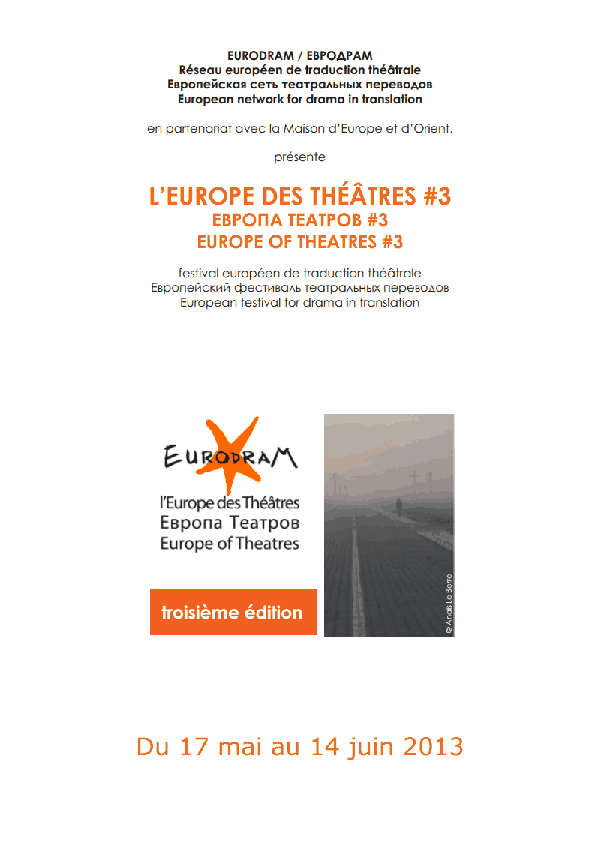
EURODRAM: Festival européen de la traduction théâtrale

L’Europe des Théâtres a pour objectif la promotion de la traduction théâtrale en Europe et dans les régions voisines, par l’organisation de lectures publiques de pièces de théâtre traduites de langues européennes ou voisines, accompagnées de rencontres avec des auteurs et des traducteurs, mais aussi des théoriciens ou praticiens du théâtre.

Cette manifestation est portée par EURODRAM, réseau européen de traduction théâtrale, coordonné par la Maison d’Europe et d’Orient. Multilatéral, international, organisé en une quarantaine de comités linguistiques interconnectés, le réseau contribue à élargir et à fluidifier les canaux de circulation des œuvres dramatiques à l’échelle du continent, en exerçant une veille permanente et en prêtant une attention particulière à la production émergente et innovante.

Dépasser la longue tradition de traduction théâtrale des langues occidentales entre elles, élargir le champ de vision du public et des professionnels, favoriser les rencontres et échanges entre auteurs, traducteurs et public… autant d’objectifs que poursuit la Maison d’Europe et d’Orient depuis sa création, par le biais notamment de ce festival unique en son genre.

Voir la liste des évènements :

★ vendredi 17 mai à 18h30
France, Paris, Maison d’Europe et d’Orient
Ouverture de l’Europe des Théâtres #3

Vernissage de l’exposition Errances d’un Homme sans passé
d’Anaïs Le Berre
(en savoir plus)
à 19h30
Présentation du festival par les compagnies participantes

HORS LES MURS
★ du 10 au 17 mai
France, Dijon
Scènes d’!nsultes, focus sur la scène roumaine actuelle
Lectures, rencontres, colloque & ateliers d’écriture
(en savoir plus)

HORS LES MURS
★ vendredi 17 mai à 20h
France, Grenoble, Théâtre 145
Antidote
de Nicoleta Esinencu
festival Regards Croisés
(en savoir plus)
traduit du roumain (Moldavie) par Alexandra Lazarescou

★ samedi 18 mai à 20h30
France, Paris, Maison d’Europe et d’Orient
On n’a qu’à Koliader !
lecture de textes de Nikolaï Koliada
(en savoir plus)
traduits du russe par Elsa Furtado
Direction Bérangère Delobelle et Elsa Furtado

★ lundi 20 mai à 20h30
France, Paris, Maison d’Europe et d’Orient
Cabaret de la traduction
en partenariat avec Eurodram, réseau européen de traduction théâtrale
(en savoir plus)

HORS LES MURS
★ du mardi 21 au dimanche 26 mai
France, Paris, Théâtre de l’Atalante
Traduire, transmettre, rencontres autour de la traduction théâtrale

quatrième saison : la Grèce

(en savoir plus)
en présence de Dimitris Dimitriadis

24 mai à 19h30
France, Paris, Maison d’Europe et d’Orient
Remontée de Gagik Ghazareh
(en savoir plus)
traduit de l’arménien par Kegham Nigoghossian, Anaïd Donabédian et Shaga Yuzbashyan
publié aux éditions l’Espace d’un instant
Direction Dominique Dolmieu

HORS LES MURS
25 mai à 18h
France, Montreuil, jardin Pouplier
Les Villes invisibles d’Italo Calvino
(en savoir plus)
traduit de l’italien par Jean Thibaudeau
Direction Anna Dewaele

★ lundi 27 mai à 19h30
France, Paris, Maison d’Europe et d’Orient
Rose is a rose
de Yana Borisova
(en savoir plus)
traduit du bulgare par Snéjina Roussinova-Zdravkova
Cette lecture fait suite à un travail de stage avec Galin Stoev.

HORS LES MURS
★ lundi 27 mai de 10h à 18h
France, Lyon, MJC Monplaisir
lectures d’extraits de textes publiés aux éditions l’Espace d’un instant
Lundis en coulisse (Théâtre Narration)
(en savoir plus)
direction Dominique Dolmieu

HORS LES MURS
★ mardi 28 mai à 20h
France, Paris, Institut hongrois
Mein Kampf (Farce)
de George Tabori
(en savoir plus)
traduit de l’allemand par Armando Llamas
direction Makita Samba et Marine Reiland

HORS LES MURS
★ mercredi 29 mai à 19h
France, Paris, Le Grand Parquet
Fleurs de prière de Girish Karnad
(en savoir plus)
traduit de l’anglais par Nathalie Bassand
direction et lecture Asil Raïs

★ mercredi 29 mai à 19h30
France, Paris, Maison d’Europe et d’Orient
Le cabaret de l’austérité à partir des textes de Gilad Kahana
(en savoir plus)
traduit de l’hébreu par Zohar Wexler
dirigé par et avec Catherine Gandois, Julie Pouillon et Zohar Wexler

HORS LES MURS
★ mercredi 29 mai à 20h et 30 mai à 15h
France, Paris, Centre Culturel tchèque
Komunizmus, une comédie de normalisation de Viliam Klimáček
(en savoir plus)
traduit du slovaque par Jaromír Janeček et Claire Vidoni
Direction Éric Cénat

HORS LES MURS
★ vendredi 31 mai à 15h et 19h
France, Orléans, Centre Dramatique National Orléans/ Loiret / Centre
Komunizmus, une comédie de normalisation
de Viliam Klimáček
(en savoir plus)
traduit du slovaque par Jaromír Janeček et Claire Vidoni
Direction Éric Cénat

HORS LES MURS
★ vendredi 31 mai à 17h
Serbie, Novi Sad, projet Trans Script
Georges Kaplan
de Frédéric Sonntag
traduit du français par Jovana Papovic and Ugljesa Sajtinac
(en savoir plus)
Direction Zanko Tomic

HORS LES MURS
★ samedi 1er juin à 17h
Serbie, Novi Sad, festival Trans Script
Traduire le théâtre, traduire les cultures ?

(en savoir plus)
avec Frédéric Sonntag, Philippe Le Moine, Dominique Dolmieu, Milos Kreckovic et Igor Bojovic

HORS LES MURS
★ samedi 1er juin à 16h
France, Lille, librairie Dialogues Théâtre
Mères sans chattes de Nicoleta Esinencu
(en savoir plus)
traduit du roumain par Mirella Patureau
direction Veronika Boutinova

★ lundi 3 juin à 19h30
France, Paris, Maison d’Europe et d’Orient
Respire ! d’ Asja Srnec Todorović
(en savoir plus)
traduit du croate par Mireille Robin
publié aux éditions l’Espace d’un instant
direction Olivier Hamel

HORS LES MURS
★ lundi 3 juin à 19h
Espagne, Madrid, Centre Culturel Le Torito
Le Veilleur de pierres de János Hay
(en savoir plus)
traduit du hongrois vers l’espagnol par Gabriela Zombory
direction Carlos de Matteis

HORS LES MURS
★ mardi 4 juin à 19h
Espagne, Madrid, Centre Culturel Le Torito
Orchestre Titanic de Hristo Boychev
(en savoir plus)
traduit du bulgare vers l’espagnol par Maia Guenova
Direction Daniel Martos

★ mardi 4 juin à 19h30
France, Paris, Maison d’Europe et d’Orient
L’Histoire des ours pandas racontée par un saxophoniste
qui a une petite amie à Francfort
de Matéi Visniec
(en savoir plus)
direction Katia Ogorodnikova

★ vendredi 7 juin à 19h30
France, Paris, Maison d’Europe et d’Orient
Cunégonde en Carlaland de Venko Andonovski
lecture et vernissage du livre publié aux éditions l’Espace d’un instant
(en savoir plus)
traduit du macédonien par Maria Béjanovska
direction Tristan Le Doze

HORS LES MURS
★ samedi 8 juin à 15h30
France, Bazoches-sur-Guyonne, Maison Jean Monnet
Respire !
d’ Asja Srnec Todorović
(en savoir plus)
traduit du croate par Mireille Robin
publié aux éditions l’Espace d’un instant
direction Dominique Dolmieu

★ dimanche 9 juin à 18h30
France, Paris, Maison d’Europe et d’Orient
La Gorge de Žanina Mirčevska
(en savoir plus)
lecture et vernissage du livre publié aux éditions l’Espace d’un instant
traduit du macédonien par Maria Béjanovska

HORS LES MURS
★ mardi 11 juin à 12h30
France, Paris, Théatre du Rond-Point
Černodrinski revient à la maison de Goran Stefanovski
(en savoir plus)
lecture et vernissage du livre publié aux éditions l’Espace d’un instant
traduit du slavoslavomacédonien par Maria Béjanovska
direction Dominique Dolmieu

HORS LES MURS
★ mardi 11 juin à 19h
Espagne, Madrid, Centre Culturel Le Torito de la Mairie de Madrid
Forteresse Europe de Tom Lanoye
(en savoir plus)
traduit du flamand vers l’espagnol par Ronald Brouwer
Direction Luis Miguel G. Cruz

★ mercredi 12 juin à 19h30
France, Paris, Maison d’Europe et d’Orient
Par la fenêtre de Yair Packer
(en savoir plus)
traduit de l’hébreu via l’anglais par Nathalie Bassand
direction Lucienne Deschamps et Catherine Jabot

★ vendredi 14 juin à 19h30
France, Paris, Maison d’Europe et d’Orient
Les Monologues de Gaza
un projet du Théâtre Ashtar de Ramallah
(en savoir plus)
traduit de l’arabe par Marianne Weiss
direction Dominique Dolmieu

HORS LES MURS
★ vendredi 14 juin
Pologne,  Białystok, Teatr Dramatyczny
Les tarés reviennent s’installer en masse de Mikołaj Rudkowski
(en savoir plus)
traduit du biélorussien vers le polonais par Jakub Adamowicz
dirigé par Agnieszka Korytkowska – Mazur


La Newsletter de Theatre Cultures
Facebook Theatre Cultures (nouveau)