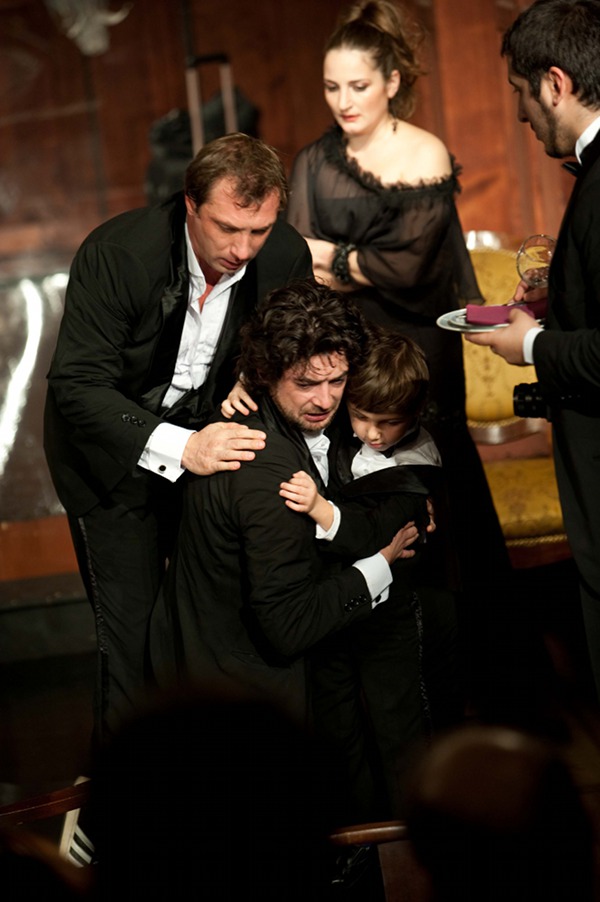
ΕΘΝΙΚΟ ΘΕΑΤΡΟ, "ΕΡΩΦΙΛΗ". ΣΚΗΝΟΘΕΣΙΑ: ΔΗΜΟΣ ΑΒΔΕΛΙΩΔΗΣΓεωργίου Χορτάτση "Ερωφίλη"
ΕΘΝΙΚΟ ΘΕΑΤΡΟ. Σκηνοθεσία: Δήμος Αβδελιώδης.
Μέχρι τις 3 Μαρτίου στην Αίθουσα Εκδηλώσεων.
Με ένα από τα κορυφαία αριστουργήματα του Κρητικού Θεάτρου συνεχίζονται – μετά τους Πλατωνικούς Διαλόγους – οι επιτυχημένες εκδηλώσεις της «Άλλης Διάστασης» στην Αίθουσα Εκδηλώσεων.
Ανοίγοντας τον κύκλο «Γλώσσα Ελληνική», η Ερωφίλη παρουσιάζεται σε μία ερευνητική προσέγγιση από τον Δήμο Αβδελιώδη, σκηνοθέτη γνωστό για την ιδιαίτερη σχέση του με το λόγο και το ρυθμό.
Παρτιτούρα με λέξεις
Κάθε γραπτό κείμενο, προορισμένο να αποδοθεί θεατρικά, είναι ένα είδος παρτιτούρας που μέλλεται να ερμηνευθεί με τη φωνή.
Κάθε κείμενο έχει τη δική του μουσική.
Μπροστά σε ένα ποιητικό έργο γραμμένο σε δεκαπεντασύλλαβο, απαιτείται διπλή προσπάθεια ώστε να μην υπερισχύσει η εξωτερική μουσική του στίχου και της ομοιοκαταληξίας επάνω στην κύρια και βαθύτερη μουσική του νοήματος.
Στην Ερωφίλη όπου κυριαρχεί το πάθος, η τέχνη και η πηγαία έμπνευση του Χορτάτση, ο λογικός και ρεαλιστικός καμβάς του συγγραφέα είναι που επιβάλει σκηνοθετικά την όλη ενορχήστρωση και την ερμηνεία.
Δήμος Αβδελιώδης
Το έργο
Η Ερωφίλη, κόρη του σκληρού και άδικου βασιλιά της Αιγύπτου Φιλόγονου, έχει παντρευτεί κρυφά τον γενναίο στρατηγό του πατέρα της, Πανάρετο. Όταν ο Φιλόγονος αποφασίζει να παντρέψει την κόρη του με κάποιον άλλο και επιλέγει τον Πανάρετο ως μεσάζοντα, η μυστική ένωση των δύο νέων έρχεται στο φως. Ο Φιλόγονος θα εκδικηθεί τους δύο νέους με τον πιο σκληρό, αιμοσταγή και μακάβριο τρόπο….
Υπηρεσία Εισιτηρίων τηλεφωνικά: 210 7234567
online: http://www.ticketservices.gr/el/events/?eventid=333 Με χρέωση υπηρεσίας 7.5%
Τα εισιτήρια που αγοράζονται τηλεφωνικά ή οnline παραλαμβάνονται
οποιαδήποτε στιγμή από τα ταμεία του Εθνικού Θεάτρου.
Louis revient dans son pays lointain, celui où il est né, celui de ses racines, dire à sa famille qu’il va mourir. Il emmène avec lui la famille qu’il s’est construite dans son exil. Ces deux familles se rencontrent, s’opposent, s’associent pour mieux connaître Louis, l’aider à raconter. Les morts aussi reviennent pour l’occasion.
« Le texte de Jean-Luc Lagarce est éblouissant. Cet adieu à la vie sans le moindre pathos vous emporte comme un fleuve puissant à l’écriture limpide, jonglant en virtuose avec les codes du théâtre classique, faisant dialoguer les vivants et les morts comme dans la littérature fantastique. ʺUn roman vivantʺ, dit Luc Sabot qui signe quatre heures de mise en scène parfaitement dans l’esprit de l’auteur, avec une fluidité réjouissante.&nbs p;» Jean-Marie Gavalda, Midi Libre, 1er nov 11
Jeudi 26 janvier à l’issue de la représentation : rencontre avec l’équipe artistique et François Berreur, le plus proche collaborateur de Jean-Luc Lagarce avec qui il fonde en 1992 les Editions Les Solitaires Intempestifs dont il est encore le directeur littéraire.
Contact :
Billetterie / Hall de l’Office de Tourisme Montpellier
18 Ιανουαρίου – 25 Φεβρουαρίου  2012 (εκτός Δευτέρας & Τρίτης)
Στέγη Γραμμάτων και Τεχνών, ώρα 20:30
Η πιο σκοτεινή από τις τραγωδίες του Σαίξπηρ, Μακμπέθ, ζωντανεύει σε μετάφραση Δημήτρη Δημητριάδη και σκηνοθεσία Θωμά Μοσχόπουλου, από τις 18 Ιανουαρίου έως τις 25 Φεβρουαρίου 2012 (εκτός Δευτέρας & Τρίτης), στην Κεντρική Σκηνή της Στέγης Γραμμάτων & Τεχνών.
Αυτό το αριστούργημα της ελισαβετιανής εποχής είναι από τα ελάχιστα έργα της παγκόσμιας δραματουργίας που δεν χρειάζονται συστάσεις. Ο Μακμπέθ είναι μια τραγωδία που μπορεί να αποτελέσει υλικό για ένα θέατρο ζωντανό, παλλόμενο και συγκλονιστικό. Τρομοκρατία, καταστολή, κοινωνική και ιδεολογική αστάθεια είναι ο σκηνικός χώρος της καθημερινότητας των συγχρόνων του Σαίξπηρ. Το έργο είναι γραμμένο σε μια εποχή δραματικών κρίσεων και μεταβολών σε πολιτικό, κοινωνικό και ιδεολογικό επίπεδο για τη Βρετανία αλλά και ολόκληρη την Ευρώπη. Οι αναγωγές στην εποχή μας θα μπορούσαν να θεωρηθούν παρακινδυνευμένες, πλην όμως είναι αναπόφευκτες. Γνωστός για την έμφαση που δίνει στις παραστάσεις συνόλου, ο Θωμάς Μοσχόπουλος συνεργάζεται στο φιλόδοξο αυτό εγχείρημα με ξεχωριστούς καλλιτέχνες, στην πλειονότητά τους σταθερούς συνοδοιπόρους των θεατρικών διαδρομών του.
Αν και ο αγαπητός στο θεατρόφιλο κοινό Θωμάς Μοσχόπουλος δεν επιδιώκει την επικαιροποίηση του σαιξπηρικού κειμένου, το προσεγγίζει με μια εμφανή διάθεση να αναδείξει τις κρυφές συνδέσεις του με την εποχή μας. Άλλωστε, το έργο πραγματεύεται καταστάσεις και πάθη σύμφυτα με τον άνθρωπο και πάντα επίκαιρα.
Στην πρώτη του αναμέτρηση με την σαιξπηρική τραγωδία, ο Θωμάς Μοσχόπουλος ενδιαφέρεται πρωτίστως για την απόδοση της σχέσης μεταξύ πραγματικού και ψευδαισθησιακού. Αναγνωρίζοντας στον Μακμπέθ τα χαρακτηριστικά ενός πρώιμου μπαρόκ έργου, η σκηνοθεσία βασίζεται στην συνύπαρξη ρεαλισμού και αντιρρεαλισμού, φορμαλιστικής και υπερφυσικής διάστασης.
***
Ο Θωμάς Μοσχόπουλος γεννήθηκε στην Mπίτολα της Γιουγκοσλαβίας.
Σπούδασε φιλολογία στο Αριστοτέλειο Πανεπιστήμιο Θεσσαλονίκης, θέατρο στη Δραματική Σχολή του Κρατικού Θεάτρου Bόρειας Ελλάδας και κινηματογράφο στο Διεθνές Εργαστήριο Eπικοινωνίας του Oύντινε (Iταλία).
Από το 2001 έως 2008 υπήρξε καλλιτεχνικός συνδιευθυντής μαζί με τον Γιάννη Χουβαρδά του Θεάτρου του Νότου (Αμόρε).
***
Λίγα λόγια για το έργο:
Ο στρατηγός Μακμπέθ, επιστρέφοντας νικητής από πόλεμο, συμβουλεύεται τρεις μάγισσες που του προλέγουν ότι θα γίνει Βασιλιάς. Παρακινούμενος τότε από την αχαλίνωτη φιλοδοξία του αλλά και από εκείνη της συζύγου του δολοφονεί τον φιλοξενούμενό του Βασιλιά Ντάνκαν και καταλαμβάνει το θρόνο της Σκωτίας. Διατηρώντας όμως στη μνήμη του τη προφητεία των μαγισσών ότι ο φίλος του, στρατηγός Μπάνκο, θα αποκτήσει τέκνα που θα γίνουν Βασιλιάδες, επιφορτίζει δύο δολοφόνους να φονεύσουν τον Μπάνκο.
Η τραγωδία του Σαίξπηρ σκιαγραφεί με μελανά χρώματα την σήψη της εξουσίας και την υπέρμετρη φιλοδοξία του ανθρώπου που τον αποκτηνώνει και τον οδηγεί στον θάνατο. Χρησιμοποιώντας τα αγαπημένα του θέματα, ο Σαίξπηρ δημιουργεί μια αξεπέραστη πολιτική τραγωδία με ολοζώντανους χαρακτήρες.
Αποκτήστε το εισιτήριό σας ηλεκτρονικά, τηλεφωνικά ή από τα εκδοτήρια εισιτηρίων της Στέγης.
Πληροφορίες παραστάσεων και τηλεφωνική πώληση εισιτηρίων:
Tηλ.: 210 900 5 800 (Δε-Κυρ: 9:00-21:00)
Ηλεκτρονική πώληση εισιτηρίων: στην ιστοσελίδα της Στέγης Γραμμάτων και Τεχνών για αγορά εισιτηρίων online με χρέωση της πιστωτικής σας κάρτας www.sgt.gr
THEATRE FROM THE EDGES OF EUROPE IN AN INTERNATIONAL CONTEXT
by Gordana Vnuk *
Talking today about performing arts in the Balkan region (I will concentrate on former Yugoslavia and, being highly selective, on its creative highlights), takes into account, more seriously than elsewhere, the unreliable edges of historical contexts which have multiplied in the last 30 years.
After the death of Tito and Titoism thirty years ago, ex-Yugoslavia was passing through a tumultuous period of political disorientation. The arts, and theatre as its most vital branch, tried to stop this disorientation by either taking part in the national homogenization or in the transnational symbolization. Both paths looked anachronistic from the European point of view, but, if only somebody was willing to deal with it, also authentic.
While the theatre in Western Europe, in the sense of Badiou, turned towards totalitarianism, meaning self-referentiality, here the theatre still counted on playfulness and theatricality as an interspace between artistic use and political abuse. It had a sense for grandeur of a theme and some of the best Yugoslav directors were skilled in carrying these themes through a dialectical procedure, in contrast to self-referential purism which, instead of the deideologisation of social themes, abolished the social dimension altogether by putting a mediocre individual into a centrifuge, after which all laundry had to be white.
In the history of secondary cultures, as the Yugoslav ones were, we can find numerous art works that were created out of reach of artistic authorities, which enabled the creators to work with greater artistic freedom and, in this way, often come to radical and unique solutions which preceded the ruptures within a dominant style. (In Croatia there are examples from the Church of St. Cross in Nin and the Šibenik Cathedral to the visual arts movement of the fifties, EXAT, the 20th century poet Nikola Šop, etc.).
In the most influental discourse of the time it seemed that the new theatre of the eighties (later post-dramatic theatre), which rebelled against logo-centric statements in favour of media syncretism that opened the theatre towards new technology, other media, visual arts, dance and movement, was limited in its phenomenological aspect to Western Europe, which provided the examples for the theory of post-dramatic theatre. Although it pretended to be “European”, its promoters who tried zealously to devise a theoretical and critical background for this new generation of artists, did not move further than the western capitals (and let’s not mention non-European cultures).
The theatre in ex-Yugoslavia did not have a problem with the articulation of these post-dramatic aesthetics but had to accept playing with a reduced deck of cards. This kind of theatre would serve the purposes which Badiou refers to as étatiques and it would make a political and intellectual difference in Eastern Europe, however, mostly in its representational dimension through festivals. For a more serious and fundamental cultural purpose, it lacked the permission for a bigger stake.
No wonder that in the Yugoslav culture of festivals Robert Wilson appeared in Belgrade only a year after his European début in Nancy. The German hyper-realism (Stein, Peymann, Zadek, ..) was awarded many times at the same festival. We can say that Yugoslavia “kept pace,” though the best examples of Yugoslav theatre were created outside the governing trends and in opposition to the technology of selfishness which was already taking root in our soil as well.
The fall of the Berlin Wall took place at the right moment, just as post-dramatic theatre formalized its informality through institutions (IETM, cultural strategies of EU, etc.), so there was no time to listen to the Other and the Otherness. In this way East European theatre was supposed to smell of the reiteration of Kantor and Grotowski (Purcarete & Co.), and Russia of the Slavic soul and mysticism (Vasiljev & Co.), while the field of action was directed towards those who experienced the fall of the Berlin Wall as a gift from above and not as a result of deep, uncompromising, social and aesthetic battles led by previous generations. These young ones (like Arpad Schilling, Grzegorz Jarzyina, Krzysztof Warlikowski, Alvis Hermanis, etc.) were easy to uproot from their countries’ theatre traditions, with which they could no longer establish a dialogue. On the other hand, these traditions became politically hibernated, and furthermore, they showed a certain naivety, and aesthetically they were very fragile (for example, the video documentation of Grotowski’s performances were barely or not at all available, and the book Towards PoorTheatre was written in an impressionistic way with apologetic amendments and with only a very small number of Grotowski’s own texts).
So it was in the nineties, but in more recent times the approach has not been more profound either, as was shown by the notorious Theorem1 programme, which was never interested in taking the local context and meta-text into account. It could not exert a minimum of ethnological concentration on the variety of different culturological references – this was too much work for the European post-dramatic theatre.
The decisions about what is contemporary and innovative, and likewise the decisions about currency rates and the value of shares, were taken in the centres of economic and cultural power (Brussels, Amsterdam, Berlin, etc.) where several production and presentation organizations and theatres gathered, just as in the world of economics, in order to promote and protect their common interests. These were supported by invited critics and theoreticians whose task was to back up the aesthetics, coming mainly from Belgium, which were in the focus of the producing and touring funds. In the early nineties, one of these “clusters” was gathered around the magazine Theaterschrifft (1992 – 1995), edited by some of the major “players” on the scene in those times (Kaaitheater, Theater am Turm, Hebbel Theater, Wiener Festwochen, Felix Meritis), and who were connected by “like-minded interest” in certain artists. They started something that, in the course of the following years, would grow into a well organized and heavily funded platform for the inflated names (mostly from Belgium, Germany, etc.) whose artistic value has never been questioned because behind them stood the powerful structures and markets created by the consensus of producers and opinion-makers. The work of Jan Lauwers, Jan Fabre, Meg Stuart, Alain Platel, Lloyd Newson, Thomas Ostermeier, Rene Pollesch, etc., never posed perception problems, and so they became regular guests at festivals all over.
In those days the cultural West was quickly expanding its market towards the East of Europe, where it found another lucrative area for the export of its aesthetic concepts, its workshops and seminars, and its technology, giving in this way its contribution to the overall uniformity of the European theatre landscape.
Today these processes have gone even further, in the form of countless networks which work on creating a circle of artists who are then touring everywhere; the festivals provide alibis to one another (because what is good for Wiener Festwochen must also be good for Kunstenfestival or Festival d’Avignon). Everywhere we encounter the same names; the festivals neglect their creative potential and do not work on authentic selection decisions and programming concepts, what is, furthermore, highly supported by funding bodies and distribution organizations (like ONDA in France). If before everybody grabbed from the same sack, now they are all eating from the same plate.
But let’s get back to the eighties: ideas about the European Union were still in infancy, artistic exchange and information flow between the East and the West were almost symbolic and limited to a small number of festivals (in Yugoslavia, before the eighties, it was BITEF in Belgrade, and in Zagreb in the sixties and seventies, there was the propulsive festival of students’ theatre, IFSK, however these belong to another time period and would require a separate text). Thanks to its specific, eccentric position – neither in the East nor in the West – and to Tito’s political dystopia of the so called The Third Way (the movement of non-aligned countries, self-managed socialism as a milder variation of communism), Yugoslavia was one of the rare places where the West could encounter the East and where The Living Theatre could meet Grotowski, tête à tête.
In the eighties, after years of intelligent adjustments of Peter Stein-Botho Strauss models (in which the Serbian director Ljubiša Ristić and the Slovenian playwright and director Dušan Jovanović were at the forefront), there was a rupture – a new generation of Yugoslav directors (then all younger than 30) was running towards its creative peak. Among them we have to point out the Croatian Branko Brezovec, the Slovenians Dragan Živadinov and Vito Taufer, the Bosnian Haris Pašović, and into this group, following its aesthetic and dramaturgic affinity, we can also add the early performances of the Bulgarian Ivan Stanev. They were educated in the institutions of a rigid theatre system, but thanks to a free flow of information and cultural mobility (that allowed interesting aesthetic, cultural, and multilingual leaps) they could have produced strong concepts and erudition of the highest order comparable to any relevant European “generation” project (the generation of German directors in the seventies, the Flemish wave in the eighties). These directors did not belong to the so-called independent scene, the context in which the majority of new theatre in Western Europe was produced in often modest conditions, but they directed astoundingly radical performances in big repertory and national theatres, where the themes of social and political responsibility could be tested without the pressures of commercial exploitation.
About the semiozis of their work we have already said something at the beginning of this text. It was a socially relevant, we might say, engaged theatre of high budgets which, almost perversely, dared to include into its wild and amazing synthesis a ritual, almost cathartic memory of the Balkan region, an element that the European theatre had forgotten, although not renounced. They jumped with superiority through different, sometimes incompatible dramatic levels within one performance, where it was possible to create communication between the theatre of image and ancient ritual, Bosnian sevdah and Robert Wilson, emptied, recycled historical styles and technological schizophrenia. This gave a contaminated style that stood out against the formalism and hygiene of the theatrical languages that burdened the West European market.
The war which led to the break-up of Yugoslavia dispersed this generation which had experienced Yugoslavia as one cultural space. Newly formed states closed themselves inside national borders, within which these directors continue to provoke social and aesthetic claustrophobia, systematizing their own multiplicity (Brezovec carries on with the tradition of trans-national projects, as in his Slovenian-Croatian-Macedonian production of Caesar, and employs pop stars in the staging of Croatian literature; Živadinov radicalises his cosmic theatre by moving its visions into outer space; Taufer in his Psyche and Pašović in his Hamlet transcode and transform different dramatic myths either by destroying their pathos or turning them into pathology).
Although today many of the above mentioned proceedings are close to the usual stylistic repertory of so called multicultural projects, at the time when, in the eighties, this generation was applying them in their performances as an authentic theatre expression, their shift from the horizontal towards vertical multiculturalism2 was neither understood nor recognized on the European level.
At that time Europe decided to radicalise the protestant flavour of its theatre praxis and, under the aegis of the Flemish wave, insisted on aesthetic purity and hygiene, cold self-referentiality, epidemic of geometry, narcissism and cynicism, irony when it wants to be political, overdone wittiness. All these can be viewed today as overripe procedures that, in the meantime, have multiplied into thousands of variations in both Western and, without asking why, Eastern Europe.
In the nineties when Yugoslav theatre swiftly fell apart, a number of talented epigones made their way through by adapting their work to the aesthetics coming mainly from Belgium. The Slovenians were at the forefront: Betontanc and Matjaž Pograjc, Tomaž Štrucl, and Emil Hrvatin to whom the Croatian company Montažstroj and its director Borut Šeparović can also be added. European new theatre mainstream has had no problem with such performances – their contexts were minimized, their meta-text did not exist; you see what you watch.
The nineties are also the war years in the Balkans. The interest for the theatre from this region increased, but this interest would take us back towards The Living Theatre – La MaMa – like lyricism, the quasi-engagement of Eugenio Barba, and the theatre of political correctness. Here are the Serbs and Macedonians at the forefront. The Macedonian playwright Dejan Dukovski gains a European reputation with plays about the likeable, untamed savagery of the Balkans (Balkan is not Dead), and the Belgrade based Center for Cultural Decontamination interprets serious plays like Macbeth as a political-critical parallel (Milošević = Macbeth). Close to this understanding of theatre we can also place the Serbian playwright with European recognition, Biljana Srbljanović.
The late nineties bring onto the stage generations from the Balkans who take part on an equal level with other countries in the process of rendering uniform the European theatre landscape. They gain education with foreign bursaries, secured from all sides by workshops and seminars, and they do not mind the homogenization of global projects. They buy in one place and sell in another; sensation stands before confidence. Today they all dance to the same score, in Slovenia and in Macedonia (though here the influence of Russian neoclassicism causes some disturbances), just as in, for example, Portugal and Norway; it is impossible to determine the country of origin.
The romantic charm of the Balkans as a place of authentic energies, in the nineties, still inspired a generation of older artists, to whom the war gave a sporadic European alibi (the Roma director Rahim Burhan, the Macedonian Aleksandar Popovski, the Slovenian Eduard Miler). There were also a few intelligent directors who, with self-conscious refinement, imitated the heroic phase of the innovative theatre of the seventies and eighties and its authentic traits. In Slovenia Tomaž Pandur relies on the rigid monumentality of German theatre, in Croatia and Serbia, Paolo Magelli, in his early works, almost anticipated the procedures later used by Peter Sellers, and in Macedonia Slobodan Unkovski uses elegance after the model of Antoine Vitez.
Outside the formal parameters of new theatre but close to the concept of self-referentiality, the Croatian author duo who appeared in the mid nineties, Bobo Jelčić and Nataša Rajković, are tied to narratives cleared of their archetypal vocabulary. It is a theatre of spending time on stage in a very noble meaning of the phrase. Narrative structures are neglected, presentation is in the constant process of postponement, theatricality does not incite an event, the event is expected due to its dramatic absence in an interspace between sincerity and conditionality.
We are in the 21st century; among the generation of directors singled out above, only Brezovec has not lost his breath. In Živadinov’s cosmic-Orphic concepts we can identify self-irony, which comes in place of the aesthetic narcissism and prophetic character of his early projects in the eighties. Pašović and Taufer, on the contrary, lose their irony and, without any special liveliness, put an emphasis on the elegance of their performances. In the ZKM theatre Brezovec staged three politically vehement projects (Great Master of All Villains, Kamov, Necrology/Moulin Rouge and The Fifth Evangelium) that employ an immense energy and complex transpositions – it is a political theatre based on entirely new assumptions and perspectives.
In the past decade Slovenian theatre, with the exception of the hybrid performances of Bojan Jablanovec and his company Via Negativa, has lost that what made it interesting in the last twenty years of the 20th century. Serbian theatre has had very self conscious actors, but we cannot single out any particular director as important. In Macedonia, also with actors of exceptional quality and broad intuition, a young director Martin Kočovski uses Brecht’s texts and elements of Meyerhold’s constructivism. Bosnia, Montenegro and Kosovo se débrouillent.
But all these countries do not have shortage of festivals, which are abundant; here too, we can spot promiscuity on a European level.
And in the end – my Croatia: I can say that twenty years ago Croatia had strong festivals (among them, without false modesty, Eurokaz, which celebrated its 25th edition this year, but also summer festivals in Split and Dubrovnik), and weak theatre (especially in comparison with Slovenia).
Nevertheless, it seems that a new generation of directors (Oliver Frljić, Anica Tomić) who received their diplomas in recent years at the Zagreb Theatre Academy, is willing to engage on a social and political level, so hopefully the Croatian theatre will acquire a new sway. Among them Anja Maksić Japundžić shows a superiority on a formal level that can be seen in her performance Njarabum, where she starts from vertiginous concepts coming from spaces which are not yet occupied.
The Croatian director from the first half of the 20th century Branko Gavella said once: “I think that an uneven line of development is a characteristic of the literature of small countries and not their quantitative backwardness”.
Unfortunately, this diagnosis is still valid. It looks as if the new theatre in this region was more influential twenty or twenty five years ago than it is now. Today, in a majority of its achievements it is epigonic (meaning, it keeps pace only in relation to its quantity), though not many people in Europe, especially younger people, could tell where the originals of these copies are, or who their predecessors were. They are the relapses of unknown roots.
This was the worst thing that could have happened to European theatre as well as to the theatre of this region.
The best statement which could help this diagnosis could be summarized in the following: if there are no originals, then this theatre follows the matrix of deep sub-consciousness after Lacan who sees the subconscious as a translation without original.
* Gordana Vnuk is founder and artistic director of Eurokaz (international festival of new theatre)
Croatia

2001-2007 she was artistic director of Kampnagel in Hamburg, Germany.
Author of theatre reviews, texts on performing arts, symposium papers etc.
1. Theorem was a multi-annual programme conceived in 1998 by around 14 European festivals and theatres (among them: Festival d’Avignon, LIFT London, Hebbel Theater Berlin, Intercult Stockholm, de Singel Antwerpen, Berliner Festspiele etc.) and supported by the European Commission. In its essence it was an organized hunt for East European directors who would then be produced under the label of Theorem. Particular attention was given to a new generation of artists, but mainly to those who could be easily tamed and exhibited in the market, who would not question the criteria of Western taste but would work on low level provocation which, by its context and the tourism of its tradition, could produce charming results. Theorem managed, in only few years, to destroy all possibilities for an authentic East European theatre by closing the door to any aesthetic which was different from the one upon which the West agreed as the only one which corresponds to the « contemporaneity ».
2. Eurokaz articulated and inaugurated vertical multiculturalism during its symposiums on post-mainstream in 1994 and 1995. A distinction between vertical and horizontal multiculturalism should have helped in clarification of the multicultural fog that had been hovering over West Europe since the time of Peter Brook. Horizontal multiculturalism, means cultural and social activity focused on minorities or the decorative use of traditional forms of mostly non-European cultures (Brook, Barba, Mnouchkine), a musaka that, with a little Indian make-up, magnificent Japanese costumes, or the screams of a few black actors, tries to convince us that it is engaged with the rest of the world, while in fact its manner of piling up sensations is intrinsically Western. In opposition to this, to name it clearly, colonial approach, artists of vertical multiculturalism, working at the intersections of different cultures and penetrating through the simultaneity of different cultural identities by using a kind of schizo-analyticalapproach, build a unique, innovative artistic form. That kind of actor manages to keep together a multitude of different archaic combinations and procedures within his mental habitus. At the same time his physis emanates the gesture of modern theatre responsible for giving vertiginous dimensions to the inner ritual element and the ritual sense of time. The same can be said about the aforementioned directing procedures. (from the book: 20 Years of Eurokaz, 2006)
Entre le 22 – 29 novembre 2011 à Chisinau a eu lieu la 3ème édition du Festival International des Théâtres de poche et des spectacles de petite forme «MoldFest.Rampa.ru», organisé par le Théâtre Dramatique d’État pour la Jeunesse «De la rue Des Roses» («С улицы Роз») et coordonné par son directeur artistique – Iurii Harmelin, Master of Arts de la République de Moldavie.
Toute information sur cet événement théâtral de Moldavie est placée sur le site officiel du théâtre: http://www.teatr.md, d’où nous avons sélectionné Les buts et les objectifs du Festival:
promouvoir la langue russe sur les scènes du monde entier;
la renaissance des traditions festivalières de la République de Moldavie et du Théâtre Dramatique d’État pour la Jeunesse «De la rue Des Roses» («С улицы Роз»);
le maintien des liens théâtraux entre la Moldavie et les théâtres d’autres pays;
l’apprentissage créatif, le partage des expériences des acteurs, réalisateurs, dramaturges, critiques de théâtre, directeurs de théâtres;
la promotion des meilleures performances en russe, des meilleurs réalisateurs et acteurs;
l’enrichissement et l’échange mutuel des idées théâtrales artistiques et esthétiques dans le domaine de la régie, de l’art des acteurs, de la scénographie;
la mise en œuvre de la communication créative entre les groupes et l’émergence de forts liens culturels;
le soutien de l’art théâtral professionnel et des traditions du théâtre russe;
promouvoir l’art théâtral russe parmi les spectateurs de la capitale moldave.
Le Festival « MoldFest.Rampa.ru 2011» a débuté par un concert pop des stars moldaves sur la scène du Théâtre Philharmonique «S. Lunchevici» de Kichinev.
Le théâtre d’accueil qui se trouve être une ancienne école maternelle n’a pu accueillir tout le monde vu l’ampleur de la manifestation (qui a dépassé les attentes) et des participants, à savoir: un grand nombre d’invités d’honneur, de nombreuses représentations des théâtres de langue russe locaux ainsi que de ceux d’autres pays, enfin, un public si nombreux qu’il n’a pu accéder aux salles.
Dans l’édition de cette année, ont participé les théâtres de Russie, Ukraine, Lituanie, Estonie, Israël,
Luxembourg, Daghestan, Moldavie, mais la présence la plus massive a été celle de la Russie:
La glorieuse Saint-Pétersbourg de I. Severeanin, S. Tchiornii, N. Agnivtsev, I. Brodsky
du Théâtre Philharmonique d’Etat pour les enfants et la jeunesse de Saint-Pétersbourg;
Le tueur de A. Molchanov, A. Tchekhov
du Théâtre Municipal «Les rencontres» («Встречи») de la région Gatchina, Saint-Pétersbourg;
Et puis j’ai eu un rêve... et J’ai dédié ma... de Brodsky
du Théâtre musical d’Irina Evdokimova «ArtNid» («Артгнездо») de Moscou;
Les essais sur le thème des amours... de S. Rubinoi
du Théâtre Dramatique Municipal «La scène de poche» («Камерная сцена») de Samara;
Le domaine de Marina de O. Bagaev
du Studio Théâtre «String» («Струна») de Novosibirsk;
Kysya de A. Kanevsky
de «Son théâtre» («Свой театр») de Vologda;
Les Mamans de V. Zuev
de la Section des metteurs en scène de l’Institut du Théâtre «B.V. Chtchoukine» de Moscou.
Les participants de l’Ukraine ont présenté:
Mères - Filles de A. Mardani
du Théâtre Académique Ukrainien Régional de drame musical «N.V. Gogol» de Poltava;
Vysotsky. La vie sans sommeil... du Théâtre «Solo»
(«Соло») de Kharkiv;
Je me sens étroite dans mon propre nom... de T. Ivashchenko
de l’Atelier Académique de l’Art Théâtral «Suzirya» («Сузирья») de Kiev.
La programmation a été complétée par les spectacles suivants:
Koba de E. Radzinsky
du Théâtre de Poche de Kaunas en Lithuanie;
Semen Zakharych de la «Crime et punition» de Dostoïevski
du Théâtre Dramatique russe «Verbe» («Глагол») de Tallinn en Estonie;
La Femme des sables de Kobo Abe
du Théâtre «ZERO» de la ville de Kiryat Ono, Israël;
Nager vers l’Irak
du Théâtre de Poche du Luxembourg;
La vie est tombée comme Zarnitsa de N. Mandelstam
du Théâtre Dramatique Russe Républicain «Maxime Gorki» de Makhatchkala, Daghestan.
Les théâtres de langue russe de Moldavie ont participé au Festival avec les représentations suivantes:
Le carré noir de L. Andreev
du Théâtre d’Etat du drame et de la comédie «N. Aronetsky» de Tiraspol;
La liste d’attente de A. Mardan
du Théâtre d’Etat de langue russe «A.P. Tchekhov» de Kichinev.
La masquarade de M. Lermontov, Niura Tchapai de N. Kolyada, Le vendeur de pluie de R. Nash
du Théâtre Dramatique d’Etat pour la Jeunesse «De la rue Des Roses» («С улицы Роз») de Kichinev.
Le programme du festival a été complété par une réunion créative avec les artistes populaires de la Russie, les chercheurs qui se penchent sur le culturel, les professeurs de VGIK Yuri Nazarov et Lioudmila Maltseva et par la participation des autres invités d’honneur du festival: Nugzar Lordkipanidze (metteur en scène, lauréat du Prix d’Etat de Tbilissi, en Géorgie), Edmond Ksumari (Directeur du festival « La communasuté internationale de théâtre «Butrinti-Fest», Tirana en Albanie), Alexander Mardani (écrivain, dramaturge, lauréat du prix «N.V. Gogol», d’ Odessa en Ukraine), Panibratets Galina (Directeur du théâtre «Langeron», fondateur du projet international «World Rose», en Bulgarie à Varna; Directeur exécutif du Festival International des Théâtres de poche «TEATRONIK»), George Velchovski (acteur, metteur en scène, dramaturge, en Bulgarie et en France), Peter Momchilova (Fondateur du projet international « Rose of the World », directeur exécutif de «TourEXPO-Varna» JSC, organisateur d’événements culturels, à Varna en Bulgarie), Alexander Lobanov (Directeur artistique – Directeur du Théâtre dramatique académique russe d’État « A.S. Pouchkine », à Iakoutsk, Sakha).
Les experts renommés et les jeunes, les troupes théâtrales et le public se sont réunis chaque jour pour discuter des spectacles vus la journée précédente. Le conseil d’experts était composé par la conseillère artistique principale du festival «MOLDFEST.RAMPA.RU» Nina Mazur (critique de théâtre, poète, dramaturge, membre de l’Association Internationale des Critiques de Théâtre d’ Hanovre en Allemagne), Tatiana Kotovich (critique de théâtre, docteur es arts, professeur de l’Université d’État «Machérov» de Vitebsk en Biélorussie), Maria Tanana (critique de théâtre, professeur au Collège de Vilnius, directrice du Festival International de Théâtre «Atspindis», à Vilnius en Lituanie), Victoria Aminova (critique de théâtre, auteur de «Magazine Théâtral de Saint-Pétersbourg», en Russie), Elena Tartakovskaya (Docteur en Beaux-Arts, chercheur indépendant, professeur de l’histoire du théâtre à l’École de Théâtre «Sophie Moscovici», à Tel Aviv en Israël).
Le conseil des jeunes experts a réuni les diplômés du séminaire de la critique de théâtre STD de Russie sous la direction de N.D. Staroselskaya, docteur es lettres: Yuri Iouchtchenko, Olga Metelkina, Dmitry Khovanskii, Irina Lyakhova.
La clôture de «MoldFest.Rampa.ru » le 29 novembre 2011 a fait l’objet d’une conférence de presse dans laquelle, outre les évaluations et les conclusions sur le festival, a été évoqué l’espoir de se revoir l’an prochain pour l’édition 2012.
The theatre is revolutionary by its nature. It does not need to come from events nor change for any reason. The theatre is beauty born from beauty before it and continues to builds upon itself. All encompassing and uncompromising, it is not influenced by events or situations. It only changes as it matures slowly. In this way, revolution has not caused the theatre to redefine itself.
The theatre is revolutionary by its nature. The first performances were about mythology, beliefs and the social contract. Then, it transcended mythology with its rebellion, chipping away at the prevailing beliefs and questioning the sacredness of social contracts.
There is Laius, who rebelled against the gods and questioned the laws of divine order. There is Oedipus killing his father, marrying his mother, defying the laws of social contract, weakening the legitimacy of the norm, pushing the limits further and crossing previously forbidden thresholds.
There is the majestic Antigone who rejects Creon, who was proclaimed as protector of the prince. And then, she brings down the prince.
There is Achilles who refused the divine order against Iphigenia. He rises against the sacrifice demanded by the gods and opposes the prince.
There is Othello killing Desdemona, the North that was within her, North that he will destroy to escape her influence.
There are the characters of Molière, strange and marvelous, but who we also find appalling, not by their tragedy but by their caustic irony in a burlesque comedy. The rise of these kinds of characters moves us beyond the day-to-day, loosens the weight of traditions and brings radical criticism to society.
And the epics of Brecht! They bring into question everything about the established order and revolutionize artistic conventions. The actors mingle with the public. There are neither actors nor audience members.
None of them waited for revolution to be revolutionaries. They were in themselves a great revolution that shook up society, turned social contracts on their head, and shook up the religious, whose presence changed as a consequence.
And Yahia Yaîche! He did not wait for revolution to be who he is. Rooted in his land, a child of his century, he had a premonition about a future where only the artist understood the secrets.
And the artist! A pioneer for the future, he refines his work. It is because of that that he is feared by the prince.
And there is Nejma waiting for her last hour. She does not fear death. On the contrary, despite the final verdict, she plays and pushes death back. Laughing and full of light, she begins her life over.
Building on a religious base, founded on the primary legitimacy of belief, society has never been able to control the challenges brought forth in the theatre. It is there that we see the heroic posture of the artist, placing in doubt the established order and religious dogma. These are the artists, at time reckless, who have brought adventure, brought harmony, created new reality, delivering art in all its splendor.
They are the ones who established the eloquence of irony and the verve of the comic. They are the ones who broke off with a church, searching to break the theatre from its religions purposes.
Save art, nothing remains. Art is what unsteadies the divine tranquility, dethrones princes and their courts, denounces the sanctimonious, defeats favoritism and terror, which, despite their power cannot spoil the spirit of art. The gods are followed by other gods, the court and faithful are followed by others like them and only art remains neither dwindling nor coming to an end.
Art continues to write sentences and letter in gold. It draws beauty from colors that will never disappear. Its perpetual movement continues to build on itself which will then build upon that, each step adding to its longevity. Art continuously evolves and it does not stop. It has been through the past, is rooted in the present, and is a promise for the future. Save art, there are only reflections of the lingering vanity and the stubborn ideas weighing on our lives.
Le théâtre est révolutionnaire par essence. Il n’a pas besoin de tirer parti des événements et ne change en aucune circonstance. Le théâtre est une esthétique née d’une autre esthétique qui le précède et se construit progressivement. Forme globale et absolue, le théâtre ne subit ni événements ni conjonctures : il ne change que par une lente maturation. De ce fait, la révolution n’entraine pas une redéfinition du théâtre.
Le théâtre est révolutionnaire par essence. D’abord représentation de la mythologie, de la croyance ou du contrat social, le théâtre a transcendé la mythologie par la révolte, ébréché les croyances dominantes et remis en question la sacralité des contrats sociaux.
Voici Laïos qui se révolte contre les dieux et conteste la légitimité d’un ordre divin qu’il interpelle. Voici Œdipe tuant le père, épousant la mère, défiant la légitimité de l’ordre social, faisant vaciller le bien-fondé de la norme, repoussant les limites de l’interdit et des seuils infranchissables.
Voici la majestueuse Antigone rejetant Créon qui s’était proclamé protecteur du prince. Et dans le même mouvement, elle fait chuter le prince.
Voici Achille qui refuse le commandement divin qui frappe Iphigénie. Il se soulève contre le sacrifice exigé par les dieux et s’oppose au prince.
Voila Othello tuant Desdémone, le nord qu’elle porte en elle, le nord dont elle l’a calciné, le nord qu’il va détruire pour échapper à son emprise.
Voici les personnages de Molière, étranges et merveilleux, qui à leur tour se révoltent, non plus par la tragédie mais par le recours à une ironie grinçante voire un comique burlesque. Leur surgissement abolit le quotidien, desserre le poids des traditions et instaure une critique radicale de la société.
Et les épopées de Brecht ! Elles remettent en question tout ordre établi et révolutionnent l’espace de la convention artistique. Les acteurs se mélangent au public. Il n’y a plus de comédiens ni de spectateurs.
Tous ceux-là n’ont pas attendu la révolution pour être révolutionnaires. Ils étaient eux-mêmes la grande révolution qui a agité les sociétés humaines, bouleversé les contrats sociaux, ébranlé le religieux dont la présence a changé en conséquence.
Et Yahia Yaîche ! Il n’a pas attendu la révolution pour être ce qu’il est. Enraciné dans sa terre, enfant de son siècle, il a su pressentir un avenir dont seul l’artiste avait perçu les secrets.
Et l’artiste ! Défricheur d’avenir, il sublime les travaux et les jours. Et c’est justement pour cela qu’il est redouté par le prince.
Et voici Nejma attendant sa dernière heure. Elle ne redoute pas la mort. Au contraire, malgré le verdict ultime, elle joue et fait reculer la mort. Riante et épanouie, elle renait à la vie.
Edifiées sur un socle religieux, fondées sur la légitimité première de la croyance, les sociétés humaines n’ont jamais pu maitriser leur contestation par le théâtre. C’est en cela que réside la posture héroïque de l’artiste, mettant en doute aussi bien l’ordre établi que les préceptes religieux. Ce sont ces artistes parfois téméraires qui ont engagé l’aventure, construit des esthétiques, sublimé le réel, accouché de l’art dans toute sa splendeur.
Ceux-là ont fondé l’éloquence de l’ironie et la verve du comique. Ce sont eux qui ont rompu avec une église cherchant à apprivoiser le théâtre à des fins religieuses.
Hormis l’art, rien ne demeure. Car c’est l’art qui a fait vaciller la quiétude divine, détrôné les princes et leurs valets, dénoncé les dévots, défait le clientélisme et la terreur. Malgré toute leur puissance, ces derniers n’ont jamais pu dénaturer l’âme de l’art : les dieux ont succédé aux dieux, les valets et les dévots ont succédé aux valets et aux dévots et seul l’art a résisté sans fin ni déclin.
L’art continue à écrire ses sentences en lettres d’or. Il dessine la beauté des couleurs qui ne s’effacent jamais. Son mouvement perpétuel bâtit de nouvelles esthétiques qui elles-mêmes cèdent le pas à d’autres esthétiques qui à leur tour s’installent dans la durée. L’art évolue sans cesse. Il ne connait jamais de répit. Il a connu toutes les époques, il est enraciné dans le présent, il est une promesse d’avenir. Hormis l’art, ce ne sont que reflets de vanités persistantes et d’idées tenaces pesant sur le cours de nos vies.
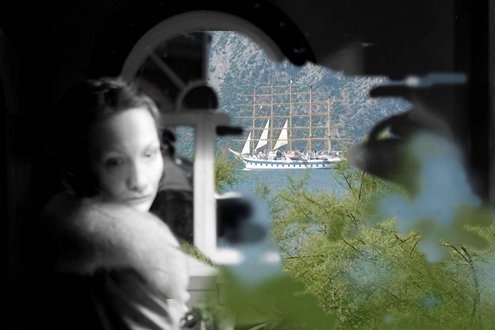
Crashes… Losses… Dreams… Craving for childhood… Love… Remains of a loving woman… A story sleeping for ages in an old house for ages comes out and causes the drama of six women. Crashed soul and body represented by the crippled houseowner, dominates the five other girls living with her. Fear of death of the girl who ran away from her hometown, story of another who got raped when she was small, another woman who stil has the traumas of her platonic love when young, a body talking about her captivity through movements, women desperately searching for love…
Sometimes body runs free from language and sometimes vice versa. Each woman’s story revives with songs or dance… Emotions sweep notions away… Conception… Voices… Dreams… Visions… Women…
Pain, related to male domination that you can see anywhere, towns, cities, home…
The Chaos, takes a ride to human’s world, iner and outer, one’s dreams, one’s notions…
Abd El – Monem AMAIRY
Syria
Written by: ABDUL MOUNEM AMAYRİ
Translation: EZGİ SÜMER YOLCU
Directed by: ABDUL MOUNEM AMAYRİ
Dramaturgy: DİLEK TEKİNTAŞ
Choreography: HANDAN ERGİYDİREN
Scenography: ABDUL MOUNEM AMAYRİ
Ligthing Design: ABDUL MOUNEM AMAYRİ - MURAT İŞÇİ
Costume Design: DUYGU TÜRKEKUL
Effects: ERHAN AŞAR
Remarcat de Toni Racklin, directoarea Barbican Centre, în Festivalul Național de Teatru, ediția 2010, spectacolul Aniversarea de Thomas Vinterberg și Mogens Rukov de la Nottara, la invitația acesteia și cu susținerea I.C.R Londra, a avut o serie de zece reprezentații la Sala Pit a faimoasei instituții londoneze. Rezultatul: public încântat, distribuția cu sentimentul împlinirii profesionale – Caietele Teatrului Nottara o probează, o presă bună și foarte bună, cronici care au subliniat valoarea muncii făcută cu talent de către Vlad Massaci și de actorii din distribuție; citez din ”The Telegraph” (vineri, 11 noiembrie 2011): ”Jocul actoricesc este intens și Aniversarea este pusă în scenă cu stil.” și din ”The Artsdesk”, apărut la aceeași dată, ”Este un exemplu de interpretare de primă mână a întregii trupe și fiecare actor are momentul lui de strălucire”; iar în ”The British Thetre Guide (tot 11 noiembrie 2011) se afirmă: ”Aniversarea este la fel de puternică pe scenă ca și atunci când a fost lansat conceptul danez Dogma […]. Acum, după treisprezece ani, Vlad Massaci și echipa lui extraordinară surprind aceeași senzație de teamă, intimitate și urgență.” Nu e puțin lucru într-un mediu teatral-artistic ca cel al Londrei, unde direcțiile și spectacolele care le ilustrează sunt atât de diverse, dinamice, iar unele înoitoare; se poate conchide că reprezentațiile cu Aniversarea au confirmat posibilitățile Teatrului Nottara și-i vor propulsa ambiția de a-și depăși limitele prin noi încercări.
O astfel de încercare este și organizarea, la începutul lunii decembrie, a ”Zilelor teatrului de/pe bulevard”, a doua ediție, un dar oferit de Sărbători spectatorilor – sau, așa cum îi numește Mircea Diaconu, cu tandrețe, ”musafirii noștri”; a fost programată Aniversarea, revenită ”în glorie” de la Londra, de asemenea și Metoda de Jordi Galcerán, regia Theodor Cristian Popescu, un alt spectacol cu adevărat remarcabil al Teatrului Nottara – a putut fi văzut în mai multe festivaluri din țară și într-un turneu la Viena, și ar merita, la rândul lui, alte deplasări în străinătate; cu ocazia acestor zile de sărbătoare a teatrului, au mai fost programate montările: Cabinierul de Ronald Harwood, regia Marcel Țop, True west de Sam Shepard, regia Alexandru Mâzgarean, 39 de trepte, o comedie după scenariul filmului lui Hitchcock, și Ultimul Don Juan de Neil Simon, tot o comedie, amândouă spectacolele în regia lui Petre Bokor, Omul Hazardului de Yasmina Reza, regia Cristi Juncu, și o satiră a moravurilor politice de pe Sena, Vacanță în Guadelupa de Pierre Sauvil și Éric Assous (coproducție cu Teatrul George Ciprian, Buzău), regia Diana Lupescu, montare cu accente care decupează și realități dâmbovițene.
Tot în aceste ”Zile ale teatrului… ” a fost plasată și premiera unui nou spectacol al actualei stagiuni a Teatrului Nottara, Nu vorbiți cu actorii de Tom Dudzick; la sfârșitul anilor 80, autorul avea o carieră promițătoare de actor, dar a renunțat la ea pentru a se consacra scrisului și, după mai multe încercări, ajunge să fie jucat într-unul dintre teatrele off Broadway, iar succesul de public este câștigat. Experiența de actriță a Dianei Lupescu a funcționat în alegerea textului pentru care și-a asumat și regia, oferind colegilor de scenă o piesă despre lumea teatrului – e drept, de pe un alt bulevard, unul new-york-ez, dar multe situații sunt comune, chiar dacă situațiile de piață (marketing!) sunt profund diferite.
Debutantul Tom Prizmezniak (Lucian Ghimeși), însoțit de iubita sa, Ana Wynirski (Ioana Calotă), vine la New York pentru a participa la repetițiile piesei pe care a scris-o și pe care un producător și regizorul Bruno Polichek (Ion Grosu) au decis să o monteze, la un teatru de pe Broadway, avându-i în distribuție pe Eva Starsky (Ruxandra Sireteanu/ Diana Lupescu; în reprezentația văzută de mine, a jucat cea dintâi) și pe Max Logan (Emil Hossu), doi actori-vedetă ai star-sistemului american, la momentul acțiunii, oarecum trecuți într-o zonă mai umbrită. Comicul de situație, cel de limbaj, deformarea uneori caricaturală a eroilor care joacă, la rândul lor, personajele piesei din piesă, sunt bine susținute dramaturgic, regizoral și actoricește în prima parte a spectacolului, ceea ce face ca atenția publicului să-l urmărească reacționând prompt la momentele de comedie bine făcută. În cele dintâi secvențe, Ioana Calotă câștigă simpatie pentru jocul nuanțat, realizat din mici tușe, cu Tom, partenerul ei în aventura teatrală de care s-au lăsat ispitiți; și Lucian Ghimiși, dacă și emisia lui vocală ar fi mai exersată, ar avea o bună prezență; cu adevărat plin de haz devine fragmentul apariției lui Max Logan, Emil Hossu jucând personajul de june-prim grizonat cu un zâmbet și o privire complice către public, și de al cărui farmec Ana, ajunsă acum alături de idolul copilăriei ei de telespectatoare, cade cucerită; se va dezmetici parțial când Logan, cu umor, îi va explica intenția lui de a o iniția în tehnica ”texturii” scenice prin care personajele capătă consistență. E un fel de a spune cât de lunecoasă, de aceea greu de sesizat și de menținut, este granița dintre realitatea cotidiană și cea a actului teatral; de fapt, aceasta este supratema comedii legere, intuită de regizor și de distribuție, dar urmată cu întreruperi în spectacol.
În cea de a doua parte, montarea este mai puțin inventivă și datorită unei construcții dramaturgice previzibile, dar și interpretării mult șarjate de care este comtaminat chiar și Emil Hossu și în care aproape se sufocă restul distribuției; Eva Starsky e până la urmă salvată de o anume revenire la un ton fireasc, dulce-amar-nostalgic, atunci când Ruxandra Sireteanu își protejează cu căldură personajul, pe actrița care a văzut și a încasat multe, de pe scena localului unde a fost descoperită până la strălucitoarea și nemiloasa lumină a Broadway-ului. Cu ceva răbdare și încredere din partea actorilor, poate și cu un plus de exercițiu mai atent, cred că și celelalte personaje si-ar regăsi măsura în partea a doua a montării.
”Zilele teatrului…” rămân o invitație deschisă spectatorilor, musafiri chemați acasă la actori, la Teatrul Nottara.