

A Celebration of Chekhov
by Irina WOLF
Chekhov’s Platonov under Alvis Hermanis’s direction, a production of Vienna’s Burgtheater, has been acknowledged as an outstanding performance. One year after its premiere, in May 2011, it was invited to participate in the Berliner Theatertreffen 2012. Germany’s most important theatre festival brings together the ten most remarkable productions of one season from the German-language theatres. Three performances of Platonov crowned the end of the 2012 edition of the Berlin festival.
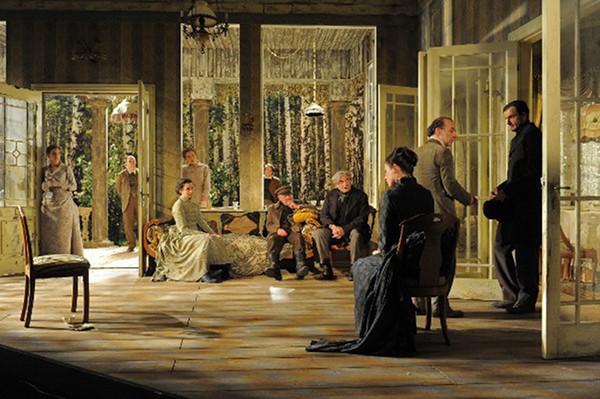
Alvis Hermanis, the Latvian master of ambiance, “manages to retain in Platonov an authentic Russian atmosphere located at the beginning of the 19th century. Furthermore, gorgeous costumes were designed by Eva Dessecker to emphasize the genuine setting. However, this is still a very modern performance, proving Hermanis’s deep understanding of an epoch and a world region,” as cited in the review of www.nachtkritik.de (Christian Desrues). The magnificent stage setting is praised in ORF.at (Sophia Felbermair) as follows: “Monika Pormale’s stage design is naturalistic and coherent down to the finest details.” In its turn, Deutschlandfunk (Michael Laages) amplifies: “Pormale’s detailed reproduction of a Russian manor is simply breath-taking: wooden floors above and below show an open salon, towards the right through transparent glass doors the dining room and behind, leading to the stage depth the terrace decorated with a most realistic wallpaper reproducing a birch forest.”
Chekhov was 19 years old when he wrote this play in 1879. After his death, it was discovered as a handwritten manuscript. Of the 134 pages, the title page was missing. Today, Platonov is considered the early masterwork of the famous playwright. The action focuses on the village teacher Platonov who returns after 15 years to his home place. Simultaneously adored by four women (Dörte Lyssewski, Johanna Wokalek, Yohanna Schwertfeger, Sylvie Rohrer), Platonov (Martin Wuttke) constantly battles cynicism and the fear of being loved. Unhappy love stories evolve through glances or touches exchanged through the glass doors. Moreover, the play also deals with two father-son dramas. One of the memorable scenes in the third act, a discussion between Platonov and the student Isaak, the idealistic and timid son of the rich Jew Abram Abramovic Vegerovic (the superb Fabian Krüger), in which the latter tries to gain Platonov’s friendship by all means, manages to draw hearty laughs from the otherwise slightly confused spectators. The confusion is created by the low level of audibility which lasts throughout the performance. It is not only that the action takes place almost always in parallel in several places, but also lots of people on the stage talk simultaneously. However, the director is cautious in this respect: a recorded tape, before the beginning of the performance, repeats the following text: “You will encounter during this evening text parts which you will not understand. This is not because of the actors or the acoustics of the theatre hall, but it is my doing.” Though it may seem annoying to some spectators, Hermanis’s “mutter-theatre” fascinates because of its hyperrealism: crickets chirp, blackbirds sing, roosters crow. The action stretches only over 24 hours during which impressive ambient light changes (Gleb Filshtinski) take place. Thus, the spectators literally get to feel the “oppressive heat” of Russian summer.
Despite of the extensive length of the performance of five hours, the daily newspaper Die Presse (Norbert Mayer) concludes: “Hermanis’s Platonov with 15 excellent actors of the Burgtheater is a celebration of Chekhov and his decadent idlers.”