
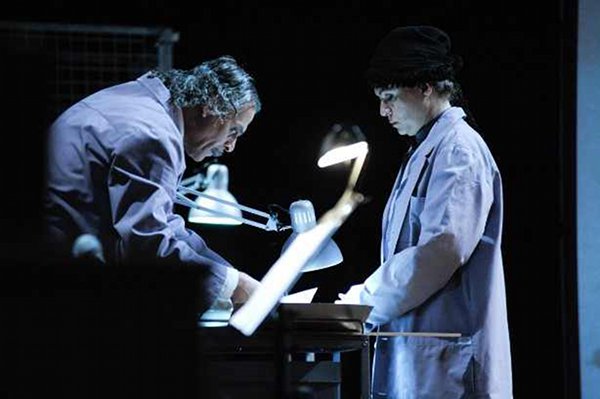

In an unnamed Arab state, in which all forms of theatre and public gatherings have been banned, a condemned 1960’s performance of Shakespeare’s Twelfth Night becomes the focal point for resistance blogs and dissident social networks. The state, eager to quell this dangerous mixture of nostalgia and dissent, commissions the Speaker, a once radical theatre maker, now regime apologist, to make a forensic reconstruction and public denunciation of the 1960’s piece. But as the Speaker and his group of volunteers delve deeper, they find themselves increasingly engaged with the condemned material and discover in the act of performance, a solidarity that transforms the gathering into an unequivocal act of defiance towards the state. A dark satire on the decades of hopelessness and political intertia that fed the recent revolts across the Arab region.
*
The Speaker’s Progress is the third part of an Arabian Shakespeare trilogy created by SABAB, an international theatre company led by writer, director Sulayman Al-Bassam, in collaboration with British artistic producer Georgina van Welie.
This unique trilogy charts a decade of political and social upheaval in the Arab and Western worlds, from the events of 9/11 through the War on Terror, the invasion of Iraq and now the Arab Spring and its aftermath, through the interpretive prism of Shakespearean texts. Following on from the Al Hamlet Summit and Richard III, an Arab Tragedy (Holland Festival, 2008), this third part of this trilogy was in the final stages of completion when the Arab Spring shook the world. The fall of Ben Ali in Tunisia and later Mubarak in Egypt, radically altered the context for this piece and, as a result, the script was reworked to take account of these massive, transformative events. Instead of offering a dark satire on the inertia and the impotence of the Arab world, the play offers the tentative outlines of a new reality characterised by hope.
The Speaker’s Progress is set in an unnamed Arab country where all forms of theatre have been banned. When a condemned 1963 production of Shakespeare’s Twelfth Night is discovered, it becomes the focal point for political resistance blogs and underground social networks. To quell dissent and improve its image overseas, the state hires the services of The Speaker, a once radical theatre maker, turned regime apologist, to reconstruct the play and denounce it. But in the act of reconstruction, he and his non-acting volunteers find themselves increasingly engaged with the condemned material they are supposed to be condemning and discover in the act of performance – and the growing complicity of their audience – a solidarity that transforms the gathering into an unequivocal act of defiance towards the state.
The production makes use of video and various other media to stage this frame narrative. Shakespeare’s Twelfth Night is set in on the twelfth night after Christmas Day, the Epiphany, traditionally a day of revelry in which chaos rules and social order is reversed.
*
BIOGRAPHY
Writer and director Sulayman Al-Bassam was born in 1972 in Kuwait and studied at Edinburgh University. He writes in Arabic and English and his work has been translated into many languages. He founded Zaoum Theatre in London in 1996 and in 2002, formed his own company in Kuwait, SABAB Theatre, an ensemble of pan-Arab and international actors, musicians and designers, who make challenging, cross-cultural theatre.
SABAB’s productions are characterised by a radical approach to text, a bold production style and an unwavering focus on the current issues of the modern Arab world. The company has achieved worldwide acclaim and recognition for its productions, including Richard III, An Arab tragedy (Holland Festival 2008) commissioned by the Royal Shakespeare Company for the Complete Works Festival, The Al-Hamlet Summit (2004) (a co-production with the Tokyo International Arts Festival; world tour 2004-2005) and The Mirror For Princess / Kalila wa Dimna (2006, a coproduction with Tokyo International Arts Festival, BITE ‘06; Dar al Athar al Islamiyyah, Kuwait).
Future work includes Ritual for a Metamorphosis at La Comédie Française, in Paris; The Lamentation for the Destruction of Ur, at the Louvre in Paris; and a new play entitled The Petrol Station.
*
The Speaker’s Progress
concept: Sulayman Al-Bassam concept: Georgina Van Welie text, direction: Sulayman Al-Bassam script editing: Georgina Van Welie stage design: Sam Collins music, sound design: Lewis Gibson lighting: Marcus Doshi costumes: Abdullah Al Awadhi assistant director: Nigel Barrettcast:
Amal Omran, Carole Abboud, Faisal Al Ameeri, Fayez Kazak, Sulayman Al-Bassam, Nicolas Daniel, Nassar Al Nassar, Nowar Yusufmusician: Tom Parkinson
production: SABAB Theatre technical direction: Saad El Shaarawy production management: Aude Albiges company manager & surtitles director: Wafa Al Fraheen touring stage manager: Faisal Al Obaid assistent tour stage manager, female understudy: Dana Mikhail producer: Natasha Freedman administration: Saif Aleslam Al-Ariefwith thanks to: Dar al Athar Al Islamiyyah, Kuwait to Agility Logistics, to Claire BéjaninWorldpremiere: New York, 6.10.2011 Duration: 1 hour 30 minutes Admission prices: € 22,50/17,50 Students/CJP € 15 (all categories) Language: Arabic and English with Dutch and English subtitles Introduction: 7.45 pm by Robbert van Heuven Meet the artist: Thu 7.6 after the performance, with Sulayman Al-Bassam Telephone Holland Festival Ticket Service: +31 20 523 77 87 Available Monday–Saturday, 12–6 pm. From June 3 also on Sunday. online: http://www.hollandfestival.nl/page.ocl?pageid=128