

a single home.
Each
and every country
and every home
is homeland to me”
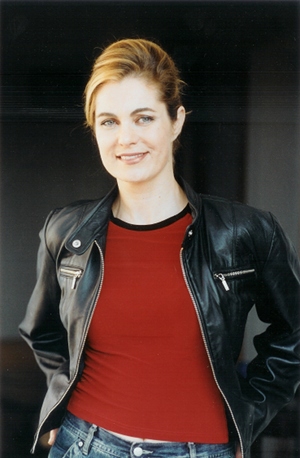
Comments on the play by the playwright from Greece
The cause for writing “Fire And Water” was twofold: On the one hand, the U.S. invasion of Iraq in 2003 and on the other, the increase of racism all over the West – a West that feels threatened by the steadily increasing numbers of foreigners from different ethnic backgrounds that flood it daily.
The title “Fire and Water” was chosen because these two elements can coexist fine, but if they are made to antagonize, they have the ability to destroy each other, and that is actually the way that the worst case scenarios predict a generalized conflict between East and West could end. We have entered their space and now they enter ours.
The play doesn’t make any attempts of political analysis. I don’t think that it is art’s role to do that. But art is naturally sensitive to whatever feels unfair. So I believe that the fanaticism and the fundamentalism that all Muslims are – indistinguishably – accused of recently, is not absent from the Westerner’s daily frame of mind. We often get as fanatic in matters religious, political or social and become less and less tolerant of anything different.
As Amos Oz says, “a fanatic is whoever wants to impose his/her value system on others.” Even if this “value” is something as simple as a healthy lifestyle, whoever tries to save us, whether we want it or not, through healthy eating, or doing yoga, or quitting smoking, would still be a fanatic, when in his absolute certainty of what is good for us, he is ready to punch our face in, in order to persuade us.
The immigrant, the one who is – by definition – the most different from us, is also the one most vulnerable to our furious attack on anything different. He is the punching bag.
Regarding “Fire and Water,” I would like to clarify that, although the beginnings of the play lie with the immigrant problem and with the conflict between east and west, the play’s primary concern is an entirely different issue. The play doesn’t deal with the differences, but rather with the similarities among people of all latitudes on earth. And not just with the similarities in those characteristics that can be called “positive” or “constructive.” For example the violence that creeps inside all people concerns me.
When this violence needs to be expressed, it usually finds expression through fanaticism of all kinds. What we really want is to devour the other, but we dress up this desire in an ideology, just so we can legalize our desire. This is a way to legalize aggression: the violent imposition of the “correct” religion, of the “correct” way of living.
There is no doubt that civilization manages to slightly “tame” this wild little animal we carry within us. Although my fear is that it might not be possible to entirely tame it (and this is a fear that is also expressed in the play). It is a matter of fact that no civilization competes or rivals with another. All great civilizations have always been the result of the confluence of many different traditions.
It is well known that until the end of the 10th century, an effort unparalleled in the history of civilization took place in Baghdad. This was the effort to translate all texts to Arabic, the result of which was the translation of the entire Greek literature that was available at the time into Arabic. Special attention was paid to the works of Aristotle and his commentators. There are more translations of Aristotle in Arabic than in any European language. Another very interesting point, that is perhaps not so widely known, is that the Arabs were the indirect cause for medieval Europe’s move to the Renaissance. When texts were not available, three hundred Arabic manuscripts of science and translations of ancient Greek literature moved to the west through Spain that was under Arab occupation.
And for all that, Baghdad, the birthplace of civilization once, is for many today a place of barbarians that should be obliterated.
Dunia Michael, an Iraqi writer, describes in her own, poetic way, some snapshots from the 2003 war:
The child woke up and asked the mother. Mother, what does “enemies” mean? It is the ghosts that lurk behind the line and turn their guns to the moon. But the moon is both theirs and ours. Do they only aim our side of the moon? Yes, sometimes, when they hit it, more than half of it falls off. Then the moon becomes a crescent. And sometimes it disappears all together. So there are times when they shoot down the other half of the moon? Their own half? Yes. It is what we call sacrifice. They sacrifice what is theirs, in order to destroy what is ours. And when are we going to go away? Where should we go? Where the moon doesn’t fall.But let us return to “Fire and Water” and attempt a small summary.
In the play’s storyline, Sahid, an Iraqi living in a European capital with Hayatt, his Iranian mate, imprisons a Westerner who accidentally knocks on his door. He takes him hostage and puts him through the torture of forcibly teaching him Arab history, Arab culture and of explaining to him, who he is.
The Westerner of course suffers through this out of fear and stays with them for seven days and nights, being forced to learn Arab history and poetry. He is forced to learn to speak some Arabic and becomes an expert on their favorite game: chess.
This constant closeness between the two men starts to create a strange friendship between them. A strong coming together of these two souls is the result of the extreme situation and of the ingenuity of the Persian Hayatt, who keeps building bridges of communication between them in every way.
Inadvertently though, she herself becomes the cause for a new clash between them, as the Westerner, who is desperately seeking a way out of his own personal dead ends, falls madly in love with her. When the Arab becomes aware of this, violence erupts.
The bridges between those two – so different from each other – worlds, crumble to dust, never to be built again. Now war seems the only way.
In the play’s last minutes, the Eastern man spreads the world map on the table and invites the Westerner to play a game of chess on it. The whole world and Hayatt is the prize. Hayatt, whose name means life.
Hayatt is dumbfounded from what she perceives as a betrayal by the two men and checkmates them both. She packs her bag, abandons them and goes in search of her freedom.
As far as the Westerner is concerned, he is depicted as just another immigrant in the play. This is the way many of us in the West feel nowadays. We feel immigrants from our own selves, in the words of the play’s main hero. It is the feeling of being a stranger in one’s own country. The Western man is not named in the play. He is only identified as the “Stranger” – a Stranger to himself, a Stranger to others. In the past, we used to say that someone was in the fringes of society – in the underground – but the number of people inhabiting this “underground” is ever increasing. We can of course say that there is some sort of “freedom,” but – more often than not – our freedom is merely a freedom to consume. And not just objects, but also ideas or concepts. It is common knowledge that in the current lack of values, people need to invent their own value system in order to survive.
Hayatt is the only one who still manages to escape the two poles of the conflicts, just like the life she is named after. It is a fact that women are in a better standard in the West than in the East, no question about it. But no matter where a woman lives, there is one thing in common: Even to this day, she manages to survive mostly through indirect means, even when she is professionally a leader, since she still doesn’t get the direct spotlight. Eastern women know this well, since their great-grandmother Scheherazade who managed to save her life for a thousand and one nights from the sultan, by telling him stories and keeping the end from him until the following day.
In closing I would like to mention a phrase by an ancient Greek, Crates of Thebes: “My homeland is not a single town, a single home. Each and every country and every home is homeland to me”. I feel that such a way of thinking can help people into finding the proper proportion for loving with their own place, their personal homeland.
Chryssa Spilioti