
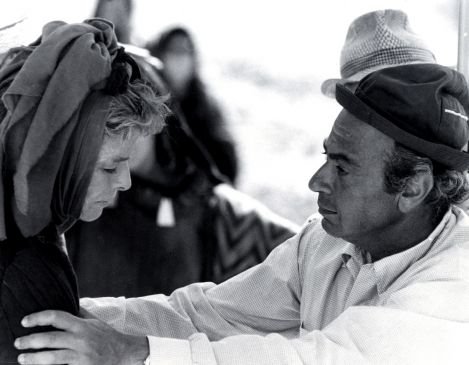

Tuesday 11th of June 2013 at 18:00
Free Entrance - Booking is necessary
Information - Bookings at the MCF
Piraeus 206, Tavros and over phone
210 3418579 Mon-Fri 11:00 - 14:00
On the occasion of the 92 years
since Michael Cacoyannis’ birth
“Trojan Women”
A civilization can be considered as great only when it has a self-critical stance towards itself.
Michael Cacoyannis
Euripides wrote “Trojan Women” while being disgusted by the slaughter in Milos Island that Athenians had committed. He used the myth of Trojan War to arouse emotions against militarism, war and suppression.
Hecuba, Queen of the Trojans and mother of Hector, one of Troys most fearsome warriors, looks upon the remains of her kingdom; Andromache, widow of the slain Hector and mother of his son Astyanax, must raise her son in the war’s aftermath; Cassandra, Hecuba’s daughter who has been driven insane by the ravages of war, waits to see if King Agamemnon will drive her into concubinage; Helen of Troy, waits to see if she will live. But the most awful truth is unknown to them until Talthybius, the messenger of the Greek king, comes to the ruined city and tells them that King Agamemnon and his brother Menelaus have decreed that Hector’s son Astyanax must die — the last of the male royalty of Troy must be executed to ensure the extinction of the line.
Euripides’ tragedy was written in 415 B.C. and the moral of its story has been constantly relevant and up-to-dated. From its premiere at Cannes Film Festival to the present days of ethic and identity dispute, its messages seem to be always contemporary.
In this play, for the first time in Euripides’ dramaturgy, we do not observe the two aspects of a matter. The focus is placed on the defeated and their constant grief is revealed. In addition, Cacoyannis’ film is structured around a beloved Euripidean topic: the switch of the roles. How can the abusers turn into victims? How can the rulers become suppressed? Beyond the field of disaster that has been created by the war, Euripides presents, on the one hand, the violent transformation of noble Trojan women into mourners. On the other hand, he depicts the Greek heroes as savage animals that are behaving barbarously.
Michael Cacoyannis noted: “Euripides had the courage to raise his rebellious cry, despite the danger of his potential exile. By shooting this film, I had the desire to unite our voices. Today the world must be awaken! When “Trojan Women” visited America, they spoke about Hiroshima. In Paris, they saw Algeria.
When Andromache screams: “You Greek, you have found non-Greek ways of torture!” the word “Greek” can be translated in various ways, according to the guilt of the audience. The Euripidean severe category against the Greek barbarism formed by reductio ad absurdum the ideal concept of Greece. It is evident that Euripides expressed his fears by exposing the rotten roots of social inequality, racism, political aspiration, cultural arrogance and religious dogmatism and his cry was proven prophetic.”
Michael Cacoyannis Foundation notes the omni-contemporary words of the great director:
“In my opinion, every Greek has to consider what brought fascism into life and how fascism functions. Fascism has been always present, even behind every action of the everyday routine. Fascism lurks in every relationship. We have to extirpate fascism to move on! The only way is the deep self-criticism, as it has been shown by the Ancient Greek Tragedies. We have to punish severely ourselves for our unintentional involvement in many crimes. Indifference and inaction are also crimes!”
“Trojan Women”
| Duration: | 111 minutes |
|---|
PRODUCTION CREDITS
| Direction: | Michael Cacoyannis |
|---|---|
| Script: | Michael Cacoyannis based on the homonym tragedy of Euripides |
| Photography: | Alfio Kontini |
| Scenery–Costumes: | Nikolas Georgiadis |
| Cast: | Katharine Hepburn, Geneviève Bujold, Vanessa Redgrave, Irene Papas, Brian Blessed, Patrick Magee, Alberto Sanz |
Theatre Cultures
Subscribe to Theatre Cultures email updates (newsletter)
Join us on Facebook Theatre Cultures community & network
(new)