
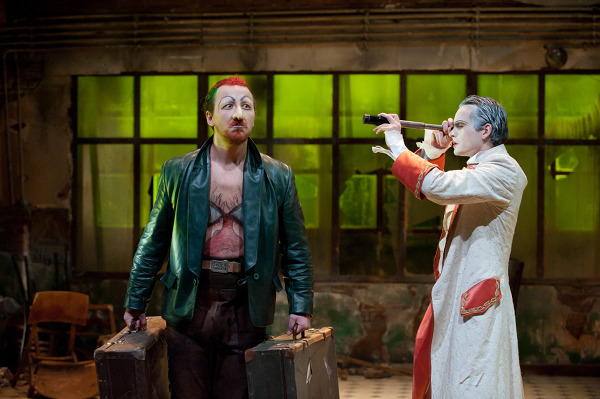

Leonce and Lena, directed by Gábor Tompa, will be a guest performance in Colombia in April at the Bogota Theatre Festival (Festival Iberoamericano de Teatro de Bogotá). The Colombian audience will have the chance to watch the performance on five occasions: on April 5 and 6 at 6 pm, on April 7 at 3 pm and 8.30 pm, and on April 8 at 3 pm in the Teatro de Bellas Artes de Bogotá.
America’s biggest theatre festival will run from March 23 to April 8, and this is the second time that the Hungarian Theatre of Cluj is taking part in the event. Pantagruel’s Sister-in-Law, directed by Silviu Purcărete, was invited to Bogota in 2006.
During the Bogota Theatre Festival Gábor Tompa will lead a workshop entitled Ways to the Magic for young Colombian directors and actors between April 2 and 6. Romania is this year’s guest country at the festival and the workshop is part of the program dedicated to Romania. Theatre companies from 45 countries have been invited to the festival; the program includes more than 800 performances and 70 side events that will be held in Bogota’s 22 theatres.
http://festivaldeteatro.com.co/2012/categorias-principales.html
Georg Büchner: Leonce and Lena
Both Leonce and Lena flee from home to avoid a wedding planned by others. However, they inevitably fall in love with each other. Leonce and Lena is a comedy written at a time when Germany was made up of eighty little states, and it is the first masterpiece in the history of drama to present the mechanism that depersonalizes and detaches thought and speech. The characters play with their death-machine toys and, like naughty children, break them in order to find their individual freedom.
Gábor Tompa
King Peter of the Kingdom of Popo: Loránd Váta
Prince Leonce, his son:	Balázs Bodolai
Princess Lena of the Kingdom of Pipi: Enikő Györgyjakab
Valerio: Gábor Viola
Rosetta: Emőke Kató
Governess: Csilla Varga
Der Hofmeister: József Biró
President of State Council: Attila Orbán
Police Chief: Sándor Keresztes
Policeman: Ferenc Sinkó
Schoolmaster: Ervin Szűcs
Court Chaplain:	Lehel Salat
First Councilor: Róbert Laczkó Vass
Second Councilor: Szabolcs Balla
Third Councilor: Alpár Fogarasi
Fourth Councilor: Melinda Kántor
directed by Gábor Tompa
set and costume design: Carmencita Brojboiu
dramaturg: András Visky
music: Vasile Şirli
choreography: Florin Fieroiu
director's assistant: István Albu
stage manager: Levente Borsos, Péter Mixtay
prompter: Imola Kerezsy
Studio performance
Duration: 1 hour 40 minutes without intermission
Press reviews
Tompa’s opening performance is an extremely comical rediscovery of Georg Büchner’s satire, Leonce and Lena written in 1836. The spectacle of the play is consistently fascinating (the set and costume designer is Carmencita Brojboiu). We can say of Büchner that he discovered naturalism and expressionism by Woyzeck and it seems that he discovered the absurd theatre as well with Leonce and Lena. Tompa’s production – similar to The Bald Primadonna production – is a charming mixture of political idiotism and absurd insolence.
Robert Cohen, Plays International
Gábor Tompa’s production creates a fairy play where light is heavy and vice versa, the weighty is feather-weight. By doing this he places Büchner’s play on the axis of the history of theatre (starting from Shakespeare until the present time) suggesting that the short-lived German poet is not just the successor of the great Englishman, but he is the predecessor of Beckett and Ionesco too. Büchner’s text is as obliviously playful as A Midsummer Night’s Dream, but at the same time it is as unsettling in his questions and emphasis as his descendants from the 20th century. This is the reason for so much graceful dance, well-composed body-play, oblivious impishness and funny visual action. This is the reason for the often vulgar words and gestures, overtones of meaninglessness and senselessness. The two registers go hand in hand all along the play like the spectacle of understanding and experience reflecting grains of truth in falsehood and grains of falsehood in truth. The « original » Büchner might be ironical, however the play’s adaptation moves into the direction of the absurd, thus it brings the play closer to our world. The culture of contemporary theatre is at home in it, but the sensitivity of an audience watching movies and television is also mobilized: the play challenges our consciousness fighting with the world of appearances.
Andor Horváth, Büchner – Tompa: Leonce and Lena
[What’s the time?] – Interferences 2010, booklet